


The Return to Nature Funeral Home Scandal: A Son’s Search for Justice
A Sacred Promise Shattered
Derrick Johnson had honored his mother’s final wishes in what he thought was the most beautiful way possible. He carefully laid Ellen Lopes’ ashes to rest beneath a golden dewdrop tree with stunning purple blossoms at his home on Maui’s Haleakalā Volcano, creating a peaceful resting place where she could watch over her beloved grandchildren. It was exactly what she had wanted, a serene spot filled with love and natural beauty. But on February 4, 2024, while teaching his eighth-grade gym class, Johnson received a phone call that would shatter this peace and transform his grief into a nightmare he could never have imagined. An FBI agent was on the line, asking if he was the son of Ellen Lopes and whether he had used Return to Nature funeral home. The cryptic suggestion to “google them” led Johnson to a horrifying discovery that would haunt him for months to come.
As Johnson frantically searched on his phone amid the clatter of the weight room, dozens of news reports flooded his screen. The words seemed to leap out at him in a nightmarish blur: hundreds of bodies stacked on top of each other, inches of decomposition fluid, swarms of insects, traumatized investigators, and a governor declaring a state of emergency. The weight of this information hit Johnson like a physical blow. Nausea overwhelmed him, his chest constricted, and the breath was forced from his lungs. He stumbled out of the building, crying out in distress as a fellow teacher rushed to help. Two FBI agents visited him the following week, confirming what he had feared but couldn’t quite believe: his mother’s body was among the 189 that Jon and Carie Hallford, the owners of Return to Nature funeral home, had abandoned in a Colorado building between 2019 and October 4, 2023. The blue box he had surrounded with flowers and rose petals, the ashes he had scattered beneath that beautiful tree—none of it was actually his mother.
The Hallfords’ House of Horrors
Jon and Carie Hallford had presented themselves as a caring husband-and-wife team running an eco-conscious funeral home in Colorado Springs. They advertised “green burials” without embalming and offered cremation services, appealing to families who wanted environmentally friendly options for their loved ones’ final arrangements. Carie would warmly greet grieving families, guiding them through what she promised would be a respectful final journey for their deceased relatives, while Jon remained mostly behind the scenes. When Johnson called the funeral home in early February 2023, the week his mother died, Carie Hallford assured him that she would take excellent care of his mother. Days later, she handed him a blue box containing a zip-tied plastic bag filled with gray powder, telling him these were his mother’s ashes. “She lied to me over the phone. She lied to me through email. She lied to me in person,” Johnson told the Associated Press, still processing the betrayal.
The truth about what the Hallfords were doing remained hidden until September 2023, when surveillance footage captured what appeared to be Jon Hallford entering the Penrose building. The video showed him handling bodies with shocking disrespect—flipping a body from a gurney onto the floor and appearing to wipe decomposition fluid onto other bodies in the room. In a text to his wife, Hallford callously referred to the decomposition fluid as “people juice.” When investigators finally entered the building on October 5, 2023, wearing protective suits, gloves, boots, and respirators, they discovered a scene that traumatized even experienced law enforcement officials. The 2,500-square-foot building contained 189 bodies stacked in nearly a dozen rooms, including the bathroom, sometimes piled so high they blocked doorways. Some bodies had been decaying for years, others for several months. Many were in body bags, some wrapped in sheets and duct tape, while others lay half-exposed on gurneys, in plastic totes, or with no covering at all.
The conditions inside the building were truly horrific. Investigators found swarms of bugs and maggots throughout the facility. Body bags were filled with fluid, and many had ripped open, requiring the placement of five-gallon buckets to catch the leaks. Removal teams had to trudge through layers of human decomposition coating the floor. The investigators believed the Hallfords had been experimenting with water cremation, a process that can dissolve a body in several hours. Adding insult to the desecration of these bodies, the Hallfords had apparently used a large bone grinder and bags of Quikcrete concrete mix to create fake ashes that they gave to unsuspecting families. While families were receiving these fraudulent remains and going through the sacred rituals of saying goodbye to their loved ones, the Hallfords were reportedly spending money on Tiffany jewelry, luxury cars, and laser-body sculpting treatments. They had also defrauded the federal government of nearly $900,000 in pandemic-era small business aid, pocketing about $130,000 that clients had paid for cremations while leaving their bills unpaid.
A Mother’s Love and a Son’s Devotion
To understand the depth of Johnson’s pain, it’s important to know the extraordinary bond he shared with his mother. Ellen Marie Shriver-Lopes raised Johnson in an affordable-housing complex in Colorado Springs, where she became a beloved figure in the community. With Johnson’s father largely absent—Johnson still remembers seeing his father punch his mother at age five, sending her crashing into a table and then onto a guitar, breaking it—Ellen became both mother and father to her son. She taught Johnson to shave, cheered loudly from the bleachers at his football games, and showed him what it meant to care for others. Neighborhood children called her “mom,” and she would open her home to any kid who needed a place to sleep or a warm meal. She even chatted with Jehovah’s Witnesses who came to the door because she didn’t want to be rude.
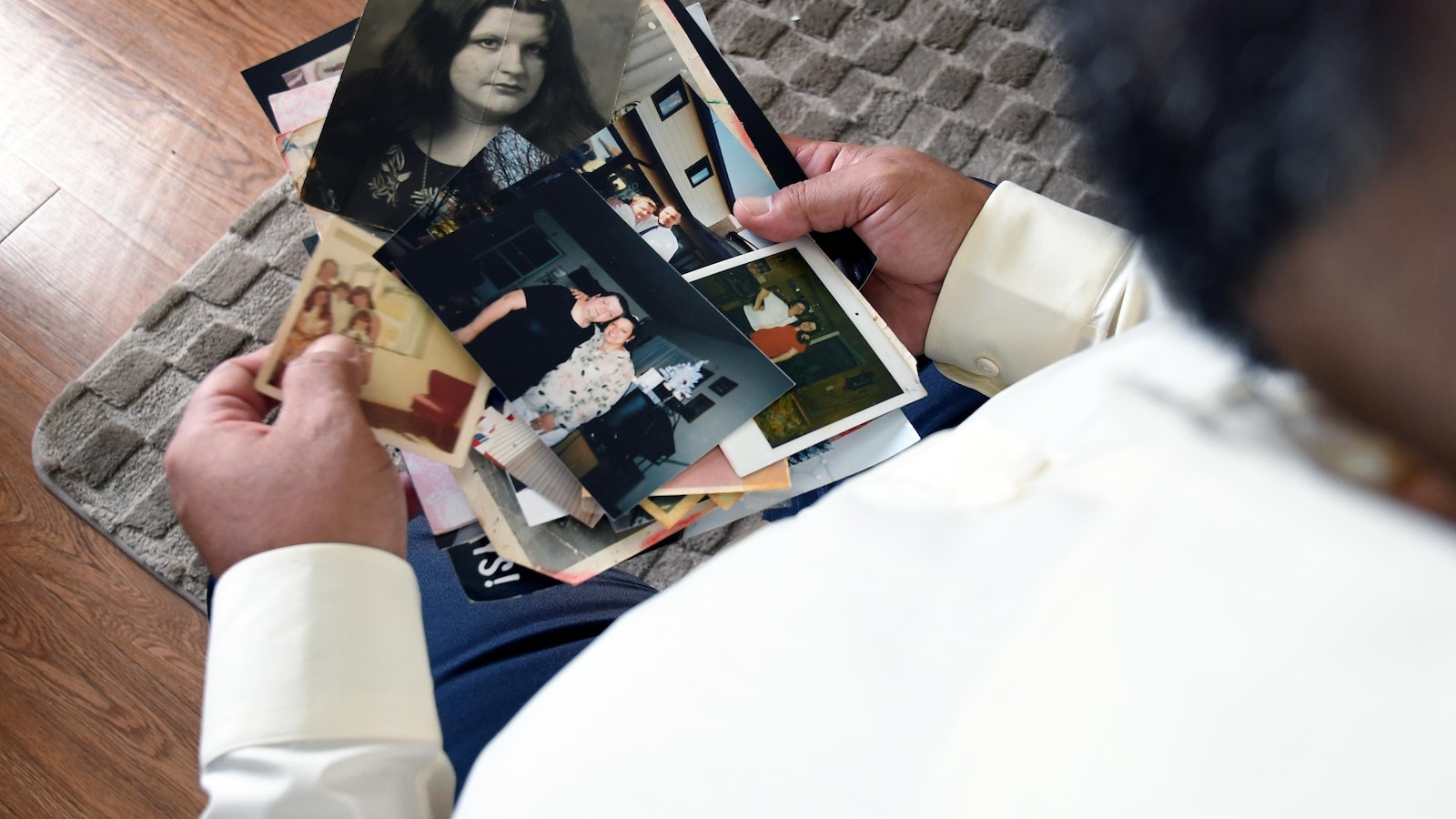
Ellen dedicated her life to social work, living by a simple philosophy she often shared with her son: “If you have the ability and you have the voice to help: Help.” Johnson spoke with his mother nearly every day, even after he moved to Hawaii. When diabetes left her blind and bedridden at age sixty-five, their phone conversations became a lifeline. She would ask Johnson to describe what her grandchildren looked like, creating pictures in her mind through his words. Their final moments together came on Super Bowl Sunday in 2023, when her heart stopped. Johnson, who had flown in from Hawaii to be at her bedside, clutched her warm hand and continued holding it until it grew cold. He made sure to honor her wishes for a final resting place overlooking her grandchildren, never imagining that what he thought were her ashes were nothing more than concrete powder mixed by people who had shown her body no respect whatsoever.
The Discovery and Investigation
The unraveling of the Hallfords’ operation began with something as simple as a bad smell. On October 3, 2023, Detective Sergeant Michael Jolliffe and Laura Allen, the county’s deputy coroner, stood outside the Penrose building following reports of a rank odor in the area. The building had a sign reading “Return to Nature Funeral Home” with a phone number that turned out to be disconnected. The property showed signs of neglect—cracked concrete, yellow stalks of grass, a shabby hearse with expired registration, and a window air-conditioner that hummed away. Neighbors had noticed the smell but attributed it to various sources; one thought it came from a septic tank, while another mentioned that her daughter’s dog always headed to the building whenever he got off-leash. The odor was reminiscent of rancid manure or rotting fish and struck anyone who happened to be downwind of the building.
Jolliffe and Allen spotted a dark stain under the door and on the building’s stucco exterior that looked disturbingly similar to fluids they had encountered during investigations involving decaying bodies. However, the building’s windows were covered, preventing them from seeing inside. Allen contacted the Colorado Department of Regulatory Agency, which oversees funeral homes, and they reached out to Jon Hallford. He agreed to show an inspector inside the next afternoon but never appeared. Inspector Joseph Berry found a small opening in one of the window coverings and peered through to see white plastic bags that looked like body bags on the floor. A judge quickly issued a search warrant. The discovery would become one of the largest findings of decaying bodies at a funeral home in U.S. history, prompting lawmakers to completely overhaul Colorado’s previously lax funeral home regulations. The Hallfords were arrested in Oklahoma in November 2023 and charged with abusing nearly 200 corpses, along with defrauding the federal government.
The Aftermath: Living with PTSD
The impact on families like Johnson’s has been devastating and long-lasting. Following the FBI’s phone call, Johnson made a promise to himself that he would speak at the Hallfords’ sentencing hearings, but he found himself struggling to talk about what had happened even with close friends, let alone in front of a judge and the perpetrators themselves. For months, Johnson became obsessed with the case, reading dozens of news reports and often staying glued to his phone until one of his children would interrupt him to play. When he closed his eyes, he couldn’t escape the horrific images his mind created of the building where his mother’s body had been stored. He imagined trudging through rooms filled with maggots, flies, centipedes, and rats feasting on the remains. The thoughts tormented him so much that he asked a preacher whether his mother’s soul had been trapped in that terrible place. When an episode of the zombie show “The Walking Dead” came on television one evening, Johnson completely broke down.
Johnson began seeing a therapist and was diagnosed with post-traumatic stress disorder. He joined Zoom meetings with other victims’ relatives, watching the number of affected families grow from dozens to hundreds. After his mother’s body was finally identified, Johnson flew to Colorado in March 2024, where Ellen’s remains lay in a brown box at a crematorium. Placing his hand on the box, he recalled saying, “I don’t think you blame me, but I still want to tell you I’m sorry.” Then his mother’s body was loaded into the cremator, and this time, Johnson pushed the button himself, ensuring that the cremation actually happened. Slowly, with therapy and the support of other victims’ families, Johnson began to improve. He engaged more fully with his students and children and started practicing what he would say at the Hallfords’ sentencing hearings during his therapy sessions.
Seeking Justice and Closure
Jon Hallford faces sentencing on Friday, with a potential prison term between thirty and fifty years, while Carie Hallford will be sentenced in April after a judge accepted their plea agreements in December. For Johnson, now forty-five years old and still suffering from panic attacks triggered by the FBI’s phone call, speaking at the sentencing has become both a promise to himself and a necessary step toward healing. He has practiced closing his eyes and envisioning standing in front of the judge—and the Hallfords—speaking his truth about what their actions have done to him and hundreds of other families. “Justice is, it’s the part that is missing from this whole equation,” he said. “Maybe somehow this justice frees me.” Yet even as he prepares to confront the people who desecrated his mother’s body and lied to his face, Johnson acknowledges the uncertainty that many trauma survivors face: “And then there’s part of me that’s scared it won’t, because it probably won’t.”
The Return to Nature funeral home scandal has exposed vulnerabilities in how we regulate the death care industry and trust those we hire to handle our loved ones’ remains during our most vulnerable moments. Hundreds of families went through sacred rituals—memorial services, the spreading of ashes in meaningful locations, keeping urns close as a connection to the deceased—not knowing that what they held wasn’t actually their loved ones. The emotional and psychological damage extends far beyond the initial shock of discovery. When Johnson promised his mother he would see her to her final resting place overlooking her grandchildren, when he carefully scattered rose petals over what he thought were her ashes as a preacher intoned “Ashes to ashes, dust to dust,” he was participating in rituals that humans have used for thousands of years to process grief and honor the dead. The Hallfords didn’t just fail in their professional duties—they violated something sacred and fundamental about how we care for our dead and support the living through grief. As Johnson prepares to face them in court, he carries not just his own pain but the collective anguish of hundreds of families who trusted Return to Nature and received betrayal in return.