


Luigi Mangione Voices Frustration as Court Date Conflict Intensifies
A Battle Between Two Courts
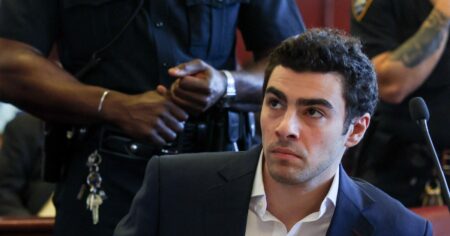
The legal proceedings surrounding Luigi Mangione took a dramatic turn this Friday when the accused appeared in Manhattan Supreme Court and openly challenged the scheduling of his state murder trial. Judge Gregory Carro tentatively set June 8 as the start date for the state case, creating a significant conflict with the federal trial timeline already established by U.S. District Judge Margaret Garnett. The federal trial had been scheduled to begin with jury selection on September 8, with opening statements to follow on October 13. This scheduling conflict has created what Mangione’s defense team describes as an impossible situation, forcing them to prepare simultaneously for two major trials involving the same incident—the December 2024 shooting death of UnitedHealthcare CEO Brian Thompson outside a Midtown Manhattan hotel.
Judge Carro made his position clear from the outset of Friday’s hearing, expressing frustration with what he perceived as the federal government backing away from an earlier agreement. “It appears that the federal government has reneged on their agreement to let the state, who did most of the work in this case, to go first,” Carro stated at the beginning of proceedings. This comment revealed underlying tensions between state and federal prosecutors, both of whom want to prosecute Mangione for the same alleged crime. The judge’s firm stance throughout the hearing demonstrated his belief that the state case deserves priority, particularly given that state investigators conducted most of the groundwork in building the case against Mangione.
Mangione’s Courtroom Outburst
The most striking moment of the hearing came as Mangione was being escorted from the courtroom. Shackled and wearing tan jail attire, the defendant turned toward the gallery and loudly proclaimed, “One plus one is two. Double jeopardy, by any common-sense definition.” This spontaneous outburst encapsulated the core argument his defense team had been making throughout the hearing—that prosecuting him in both state and federal court for the same killing violates fundamental principles of justice. While double jeopardy protections typically prevent someone from being tried twice for the same crime, the legal reality is more complex when dealing with separate state and federal jurisdictions, which can sometimes prosecute the same conduct under different statutes.
Mangione’s statement, though brief, revealed his personal frustration with a legal system that he believes is unfairly subjecting him to redundant prosecution. His choice of words—”one plus one is two”—suggested he views the double prosecution as a simple mathematical equation that any reasonable person should recognize as wrong. The outburst also demonstrated that despite being represented by experienced attorneys, Mangione feels compelled to voice his own objections to proceedings he considers fundamentally unjust. His visible agitation in court reflected the immense pressure of facing two separate trials for the same alleged act, each carrying severe potential consequences.
Defense Arguments for Delay
Karen Friedman Agnifilo, Mangione’s defense attorney, forcefully argued throughout the hearing that the June 8 trial date would leave her team woefully unprepared and would deny her client a fair trial. “The defense will not be ready on June 8,” she stated plainly. “Mr. Mangione is being put in an untenable situation that is a tug of war between two different prosecution officers.” Friedman Agnifilo’s arguments highlighted the practical impossibility of adequately preparing for two major trials simultaneously, especially when the state trial would occur just months before the federal case. She emphasized that her team has been “working round the clock in both cases, fighting both cases,” but that even with maximum effort, the compressed timeline creates an unfair disadvantage for the defense.
The defense attorney also raised concerns about what she characterized as prosecutorial overreach, with state prosecutor Joel Seidemann wanting “two bites of the apple.” She referenced New York state’s double jeopardy protections, suggesting that the state’s aggressive push to try the case first, despite the scheduled federal trial, creates legal and ethical problems. When Judge Carro suggested that the defense could resolve the scheduling conflict by requesting a delay in the federal case, Friedman Agnifilo refused, stating firmly, “It would be legal malpractice for us to do something that is not in our client’s best interest.” This response underscored the defense team’s belief that the federal case, which recently had the death penalty removed from consideration, might offer more favorable circumstances for their client than the state prosecution.
Prosecution’s Counterarguments
Prosecutor Joel Seidemann presented a very different perspective, arguing that the defense was deliberately trying to create a double jeopardy issue to avoid the state trial altogether. “Counsel is seeking to jeopardize us out of the federal case,” Seidemann contended. “We have every reason to be the prosecuting authority.” He emphasized that state prosecutors and investigators had conducted the bulk of the investigation into Thompson’s death, which occurred on Manhattan streets, clearly within state jurisdiction. From the prosecution’s viewpoint, it would be fundamentally wrong for federal authorities to swoop in and take over a case that state officials had worked diligently to build from the ground up.
Seidemann also revealed that Thompson’s family had specifically requested that the state case proceed first, adding an emotional dimension to the scheduling debate. “That’s something certainly to be considered,” he remarked, suggesting that the wishes of the victim’s family should carry weight in determining which prosecution takes precedence. The prosecutor’s arguments reflected a broader jurisdictional dispute between state and federal authorities, with state prosecutors feeling that their hard work and legitimate claims to the case were being overshadowed by federal intervention. This tension between different levels of government prosecution is not uncommon in high-profile cases, but it places defendants like Mangione in an exceptionally difficult position.
Judge’s Firm Stance and Possible Resolutions
Judge Carro concluded the hearing with a stern directive to the defense team, showing little sympathy for their scheduling concerns. “You have done a great job, so be ready on June 8,” Carro told the defense attorneys. “That’s it.” This blunt statement left little room for negotiation and demonstrated the judge’s determination to move forward with the state trial on his preferred timeline. However, Carro did acknowledge one potential scenario that might alter the schedule: if the Department of Justice decides to appeal a ruling in Mangione’s federal case, he indicated he could postpone the state trial to September 8, aligning it more closely with the federal timeline.
This conditional flexibility suggests that despite his firm public stance, Judge Carro recognizes the complexity of the jurisdictional issues at play. The possibility of a DOJ appeal provides a potential off-ramp that could resolve the scheduling conflict without either side having to formally back down. Meanwhile, the broader legal questions remain unresolved: Can state and federal governments prosecute the same defendant for the same killing without violating double jeopardy principles? Which jurisdiction has the stronger claim to prosecute first? And most fundamentally, what serves the interests of justice—allowing both prosecutions to proceed as planned, or requiring prosecutors to coordinate so that the defendant faces only one trial? As Mangione, who has pleaded not guilty to all charges in both jurisdictions, awaits resolution of these procedural battles, his fate remains caught between two separate legal systems, each determined to hold him accountable for the alleged murder of Brian Thompson. The coming weeks will determine whether one trial proceeds before the other, or whether legal maneuvering might yet alter the course of this high-profile prosecution.