


The SAVE America Act: A Deep Dive into the Controversial Voting Reform Proposal
Understanding the Core of the SAVE America Act
Washington is once again embroiled in a heated debate over election integrity and voting rights as Republicans push forward with the SAVE America Act, officially known as the Safeguard American Voter Eligibility Act. This legislative proposal represents the latest chapter in an ongoing partisan battle over how Americans should prove their eligibility to vote in federal elections. At its heart, the bill would fundamentally transform the voter registration process by requiring Americans to provide proof of citizenship in person when registering to vote and implement stringent photo ID requirements at polling places.
The documentation requirements outlined in the bill are extensive and specific. Americans would need to present one of several approved forms of identification, including a REAL ID-compliant identification card that indicates citizenship, a valid passport, military identification accompanied by service records showing U.S. birth, or a government-issued photo ID displaying the person’s U.S. birthplace. For those without these primary documents, the bill allows for other government-issued photo identification when accompanied by a birth certificate or naturalization certificate. This new version of the legislation goes further than previous iterations by also requiring voters to show photo ID when casting their ballots, and absentee voters would need to submit copies of their photo identification along with their ballots.
Perhaps most controversially, the bill would require anyone attempting to register by mail to present their proof of citizenship documents in person, effectively eliminating the convenience of mail-in registration for most Americans. The legislation does include a provision for individuals who cannot provide standard proof of citizenship, allowing them to sign an attestation under penalty of perjury declaring their citizenship status, but this would still require verification by state or local officials who would need to sign their own affidavit confirming the person’s citizenship has been adequately established.
The Reality of Noncitizen Voting in America
One of the central questions surrounding this debate is whether noncitizen voting actually represents a significant problem in American elections. The answer, according to available evidence, is overwhelmingly no. Federal law has prohibited noncitizens from voting in federal elections since 1996, when Congress passed the Illegal Immigration Reform and Immigrant Responsibility Act. Violating this law carries serious consequences, including up to one year in prison, creating a strong deterrent against illegal voting.
Recent audits conducted by several states provide concrete data on the actual scope of noncitizen voting. Georgia’s comprehensive citizenship audit of its 8.2 million registered voters found just 20 noncitizens on the rolls, with an additional 156 cases requiring further investigation. In Ohio, officials identified 597 noncitizens registered to vote out of more than 8.1 million total registered voters, with only 138 appearing to have actually cast ballots. Texas, with its massive population, found 2,724 potential noncitizens registered among more than 18.6 million registered voters following citizenship verifications. These numbers, while not zero, represent an infinitesimally small fraction of the total electorate in these states.
David Becker, a CBS News election law contributor and executive director of the Center for Election Innovation and Research, offered a pointed observation about the mismatch between the problem and the proposed solution. He noted the irony that while the bill aims to address what he characterized as “a nearly non-existent problem” driven by conspiracy theories, it could actually have more detrimental effects on Republican voters, who statistically lack multiple forms of documentation—particularly passports—at higher rates than Democratic voters. It’s worth noting that while noncitizen voting is prohibited in federal elections, a handful of municipalities in California, Maryland, Vermont, and the District of Columbia do allow noncitizens to participate in local elections, a distinction that sometimes gets lost in the broader debate.
The Democratic Opposition and Concerns About Voter Suppression
Democratic leaders have responded to the SAVE America Act with fierce opposition, characterizing it as a deliberate attempt to suppress legitimate voters under the guise of election security. Senate Minority Leader Chuck Schumer didn’t mince words, declaring the legislation “dead on arrival” in the Senate and calling it “Jim Crow 2.0,” a reference to the discriminatory laws that systematically disenfranchised Black voters in the American South for nearly a century following the Civil War.
Schumer and other Democrats argue that the bill’s true impact would be to create insurmountable barriers for millions of eligible American voters. They warn that the in-person proof-of-citizenship requirements would effectively end online voter registration, registration by mail, and the community registration drives that have historically helped bring marginalized communities into the democratic process. The concern centers on Americans who don’t have ready access to the required documents—a group that’s larger than many people might imagine.
According to a 2023 survey conducted in part by the Brennan Center for Justice, at least 3.8 million Americans lack proof of citizenship documents. While the State Department reported nearly 170 million valid passports in circulation in 2025—representing just under half the U.S. population—that still leaves more than half of Americans without this form of identification. Birth certificates can be difficult to obtain, particularly for older Americans, those born in rural areas or through home births, and those who have experienced displacement due to natural disasters or other circumstances. The situation becomes even more complicated for Americans who have changed their names after marriage or for other reasons, as their identification documents may not match their birth certificates.
Eliza Sweren-Becker, deputy director of the Brennan Center’s Voting Rights and Elections Program, characterized the legislation as “catastrophic for American voters” and described it as creating a “show-your-papers policy” that would require documents like passports or birth certificates for the vast majority of people attempting to register. She warned of “chaos for election officials to implement” and called the situation “a five-alarm fire for American voters and a five-alarm fire for election administration and election administrators throughout the country.” Democrats also express concern about the bill’s provisions requiring states to purge voter rolls using data from federal agencies, warning this could lead to eligible citizens being wrongly removed from registration lists.
The Republican Defense and Public Opinion
Republicans have countered Democratic criticisms by framing the SAVE America Act as common-sense legislation that enjoys broad public support. House Speaker Mike Johnson has emphasized polling data showing overwhelming American support for voter identification requirements. A Pew Research Center poll from August found that 83% of Americans favor requiring voters to show government-issued photo identification to vote. An October 2024 Gallup poll found the same percentage—83%—supporting a requirement for first-time voters to provide proof of citizenship when registering.
Johnson defended the legislation as essential to maintaining the integrity of American elections: “These are very important things to ensure that our elections are free and fair and safe, and that’s a critical component of maintaining the constitutional republic.” Republicans argue that requiring proof of citizenship is a reasonable safeguard that most developed democracies employ in some form, and that concerns about accessibility are overblown given the various alternative documentation options included in the bill.
The GOP has attempted to pass versions of the SAVE America Act through Congress for years. The House has successfully passed earlier iterations twice, but the legislation has consistently stalled in the Senate, where the 60-vote threshold required to advance most legislation makes passing partisan bills extremely difficult. This procedural reality has frustrated Republicans who see the measure as addressing a legitimate, if statistically small, problem while enjoying strong public support according to opinion polls.
President Trump’s Role and Constitutional Questions
Former President Donald Trump, who has made unfounded claims of widespread voter fraud for years and continues to falsely assert he won the 2020 presidential election, has been a driving force behind the push for stricter voting requirements. During his current term, he signed an executive order in March seeking to overhaul U.S. elections with requirements for documentary proof of citizenship to register to vote. However, voting rights groups, Democratic campaign committees, and 19 states filed lawsuits challenging the order, and federal judges have since blocked portions of it.
In a particularly notable ruling, U.S. District Judge Colleen Kollar-Kotelly wrote in a 110-page decision: “Put simply, our Constitution does not allow the President to impose unilateral changes to federal election procedures.” This decision underscored the constitutional limits on executive power in the realm of election administration, an area traditionally reserved for states and Congress.
Trump’s recent comments about “nationalizing” voting and suggesting that states are “agents of the federal government” have raised eyebrows and sparked concerns among constitutional scholars. In a podcast interview with Dan Bongino, Trump suggested Republicans should “take over” voting and claimed the party would never win another election without working to deport undocumented immigrants. When asked about these comments in the Oval Office, Trump doubled down, saying he wants “honest” elections and that if “a state can’t run an election, I think the people behind me should do something about it,” gesturing to members of Congress.
These statements touch on fundamental questions about American federalism and the balance of power between state and federal authority. The Constitution’s Elections Clause does give states primary authority to set rules for federal elections while allowing Congress to pass regulating legislation, but Trump’s suggestion of wholesale federal takeover of election administration would represent an unprecedented departure from American constitutional tradition. White House press secretary Karoline Leavitt attempted to clarify that Trump was referring to supporting the SAVE Act rather than literally federalizing all election procedures, though the president’s own words suggested a more expansive vision.
What Happens Next: Political Maneuvering and Uncertain Prospects
The immediate future of the SAVE America Act remains uncertain despite Republican control of both chambers of Congress. Some House Republicans had hoped to attach the legislation to a government funding package, but this strategy threatened to delay the reopening of the government. Trump ultimately urged lawmakers to move forward with funding without the SAVE Act provisions, though he suggested the issue could be addressed later.
GOP Representative Anna Paulina Luna of Florida, who led the effort to attach the SAVE Act to the funding package, claimed after meeting with President Trump that she received assurances about moving the bill forward in the Senate through a “talking filibuster.” This procedural maneuver would require senators opposing the bill to hold the floor continuously, potentially creating political pressure to allow a vote without the typical 60-vote threshold needed to end debate and advance legislation.
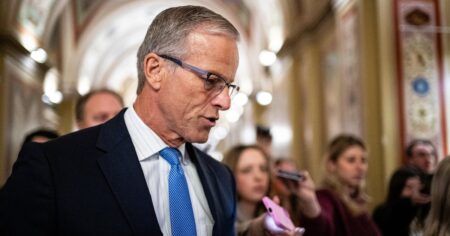
However, Senate Majority Leader John Thune expressed skepticism about this approach, noting it would “entail a tremendous amount of effort, work and cooperation at the expense of the other things that we might be doing in the Senate.” Still, Thune acknowledged that the Republican conference would discuss the strategy and committed that “we will get a vote on the SAVE Act at some point.” He suggested the legislation could potentially be incorporated into negotiations over funding for the Department of Homeland Security, providing an alternative pathway forward.
House Speaker Johnson echoed this possibility, stating that “House Republicans have already passed the SAVE Act twice” and pledging to “continue to try to advance that because we believe that is critically important to the American people and to our elections.” The linkage to DHS funding could prove strategic, as Republicans might argue that election security falls under the broader umbrella of homeland security concerns.
The debate over the SAVE America Act ultimately reflects deeper divisions in American politics about the nature of democracy, the balance between security and accessibility in voting, and competing visions of what threats face the American electoral system. While Republicans see reasonable safeguards against a potential problem, Democrats see solutions in search of a problem that would create very real barriers for millions of legitimate voters. As this legislative battle continues, the fundamental question remains: how can America ensure both the integrity and accessibility of its elections in ways that strengthen rather than undermine democratic participation?