



Deadly Mosque Attack in Islamabad: A Nation Grieves as Security Forces Hunt Down Perpetrators
The Devastating Attack and Its Immediate Aftermath
On a Friday that should have been dedicated to peaceful prayer, tragedy struck at a Shiite mosque on the outskirts of Pakistan’s capital, Islamabad, when a suicide bomber detonated his explosive vest, killing 31 innocent worshippers and wounding 169 others. The attack unfolded with calculated brutality as the bomber first opened fire on security guards attempting to stop him at the main gate before advancing to the mosque’s inner gate, where he triggered his explosive device. The mosque had been packed with families attending Friday prayer services, and heart-wrenching photos from the scene revealed children among the casualties, underscoring the indiscriminate nature of this horrific act of terrorism. Zahir Hussain, who had just arrived to pray, described the terrifying moment when the massive explosion threw him against his car door. “After that, for a while there was horrific silence, then what I saw in the mosque, I don’t have words to explain it,” he told CBS News, his testimony capturing the incomprehensible horror that transformed a place of worship into a scene of carnage. This devastating incident marked the deadliest attack in Islamabad since 2008, when a suicide bombing at the Marriott Hotel claimed 63 lives and wounded more than 250 people, serving as a grim reminder that even Pakistan’s capital remains vulnerable to terrorist violence.
Swift Action and Controversial Claims
Following the attack, Pakistani security forces moved quickly, conducting raids across multiple locations and arresting four suspects, including the alleged mastermind behind the bombing. Interior Minister Mohsin Naqvi announced these arrests on Saturday, describing the suspected mastermind as an Afghan national with links to the Islamic State. However, his subsequent claims sparked immediate controversy when he alleged, without providing evidence, that the attack had been planned in Afghanistan with financial backing from India. These accusations represent the complex and often contentious geopolitical relationships in the region, with Pakistan frequently pointing fingers at its neighbors for supporting militant activities on its soil. Neither New Delhi nor Kabul issued immediate responses to these serious allegations, though the lack of supporting evidence raised questions about the timing and motivations behind such claims. Naqvi also took the opportunity to assert that multiple militant groups were operating from Afghan territory to launch attacks against Pakistan, urging the international community to take notice and warning that regional instability could spread far beyond Pakistan’s borders. Attempting to address growing public concerns about apparent security lapses that allowed such a devastating attack to occur in the heavily secured capital, the interior minister offered a somewhat controversial defense: “If one blast happens, 99 others are being foiled as well,” suggesting that security forces were successfully preventing many more attacks than those that actually occurred.
The Perpetrators and Their Twisted Ideology
Responsibility for the attack was claimed by a regional affiliate of the Islamic State group, specifically identifying itself as Islamic State in Pakistan, in a statement carried by the organization’s Amaq News Agency. The terror group’s justification for targeting Pakistani Shiites revealed the deeply sectarian nature of their ideology, as they described the Shiite community as a “human reservoir” that provided recruits to Shiite militias fighting against Islamic State forces in Syria. This disturbing rationale demonstrates how regional conflicts can fuel local violence, with extremist groups viewing civilian populations as legitimate targets based on their religious affiliations. The Islamic State, as a Sunni extremist organization, has a documented history of targeting Pakistan’s Shiite minority communities, apparently seeking to exploit and exacerbate sectarian divisions within the majority Sunni country. This wasn’t the first time IS had struck Pakistani Shiites; in 2022, the group claimed responsibility for another suicide bombing that targeted a Shiite Muslim mosque in Peshawar, located in Pakistan’s northwestern region, which resulted in at least 56 deaths and 194 injuries. These repeated attacks reflect a deliberate strategy to sow discord and fear among religious communities, undermining the fabric of Pakistani society and challenging the government’s ability to protect all its citizens regardless of their faith.
A Community in Mourning
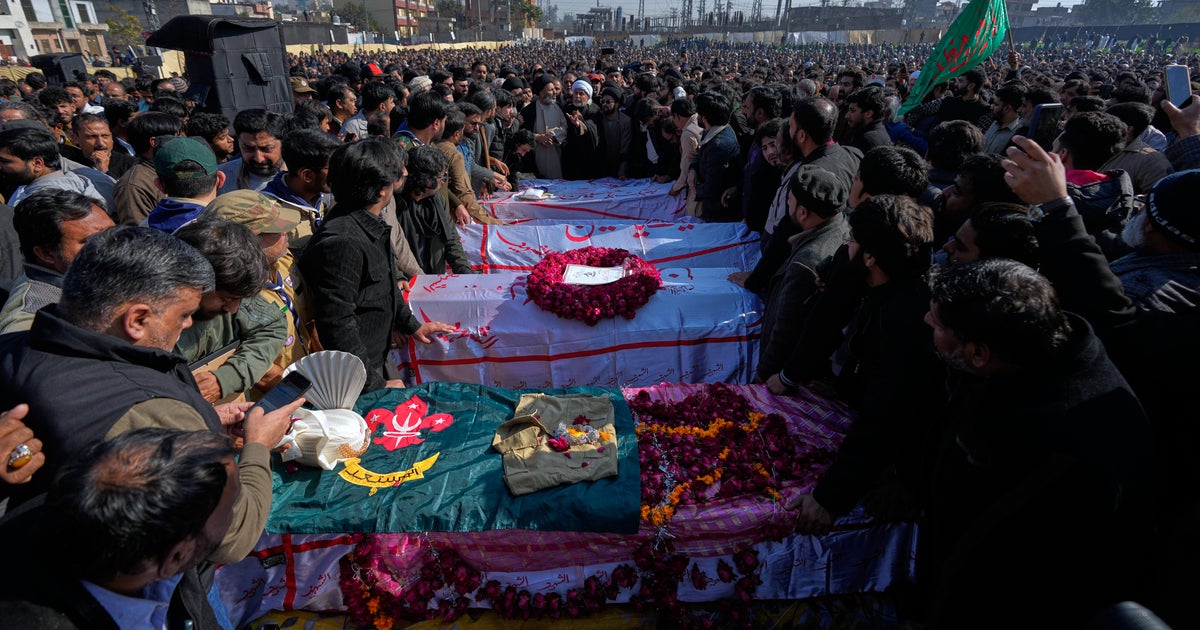
The day following the attack, more than 2,000 grief-stricken mourners gathered at the very same mosque that had been attacked, their presence a testament to resilience in the face of terror. Coffins of approximately a dozen victims were brought to the mosque for funeral prayers, with the solemn ceremony attended by Shiite community leaders and senior government officials who came to pay their respects and show solidarity with the bereaved. The decision to hold funerals at the attack site itself carried powerful symbolism, demonstrating that the community would not be driven from their place of worship by violence and fear. Other victims’ funerals were scheduled to be held in their respective hometowns, as families scattered across the country prepared to bury their loved ones who had simply gone to Friday prayers and never returned home. Photographs from the funeral ceremonies showed mourners arranging coffins and weeping over the remains of their relatives, capturing the profound personal tragedies behind the casualty statistics. These images of collective grief illustrated how terrorism doesn’t just claim lives in the moment of attack but ripples outward, devastating families, shattering communities, and leaving scars that may never fully heal. The presence of government officials at the funerals was meant to demonstrate state support for the victims and their families, though for many mourners, such gestures likely felt insufficient in the face of such devastating loss and the security failures that had allowed it to happen.
Regional Tensions and Finger-Pointing
The attack quickly became entangled in the complex and often hostile relationship between Pakistan and Afghanistan, with Pakistani officials pointing accusatory fingers at their western neighbor. Defense Minister Khawaja Mohammad Asif told reporters that the attack demonstrated that Pakistan-based militants operating from Afghanistan could strike even in the heavily secured capital, a statement that drew a sharp response from Afghanistan’s Taliban government. In a statement, Afghanistan’s Defense Ministry condemned the mosque attack but accused the Pakistani defense minister of “irresponsibly” linking it to Afghanistan without proper evidence. This exchange reflects the ongoing tensions between the two countries, with Pakistan frequently accusing Afghanistan—where the Taliban returned to power in August 2021—of harboring militants, including members of the Pakistani Taliban, known as Tehrik-e-Taliban Pakistan or TTP. Kabul consistently denies these accusations, creating a diplomatic stalemate that complicates efforts to address cross-border terrorism. The Pakistani government’s claims that the attack was planned in Afghanistan with Indian financial backing further complicated an already tense regional situation, potentially straining Pakistan’s relationships with both neighboring countries simultaneously. These allegations, made without immediate supporting evidence, raised questions about whether they represented genuine intelligence findings or politically motivated attempts to deflect from domestic security failures and leverage international support against regional rivals.
International Response and Pakistan’s Ongoing Security Challenges
The devastating attack prompted widespread international condemnation, with messages of sympathy and support arriving from countries and organizations across the globe, including the United States, Russia, and the European Union. Prime Minister Shehbaz Sharif expressed gratitude for these messages following what he described as the “heart-wrenching suicide attack in Islamabad,” emphasizing that international support remained critical to Pakistan’s counterterrorism efforts while vowing that the perpetrators would be brought to justice. However, such promises have been made before, and Pakistan faces significant challenges in addressing the root causes of militant violence that continues to plague the country. Although Islamabad has experienced relatively few attacks compared to other regions of Pakistan, the country as a whole has witnessed a concerning rise in militant violence in recent years. Much of this violence has been attributed to Baloch separatists operating primarily in the southwestern province and to the Pakistani Taliban (TTP), which, despite being a separate organization from Afghanistan’s Taliban, maintains allied relationships with the group now governing Afghanistan. This complex landscape of militant groups with varying motivations—from sectarian extremism to separatist aspirations to anti-government insurgency—presents enormous challenges for Pakistani security forces. The attack at the Shiite mosque, occurring in the capital where security is theoretically tightest, exposed vulnerabilities in Pakistan’s defensive posture and raised difficult questions about how such attacks can be prevented in the future. For ordinary Pakistanis, particularly members of minority communities who find themselves targeted by extremist groups, each attack erodes confidence in the government’s ability to protect its citizens and maintain security. As Pakistan continues to grapple with these persistent threats, the international community watches closely, recognizing that instability in this nuclear-armed nation of over 220 million people has implications far beyond its borders.