


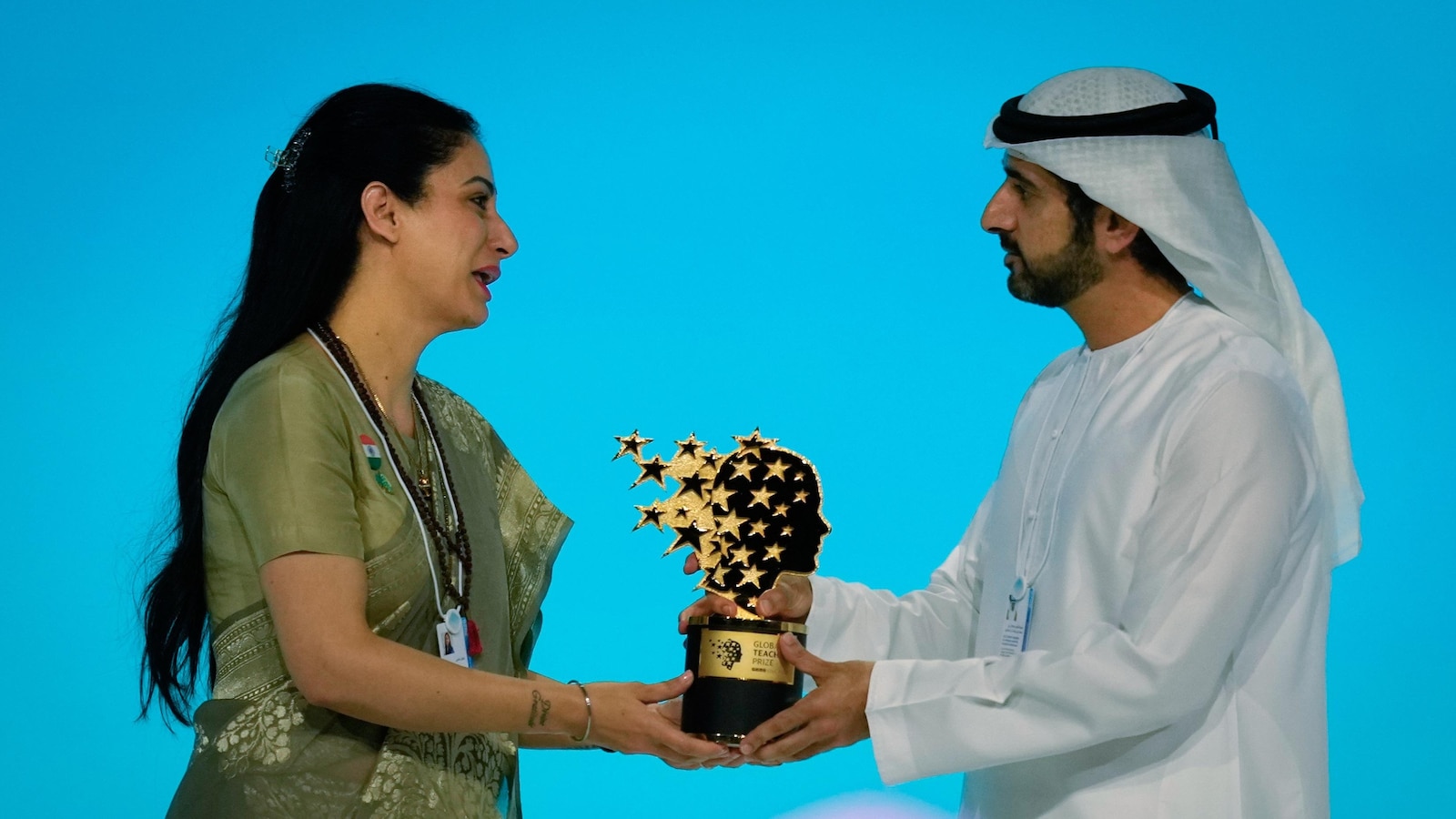

Indian Teacher Wins $1 Million Global Prize for Transforming Lives Through Education
A Remarkable Journey from Small Beginnings to Massive Impact
Rouble Nagi, an Indian teacher and activist whose dedication to educating underprivileged children has transformed countless lives, was honored with the prestigious $1 million Global Teacher Prize on Thursday. The award ceremony took place at the World Governments Summit in Dubai, United Arab Emirates, a prominent annual gathering that attracts government leaders and influential figures from around the world. What makes Nagi’s achievement particularly remarkable is the scale and creativity of her work: her Rouble Nagi Art Foundation has established more than 800 learning centers throughout India, reaching children who might otherwise never have the opportunity to receive an education. Her innovative approach goes beyond traditional classroom settings, as she paints colorful educational murals on the walls of slums, transforming these overlooked spaces into outdoor classrooms that teach literacy, mathematics, science, history, and other essential subjects. These murals serve a dual purpose—they beautify neglected communities while simultaneously providing accessible learning resources to children who may have never set foot in a formal school. Her work targets two crucial groups: children who have never attended school and need structured learning opportunities to begin their educational journey, and children already enrolled in schools who benefit from additional support and creative teaching methods.
From Dream to Reality: Twenty-Four Years of Dedication
When accepting the award, Rouble Nagi expressed that the recognition was an honor not just for herself, but for India as a whole. With genuine humility, she reflected on her journey that began 24 years ago with just 30 children in one small workshop. Today, her foundation’s reach has expanded exponentially, touching the lives of over one million children across the country. “I think every step has just motivated me, inspired me to take every child in India to school,” Nagi explained during her acceptance speech. She shared a deeply personal connection to her mission, revealing that even as a child, she dreamed of seeing every child in India have access to education. Watching that childhood dream become reality for as many children as she can reach has been, in her words, “a very humbling experience.” Her story exemplifies how one person’s vision and persistent effort can create waves of positive change that ripple through entire communities. The transformation from helping 30 children in a single workshop to establishing hundreds of learning centers and impacting a million young lives demonstrates not only the magnitude of the educational crisis in India but also the power of sustained commitment to a cause. Nagi’s approach recognizes that education is not merely about academic knowledge but about opening doors to opportunities, building confidence, and breaking cycles of poverty that have trapped families for generations.
Recognition from the Global Education Community
The Global Teacher Prize is awarded by the Varkey Foundation, an organization founded by Sunny Varkey, who also established GEMS Education (Global Education Management Systems), a for-profit company that operates dozens of schools across Egypt, Qatar, and the United Arab Emirates. The foundation created this prize to celebrate exceptional teachers worldwide and to elevate the teaching profession’s status globally. In a statement posted to the Global Teacher Prize website, Sunny Varkey praised Nagi’s extraordinary contributions: “Rouble Nagi represents the very best of what teaching can be – courage, creativity, compassion, and an unwavering belief in every child’s potential.” Varkey emphasized that by bringing education to the most marginalized communities, Nagi has not only transformed individual lives but has strengthened entire families and communities in the process. This recognition highlights an important reality: great teaching extends far beyond the classroom walls and can serve as a catalyst for broader social change. The prize, which began in 2015, has honored ten exceptional educators, including Nagi. Previous winners represent a diverse range of backgrounds and approaches to education: a Kenyan teacher from a remote village who generously gave away most of his earnings to help the poor, a Palestinian primary school teacher who taught her students about non-violence in a region torn by conflict, and a Canadian educator who brought quality education to a remote Arctic village of Inuit students. Last year’s recipient was Mansour al-Mansour, a Saudi educator recognized for his dedicated work with impoverished communities in Saudi Arabia.
Plans for the Prize Money: Creating Lasting Change
Rather than using the substantial $1 million prize for personal gain, Rouble Nagi has already outlined plans that reflect her continued commitment to education and community development. She intends to use the funds to build an institute that will offer free vocational training, recognizing that education must be practical and relevant to students’ lives and future employment opportunities. This vocational training institute represents a natural extension of her educational philosophy—that learning should be accessible to all and should equip students with skills they can use to improve their economic circumstances. By focusing on vocational training, Nagi acknowledges that while traditional academic education is important, many young people in marginalized communities need practical skills that can lead directly to employment and economic independence. This approach addresses a critical gap in many education systems, where the emphasis on theoretical knowledge sometimes overlooks the immediate needs of students who must contribute to their family’s income. Her decision to make this training free ensures that financial barriers won’t prevent deserving students from accessing these opportunities, staying true to the inclusive philosophy that has guided her work for nearly a quarter-century.
International Recognition of Teaching Excellence
Stefania Giannini, UNESCO Assistant Director-General for Education, added her voice to the chorus of praise for Nagi’s achievements, stating that her prize “reminds us of a simple truth: teachers matter.” In comments published on the Global Teacher Prize website, Giannini expressed that UNESCO was “honoured to join the Global Teacher Prize in celebrating teachers like you, who, through patience, determination, and belief in every learner, help children into school — an act that can change the course of a life.” This statement from a high-ranking UNESCO official underscores the international significance of Nagi’s work and places it within the broader context of global educational development goals. The recognition from UNESCO, the United Nations’ educational, scientific, and cultural organization, validates the importance of grassroots educational initiatives and highlights how individual educators can make meaningful contributions toward achieving universal education access. It also acknowledges the particular challenges faced by educators working in underserved communities and the exceptional dedication required to overcome barriers of poverty, social marginalization, and lack of infrastructure that often prevent children from accessing quality education.
The Broader Context of Educational Innovation
The Global Teacher Prize and GEMS Education, the organization behind the award, exist within an interesting educational landscape. GEMS Education is one of the world’s largest private school operators and is believed to be worth billions of dollars. The company’s success has paralleled the growth of Dubai, where private schools dominate the educational sector because they specifically serve the children of foreign workers who power the emirate’s economy. This context adds an interesting dimension to the prize: it represents a bridge between well-resourced private education systems and grassroots educational initiatives in underserved communities. While GEMS operates in the profitable private education sector, the Global Teacher Prize recognizes educators like Nagi who work in the opposite environment—bringing education to those who have the least access and the fewest resources. This highlights a fundamental tension in global education: while some children have access to world-class private education with state-of-the-art facilities, millions of others struggle to access even basic learning opportunities. Rouble Nagi’s work addresses this inequality directly, creating educational opportunities where none existed before and using creative approaches like murals to overcome the barriers of inadequate school buildings and limited resources. Her recognition with this prize sends a powerful message that teaching excellence can be found not just in elite institutions but in slums and marginalized communities where dedicated educators work with limited resources but unlimited compassion and creativity to transform young lives.