


The Angel Fresco Controversy: When Italian Politics Met Sacred Art
A Startling Discovery in Rome’s Historic Basilica
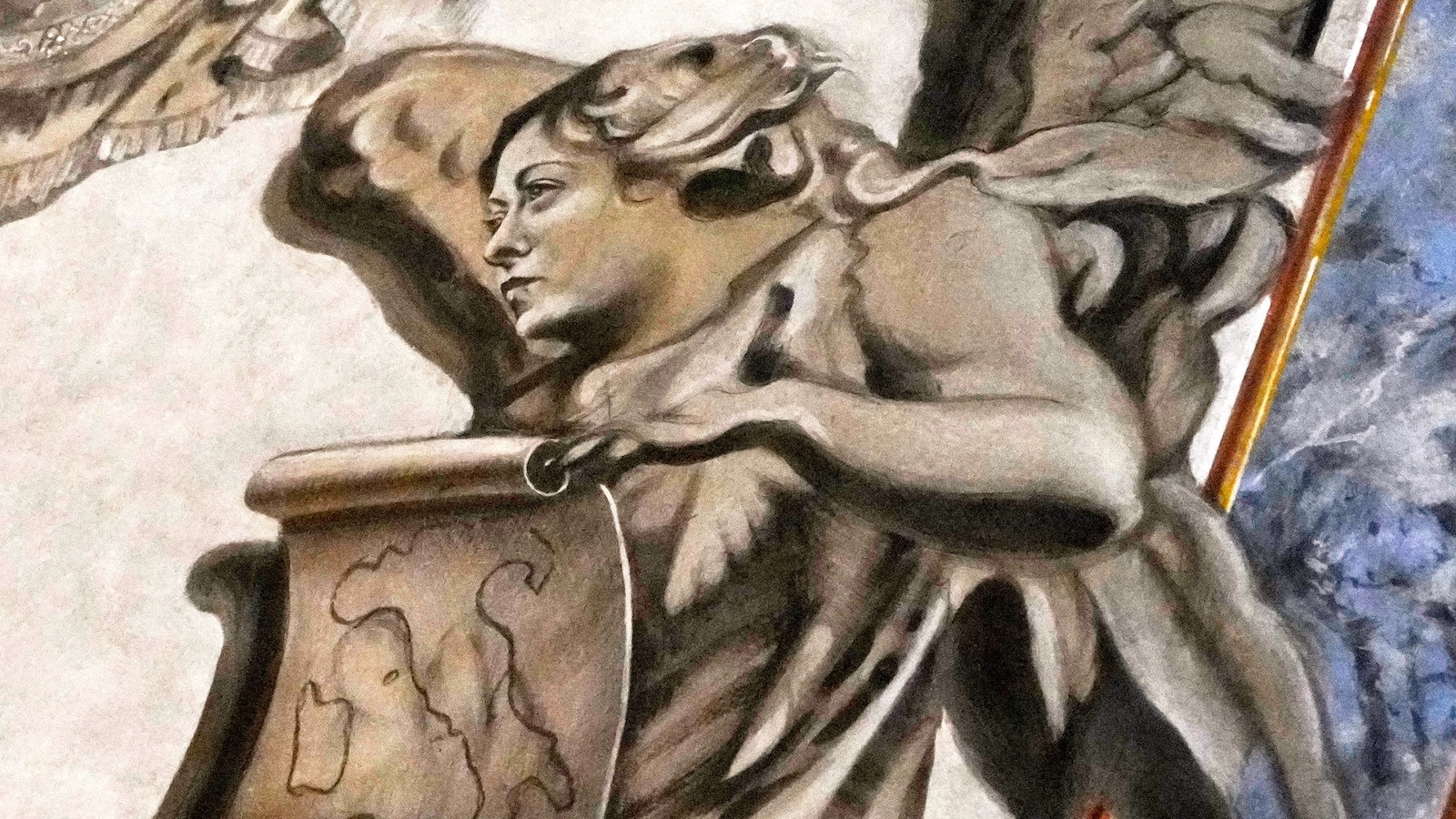
In the heart of Rome, just a stone’s throw from Italy’s government headquarters, an unexpected political storm has been brewing inside the ancient basilica of San Lorenzo in Lucina. This historic church houses a chapel honoring Umberto II, Italy’s last reigning monarch, adorned with religious artwork depicting angelic figures watching over the fallen king’s memorial. The chapel features two feminine angel-like forms hovering near a marble bust of the monarch—one delicately holding a crown symbolizing royal authority, while the other cradles a map representing the Italian peninsula. What should have been a routine restoration project following water damage has instead ignited a controversy that has captured national attention and sparked heated debates about the intersection of sacred art, political influence, and artistic integrity.
The controversy erupted when La Repubblica, one of Italy’s most prominent newspapers, published their investigation revealing something peculiar about the restored frescoes. Visitors who had previously passed through the chapel without a second thought suddenly found themselves doing double-takes at one particular angel. The celestial figure holding the map of Italy bore what many considered an unmistakable resemblance to none other than Giorgia Meloni, Italy’s current Prime Minister. What followed was a media frenzy as curious citizens, journalists, and art enthusiasts descended upon the basilica, transforming the normally peaceful place of worship into something resembling a tourist attraction. People came not for quiet contemplation or prayer, but to witness firsthand this unlikely fusion of contemporary politics and religious iconography, their smartphones at the ready to capture images of the controversial artwork.
The Restorer’s Defense and Political Connections
At the center of this tempest stands Bruno Valentinetti, the restorer responsible for the chapel’s renovation work, who was identified by church staff as a volunteer working on the project. When initially confronted about the apparent likeness between the angel and the Prime Minister, Valentinetti vehemently denied any intentional resemblance. “Who says there is a resemblance? I only restored what was there before. These are all inventions,” he insisted when speaking to ANSA, Italy’s national news agency. However, his denial became harder to maintain as scrutiny intensified and his background came under examination. Valentinetti’s professional history reveals significant connections to Italy’s political right wing—he had previously worked for Silvio Berlusconi, the controversial former Prime Minister known for his theatrical political style, and had maintained associations with far-right political parties throughout his career.
As pressure mounted from the relentless media attention and the growing crowd of visitors transforming the basilica into an impromptu exhibition space, Valentinetti’s story began to shift. In a subsequent interview with La Repubblica, he adopted a more playful tone, comparing himself to Renaissance master Raphael and noting that he too enjoyed “inserting jokes” into his paintings. He eventually admitted to drawing inspiration from Prime Minister Meloni’s features while working on the restoration, though he maintained that his approach remained faithful to the style of the original artwork. This revelation added another layer of complexity to an already complicated situation. The original fresco itself was not an ancient masterpiece but had been painted merely twenty-five years earlier, making the entire episode a curious blend of modern artistic license masquerading as historical restoration.
Professional Standards and Artistic Ethics
The controversy has raised serious questions about professional ethics in art restoration, a field that operates under strict guidelines designed to preserve cultural heritage authentically. Chiara Rossi, a professional cultural heritage restorer who was not involved in the basilica project, provided crucial context about the standards that should govern such work. She explained that restoration philosophy rests on two fundamental pillars established by Cesare Brandi, widely regarded as the father of modern restoration theory: aesthetics and history. “Falsifying a work of art means depriving it of its historicity,” Rossi emphasized, highlighting how Valentinetti’s alterations violated core principles of the profession. A properly trained restorer with legitimate credentials would never have taken such liberties with a commission, regardless of the artwork’s age or cultural significance.
Rossi did note one mitigating factor in this particular case—the fresco in question was relatively recent and not under the official protection of Italy’s Superintendency for Cultural Heritage, the governmental body responsible for safeguarding the nation’s artistic treasures. Had the artwork been older or officially protected, the consequences for such unauthorized alterations would have been far more severe, potentially including legal penalties. Nevertheless, the incident has sparked broader conversations within Italy’s art restoration community about maintaining professional standards, the responsibilities that come with working on religious art regardless of its age, and the ethical boundaries that should never be crossed even when dealing with relatively modern works in sacred spaces.
Political and Religious Backlash
The controversy quickly escalated beyond artistic circles into the political arena, with Prime Minister Meloni herself weighing in on the situation. In a characteristic display of her communication style, she took to Instagram to address the matter directly with her millions of followers. “No, I definitely do not resemble an angel,” she wrote with apparent self-deprecating humor, sharing an image of the controversial fresco. Her response, while light-hearted on the surface, couldn’t completely diffuse the growing storm of criticism. Public reaction split along predictable lines, with some finding the entire episode amusing while others expressed genuine outrage. “This is pure blasphemy,” one commenter wrote online, articulating a sentiment shared by many who found the apparent insertion of a politician’s likeness onto a religious icon deeply offensive and inappropriate, regardless of one’s political affiliations or opinions about Meloni’s government.
The Diocese of Rome responded swiftly and decisively to the mounting controversy. Church officials declared that Valentinetti’s changes had been completely unauthorized, and Cardinal Baldo Reina issued a stern warning against the politicization of sacred art. The Diocese launched an official inquiry into how such alterations could have occurred without proper oversight and approval. Opposition politicians seized the opportunity to demand their own investigations, seeing in the incident either a genuine abuse of religious spaces for political propaganda or at minimum a useful point of attack against the current government. The situation highlighted the delicate balance religious institutions must maintain in Italy, where the Catholic Church’s influence remains significant and its spaces are meant to transcend the partisan conflicts that dominate secular political life.
The Cover-Up and Public Spectacle
By Wednesday, mere days after the controversy erupted, church authorities had seen enough. They ordered that the controversial angel’s face be covered and subsequently replaced with an image that wouldn’t spark political associations. What happened next would have been comical if it weren’t so revealing about contemporary media culture and public behavior. Crowds of photographers, journalists, videographers, and simply curious onlookers gathered outside and inside the basilica to witness the alteration process. The scene resembled the unveiling of a major art installation rather than the correction of an unauthorized modification. For a brief period, the angel became faceless—a blank cherub that ironically drew even more attention than the controversial portrait had. People jostled for position to capture images of the work in progress, their flashes illuminating the sacred space in ways typically reserved for major religious celebrations or visiting dignitaries.
Rev. Daniele Michelett, the basilica’s parish priest, watched this circus with evident dismay. He observed that visitors were now coming to the church “for selfies, not prayer,” a lament that encapsulates broader concerns about how sacred spaces function in our image-obsessed, social-media-driven age. The whole episode had transformed his usually quiet basilica into something resembling a controversial art gallery or political rally venue. The disruption to the spiritual atmosphere of the church—its primary purpose—became collateral damage in a cultural moment that seemed to value viral content and political point-scoring over reverence and reflection. For Michelett and his congregation, the swift resolution couldn’t come soon enough, as they longed to return their worship space to its intended purpose rather than serving as the backdrop for Italy’s latest political drama, played out in frescoes and social media posts rather than parliamentary debates.