

The Great Divide: Why Wall Street Is Soaring While American Families Struggle
A Tale of Two Americas
Something peculiar is happening in the American economy right now, and it’s painting a picture of a nation increasingly split into two different realities. On one side, we have Wall Street celebrating record-breaking highs, with Bitcoin soaring and tech stocks reaching unprecedented levels. On the other side, everyday Americans are feeling more pessimistic about their financial futures than ever before. This growing disconnect isn’t just a statistical anomaly—it’s a fundamental shift in how wealth and optimism are distributed across the country, revealing uncomfortable truths about who actually benefits when markets boom.
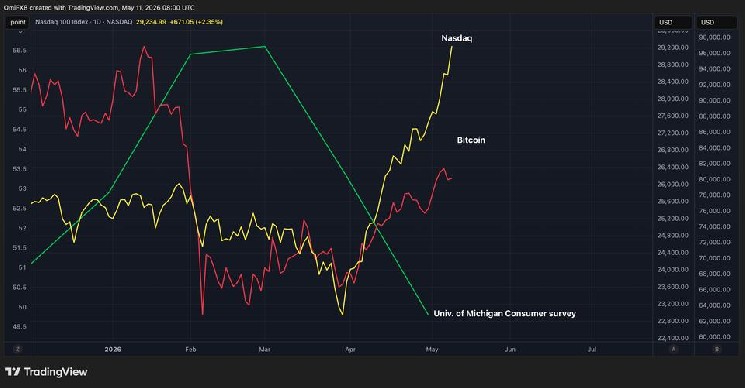
Last month alone, Bitcoin jumped nearly 12%, marking its strongest performance since April of last year, and it hasn’t stopped climbing since, recently touching $80,700. Meanwhile, the tech-heavy Nasdaq index has been on an absolute tear, surging 22% since early April to hit an all-time high of over 23,000 points. The broader S&P 500 has joined the party too, rallying more than 12% to reach 7,398 points. These are the kinds of numbers that typically signal economic prosperity and should, in theory, have Americans feeling optimistic about their finances. After all, roughly 30% of American adults—that’s over 70 million people—own some cryptocurrency, and an average of 62% of adults have owned stocks since 2023. When these assets rally, people’s net worth increases on paper, which usually translates to improved consumer confidence. But something very different is happening this time around.
Main Street’s Reality Check
While Wall Street pops champagne, Main Street is tightening its belt and worrying about tomorrow. The University of Michigan’s consumer sentiment survey, one of the most closely watched indicators of how Americans actually feel about the economy, dropped to a record low of just 48.2 points in its latest reading—down nearly 8% from the same time last year and continuing a downward trend from April’s already dismal 49.8 points. This isn’t just a small dip in confidence; it’s a historic low that tells us Americans are more worried about their economic futures than they’ve been in the entire history of this survey. The reasons behind this gloom are straightforward and painfully familiar to anyone who’s filled up their gas tank or bought groceries lately: inflation is eating away at household budgets, and people are scared it’s going to get worse.
When researchers dug into what’s driving this pessimism, they found that one-third of respondents pointed to gas prices as their biggest concern, while another third cited tariffs as their primary worry. These aren’t abstract economic concepts—they’re real costs that hit American families every single day. When gas prices climb, it costs more to get to work, to take kids to school, to run errands. When tariffs drive up the cost of imported goods, everything from clothing to electronics to food becomes more expensive. These pressures create a grinding, relentless squeeze on household budgets that no amount of positive stock market news can relieve, especially for families who don’t have significant investments in those markets to begin with.
Understanding the Disconnect
Alvin Kan, the Chief Operating Officer at Bitget Wallet, offers insight into why we’re seeing such a stark divide between market performance and consumer sentiment. According to Kan, institutional investors—the big players with deep pockets—continue pouring money into artificial intelligence, semiconductors, and digital assets like Bitcoin. These investors are essentially betting on the future, pricing in long-term productivity improvements and technological breakthroughs that might take years to materialize. They’re looking at five-year and ten-year horizons, imagining a world transformed by AI and other emerging technologies, and they’re willing to pay premium prices today for assets they believe will be even more valuable in that future world.
Meanwhile, ordinary American households are stuck dealing with the present, and the present is expensive and uncertain. They’re not thinking about productivity gains in 2030; they’re thinking about whether they can afford this month’s groceries, next month’s rent, and how they’ll manage if their car breaks down. Markets are trading the future while consumers are living the now, and those two timeframes rarely align perfectly. The recent rally in the Nasdaq has been driven largely by an investment boom in AI infrastructure and impressive earnings reports from mega-cap tech companies—the Apples, Microsofts, Googles, and Nvidias of the world. This excitement around AI has created a ripple effect, boosting demand for other emerging technologies, including cryptocurrency. Bitcoin has benefited enormously from this trend, with U.S.-listed spot Bitcoin ETFs attracting billions of dollars in recent weeks as investors seek exposure to what they see as the next wave of transformational technology.
The Changing Face of Cryptocurrency
Kan points out another crucial factor in this divergence: cryptocurrency has fundamentally changed its character. The crypto market began as a grassroots, almost rebellious movement—a way for ordinary people to participate in an alternative financial system outside the control of traditional banks and Wall Street institutions. Early adopters saw it as a tool for financial democratization, a way to level the playing field between the wealthy elite and everyone else. But the landscape has shifted dramatically, especially following the launch of spot Bitcoin ETFs about two years ago. These ETFs made it easy for institutional investors—hedge funds, pension funds, family offices—to gain exposure to Bitcoin without actually holding the cryptocurrency directly. This influx of institutional money has fundamentally changed how Bitcoin behaves, making it increasingly correlated with broader equity markets rather than moving independently.
This transformation represents a profound irony, according to Markus Thielen, founder of 10x Research. Cryptocurrency was supposed to democratize finance, to spread wealth more evenly, and to give ordinary people a chance to participate in wealth creation on equal footing with the rich. Instead, reality has moved in the opposite direction. Wealth in the crypto space, just like in traditional markets, has become heavily concentrated in the hands of a small minority. This pattern is even more pronounced in the U.S. stock market, where gains have increasingly gone to the wealthiest participants who have the capital to invest when opportunities arise and the financial cushion to weather volatility without panic-selling. The shift in how Bitcoin is perceived—from a people’s currency to just another institutional investment tied to Wall Street sentiment—represents the fading of crypto’s original promise to democratize finance and create a more equitable economic system.
Why the Gap Might Persist
So what comes next? Will consumer sentiment eventually catch up with market performance, or will markets come crashing down to meet consumer pessimism halfway? When households are squeezed by rising costs, it might seem natural to expect markets to eventually align with the negative sentiment on Main Street—after all, if consumers can’t spend, corporate profits should suffer, and stock prices should fall accordingly. But according to industry experts, that’s not necessarily what we should expect to see, at least not in the short term. Gracy Chen, CEO of Bitget, believes this gap between market performance and consumer confidence is likely to persist for the foreseeable future.
Chen explains that digital assets are increasingly operating on a different timeline and following different drivers than traditional economic cycles. They’re attracting fresh capital from investors seeking what’s called “asymmetric returns”—investments where the potential upside significantly exceeds the potential downside. This suggests we’re seeing structural, long-term growth in these markets rather than just a temporary bubble. While Chen acknowledges that risks exist—monetary policy tightening by central banks, geopolitical events, or regulatory crackdowns could all create near-term pressure on prices—she argues that the digital asset ecosystem is maturing and becoming a core tool that sophisticated investors use for diversification and risk management, especially during volatile times. In other words, wealthy investors and institutions have found value in these assets that’s independent of how the average American consumer is feeling about their personal finances.
The Bigger Picture: A Nation Divided by Prosperity
This divergence between Wall Street’s triumph and Main Street’s troubles reflects something deeper and more troubling than a temporary misalignment of market indicators. It’s evidence of a fundamental economic divide in America, where the mechanisms of wealth creation have become increasingly disconnected from the daily economic experiences of most citizens. When markets soar but consumer confidence craters, it suggests that market gains are accruing primarily to those who already have significant wealth invested, while those living paycheck to paycheck see none of the benefit and all of the pain from inflation and rising costs. The cryptocurrency revolution, which once promised to redistribute economic power and create new pathways to wealth for ordinary people, has instead been absorbed into the existing financial system, becoming another arena where institutional capital dominates and retail investors struggle to keep up.
This situation presents a challenge for policymakers, economists, and society as a whole. How do we address an economy where asset prices can reach record highs while record numbers of people feel economically insecure? The answer likely requires looking beyond traditional metrics like stock market performance and GDP growth to focus on measures that better capture how economic prosperity is distributed across the population. It means asking hard questions about whether the financial system as currently structured serves the interests of most Americans or primarily benefits those who already have substantial assets to invest. As this divide persists and potentially widens, it may reshape not just economic policy but also political attitudes and social cohesion, making it one of the most important economic storylines of our time. The markets may be betting on a brilliant technological future, but for that future to be truly prosperous, it will need to lift more than just asset prices—it will need to lift the fortunes of everyday American families who are currently feeling left behind.