


Bitcoin’s Dance Above $80,000: A New Era or Just Different Market Rhythms?
Breaking Free from Traditional Patterns
The cryptocurrency world is watching closely as Bitcoin hovers above the psychologically significant $80,000 mark, displaying behavior that’s making analysts scratch their heads. For months, Bitcoin had been moving in lockstep with the U.S. stock market—waking up when Wall Street opened, rising and falling with the same rhythm, reacting to the same fears. It was predictable, almost boring in its consistency. But something has shifted. Bitcoin now seems to be dancing to a different tune than the S&P 500, particularly as artificial intelligence stocks continue to drive traditional equity markets higher. This divergence raises a fascinating question: Is Bitcoin truly establishing itself as an independent asset class with its own rules, or is it simply responding to multiple market forces at different times, creating the illusion of independence? The answer matters deeply for anyone trying to understand where cryptocurrency fits in the modern financial landscape and what it means for portfolio management going forward.
When Oil Shocks Meet Digital Assets
The real test of this apparent independence came on May 4th, when traditional market stress signals all pointed in one direction—down for stocks—yet Bitcoin refused to follow the script. Oil prices surged nearly 6% as tensions flared up again around Iran, reaching $114.44 per barrel. Treasury yields climbed higher, meaning bond prices fell as investors demanded better returns. The U.S. dollar strengthened, typically a sign that people are seeking safety. All of these factors combined would normally send risk assets tumbling, and indeed, U.S. stocks did fall, with the S&P 500 down 0.4%, the Dow losing 1.1%, and even the tech-heavy Nasdaq slipping 0.2%. Yet there was Bitcoin, stubbornly holding near $80,000 instead of following the SPY (the S&P 500 ETF) lower as it had done during previous oil spikes. This wasn’t a minor divergence—it was a meaningful departure from established patterns. Bitcoin was up more than 2% over 24 hours and had gained over 20% in the previous month, showing genuine strength rather than just treading water. With the entire crypto market valued at approximately $2.67 trillion and Bitcoin representing about 60.6% of that total, when Bitcoin moves independently like this, it’s a signal that affects the entire digital asset ecosystem, not just an isolated event.
The Asia Connection and Multiple Market Personalities
However, the story got more complicated the very next morning. As oil prices eased and U.S. stock futures edged higher, Bitcoin softened a bit rather than continuing its independent rally. This twist reveals something crucial: Bitcoin might not be breaking away from traditional markets so much as responding to different markets at different times of day. Earlier CryptoSlate analysis had shown that Bitcoin’s move back above $80,000 actually began during Asian trading hours, driven by enthusiasm around artificial intelligence stocks and regional technology equity strength. This happened before U.S. markets even opened and before the oil, dollar, and bond yield pressures kicked in during American trading hours. In other words, Bitcoin was riding one wave—the AI and technology risk appetite from Asia—while U.S. stocks were being hit by a completely different wave—the geopolitical oil shock. The apparent “decoupling” wasn’t necessarily Bitcoin rejecting equity market logic entirely; rather, it was Bitcoin processing two different impulses that happened to overlap in time. When U.S. futures firmed up while Bitcoin eased after oil cooled, the market was essentially revealing that Bitcoin’s primary input had temporarily switched channels, like a radio picking up different stations depending on atmospheric conditions.
The Strait of Hormuz and the Macro Storm
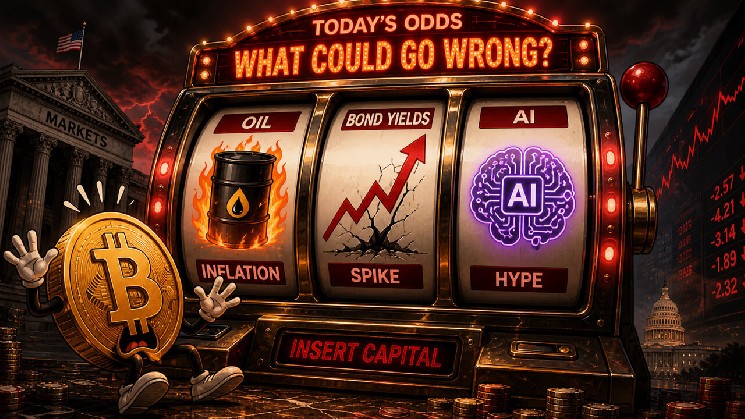
Understanding why this matters requires grasping the sheer scale of what’s happening with oil. The Strait of Hormuz isn’t just another shipping lane—it’s one of the world’s most critical energy chokepoints, with roughly 20.9 million barrels of oil passing through it daily during the first half of 2025. That represents about 20% of all global petroleum consumption and a quarter of all maritime oil trade. When this passage is threatened, it’s not just an oil story—it becomes an inflation story, a central banking story, a currency story, and ultimately, a story about how every asset gets valued. The World Bank has projected energy prices could surge 24% in 2026, describing the current disruption as the largest oil supply shock on record. Their scenarios suggest Brent crude could average anywhere from $95 to $115 per barrel this year if Middle East tensions prove more severe or longer-lasting than currently expected. This creates two completely opposite ways to interpret Bitcoin holding $80,000 while oil and bond yields rise. On one hand, it could signal that Bitcoin has genuinely found a more durable source of demand—perhaps as a hedge against monetary disorder or as a digital store of value when traditional systems face inflation pressure. On the other hand, it might simply reflect a timing lag, where Asian risk appetite is still supporting Bitcoin before the full weight of rising U.S. interest rates hits home.
The Multiple Personalities of Bitcoin
What’s becoming clear is that Bitcoin has evolved beyond having a single personality. It’s no longer just a risk-on asset that rises with tech stocks and falls with them. Instead, it’s now operating at the intersection of multiple powerful forces, each pulling it in different directions at different times. During Asian hours, it might trade like a technology risk asset, moving with semiconductor stocks and AI enthusiasm. During U.S. hours, it might get pulled into the bond market’s gravitational field, responding to inflation expectations and interest rate movements. And during periods of geopolitical stress, it can act as what some analysts call “the fastest market for repricing geopolitical risk”—essentially a liquid, 24/7 venue where investors can immediately express their views on how conflicts might affect the global financial system. The presence of Bitcoin ETFs has added another layer of complexity. These investment vehicles mean that everyday brokerage accounts can now hold Bitcoin exposure, potentially moving it alongside the same portfolio management decisions that affect AI stocks and other equity positions. Meanwhile, the oil shock has bond traders treating Bitcoin as part of the inflation and interest rate debate. The result is an asset that can appear completely uncorrelated to traditional markets in a single snapshot while still fundamentally depending on external forces—it’s just depending on different external forces at different times.
What Comes Next and What It Means
The immediate question revolves around the Strait of Hormuz situation. As of May 5th, the United States was actively attempting to force the strait open, testing a fragile ceasefire, with Iran warning against the move while the U.S. reported that two American-flagged merchant ships had successfully transited. If this effort succeeds and shipping returns to normal, oil pressure should ease, which would likely reduce the interest rate shock and allow Bitcoin to trade more cleanly on factors like ETF demand, technology risk appetite, and the psychological importance of the $80,000 level itself. But if the reopening fails or if retaliation escalates, then Bitcoin faces a much harder test—it would need to hold up against a sustained combination of high oil prices, a strong dollar, and elevated Treasury yields. Successfully weathering that storm would provide much stronger evidence that Bitcoin has truly developed a non-equity source of demand, though even then, confirmation would be needed from ETF fund flows, derivatives market positioning, and sustained price stability above the low-$80,000 range. The real significance of this apparent correlation break is what it reveals about Bitcoin’s evolving role in global markets. Bitcoin holders are now exposed to multiple macro engines running simultaneously. In one trading session, Bitcoin can behave like a tech-risk asset. In the next session, it can act like a geopolitical risk barometer. In yet another, it gets pulled back into the bond market mathematics that govern all liquidity-dependent assets. This is the genuine regime test happening right now: Bitcoin’s once-simple relationship with stocks is becoming incomplete as oil markets, AI equity performance, ETF wrapper demand, dollar movements, and Treasury yields all compete simultaneously to determine its next move. For investors, this means Bitcoin is becoming harder to predict but potentially more useful—no longer just a leveraged bet on tech stocks, but a complex asset responding to multiple dimensions of global risk and opportunity.