


XRP Takes a Hit: Understanding the Recent Crypto Selloff and What It Means for Traders
The Storm That Shook XRP Markets
The cryptocurrency world experienced a turbulent session recently, with XRP finding itself caught in the crosshairs of a broader market downturn. The digital asset suffered a sharp selloff that saw prices plummet before finding temporary stability around the $1.74 mark. This wasn’t just another routine dip in the volatile crypto markets—it was a liquidation-driven event that exposed just how fragile market positioning had become. For investors and traders watching their portfolios, the sudden 6.7% drop served as a harsh reminder that in the crypto space, sentiment can shift rapidly, and leveraged positions can amplify moves in both directions. What made this particularly noteworthy wasn’t necessarily bad news about XRP itself, but rather how interconnected the crypto ecosystem has become, with Bitcoin’s weakness rippling across the entire market and triggering a cascade of forced selling that left many traders nursing losses.
Understanding What Really Happened Behind the Scenes
When you dig into what actually caused XRP’s sharp decline, the story becomes much more interesting than a simple “prices went down” narrative. This wasn’t driven by negative developments specific to XRP—there were no regulatory announcements, no technical failures, or company-specific news that would justify such a move based on fundamentals alone. Instead, the culprit was market positioning and the domino effect that occurs when too many traders are leaning the same way. The crypto market experienced a Bitcoin-led selloff, and because XRP is considered a high-beta token (meaning it tends to move more dramatically than Bitcoin in either direction), it felt the pain more acutely than many other assets. When Bitcoin sneezes, the saying goes, altcoins catch pneumonia—and XRP was no exception.
The real trigger came from what’s known in trading circles as a “long squeeze.” Derivatives data painted a clear picture of what unfolded: more than $70 million worth of XRP futures positions were liquidated, with the overwhelming majority being long positions—meaning traders who had bet on prices going up. When you use leverage to trade, you’re essentially borrowing money to amplify your potential gains, but this cuts both ways. If the market moves against you beyond a certain threshold, your position gets automatically closed out by the exchange to prevent further losses. This forced selling then pushes prices down further, triggering even more liquidations in a vicious cycle. The $70 million liquidation figure tells us that positioning had become extremely crowded on the long side, with many traders betting on continued upside. Once the key support level gave way, it was like pulling a thread on a sweater—everything started to unravel rapidly as stop-losses were hit and margin calls were triggered.
Breaking Down the Price Movement Minute by Minute
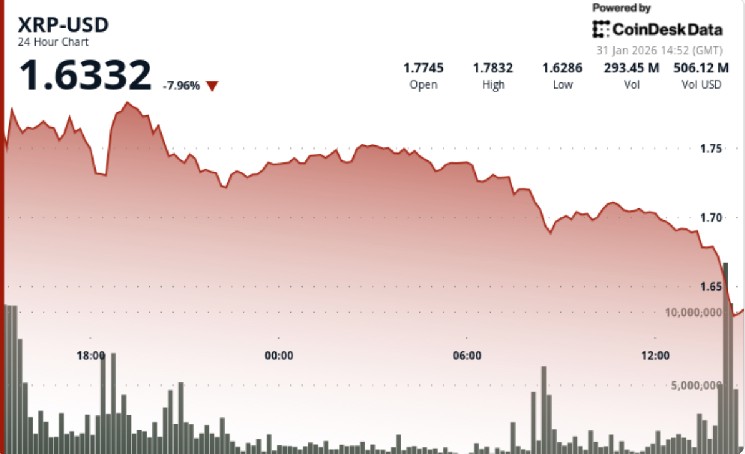
The technical aspects of XRP’s price action during this selloff reveal a lot about market psychology and the mechanics of how crashes unfold. XRP started the session trading around $1.88, a level that had represented relative stability in the preceding period. As selling pressure mounted across the crypto market, XRP began to slip, testing support near the psychologically important $1.79 level. In technical analysis, support levels are price points where buying interest has historically been strong enough to halt or reverse declines. They’re essentially lines in the sand that traders watch closely because breaking through them can trigger significant moves.
When $1.79 failed to hold, the selloff accelerated dramatically. This is textbook liquidation cascade behavior—once a key level breaks, all the stop-loss orders clustered just below it get triggered simultaneously, creating a wave of selling that feeds on itself. XRP plunged to a session low near $1.74, representing a roughly 6.7% decline from the starting point around $1.88. What made this particularly noteworthy was the volume that accompanied the breakdown. Trading volume surged sharply during the decline, which is significant because it confirms that this wasn’t just a low-liquidity event where a few large orders moved the market in the absence of participants. Instead, the high volume indicates broad-based participation, likely including institutional players and algorithmic trading systems responding to technical signals.
After touching $1.74, XRP found some buyers willing to step in at what they perceived as oversold levels. The price stabilized in a narrow range between $1.74 and $1.76 as the dust settled and liquidation pressure finally began to ease. However, this stabilization came with an important caveat—the bounce occurred on declining volume. In technical analysis, this is often interpreted as a pause rather than a genuine reversal. True rebounds typically need strong volume to confirm that buyers are genuinely committed, not just bargain hunters looking for a quick scalp trade.
What the Charts Are Really Telling Us
For traders who live and breathe technical analysis, XRP’s chart now tells a concerning story about market structure. The breakdown below $1.79 wasn’t a fakeout or a brief dip below support—it was a decisive break that occurred on exceptional volume, lending it credibility as a genuine shift in market dynamics rather than noise. This kind of high-volume breakdown suggests institutional participation, meaning that large players and sophisticated trading operations were involved in the selling, not just retail panic.
Perhaps most importantly for anyone considering positions in XRP going forward, the former support zone between $1.79 and $1.82 has now undergone what technicians call a “polarity flip.” This concept is fundamental to understanding how support and resistance work: when a support level breaks decisively, it often becomes resistance on any subsequent rally attempts. Think of it like a floor that once broken through, now acts as a ceiling. XRP’s modest rebound attempt stalled right below $1.76, well short of retesting that former support zone, and volume faded as the bounce progressed—both warning signs that the path of least resistance may still be downward.
The chart now shows a market in a precarious position. The immediate support at $1.74-$1.75 represents the battleground where bulls and bears are currently fighting for control. If that level holds and buyers can muster enough conviction to push back above $1.79, there’s a chance the technical damage could be repaired. However, if $1.74 gives way, there’s a vacuum of support below, with the next meaningful levels not appearing until $1.72 and then $1.70—levels that would represent further significant losses from current prices.
What Smart Traders Are Watching Next
In the aftermath of this liquidation event, traders are adopting a more cautious stance, and their focus has shifted to a few critical price levels that will determine XRP’s near-term trajectory. The immediate line in the sand is that $1.74-$1.75 zone. This area has now been tested and held, at least temporarily, making it the most important short-term support. For traders with a bullish bias, this is the level that absolutely must hold—a break below it would likely trigger another wave of selling as remaining stop-losses get hit and momentum traders pile on to the short side.
The recovery scenario requires several steps. First, XRP needs to hold above $1.74 and build a base of consolidation that allows liquidation pressure to fully dissipate. Then, bulls need to reclaim $1.79 with conviction—meaning on strong volume and with a decisive close above that level, not just a brief spike that gets rejected. If $1.79 can be reclaimed and held, the next target becomes $1.82, which would represent a complete reversal of the recent breakdown and potentially reset the technical picture to neutral. However, achieving this recovery path is far from guaranteed and would likely require either a strong recovery in Bitcoin or some positive XRP-specific catalyst to provide the fuel.
The bearish scenario, on the other hand, is straightforward and arguably has momentum on its side following the recent breakdown. If $1.74 fails, downside risk opens quickly toward $1.72, and if selling pressure continues, $1.70 becomes the next target. In a worst-case scenario where panic sets in, there could be even deeper retracements to levels not seen in months. What makes this particularly dangerous is that XRP remains highly sensitive to liquidations—the leverage in the system hasn’t fully washed out yet, meaning there could be additional pockets of long positions waiting to be forced out if selling continues.
The Bigger Picture and Key Takeaways for Investors
Stepping back from the minute-to-minute price action, this selloff in XRP offers several important lessons about the current state of crypto markets and what investors should keep in mind going forward. First and foremost, correlation across crypto assets remains extremely high. XRP’s move had little to do with XRP-specific fundamentals and everything to do with Bitcoin’s weakness spreading across the market. For portfolio managers and investors, this means that diversification within crypto provides less protection than many assume—when Bitcoin falls, most altcoins fall harder, regardless of their individual merits or news flow.
Second, the role of leverage in amplifying moves cannot be overstated. The $70 million in liquidations demonstrates just how much borrowed money was positioned in XRP markets, and when that leverage unwinds forcefully, it creates price action that appears disconnected from any rational fundamental assessment. For retail investors, the lesson is clear: leverage is a double-edged sword that can turn a manageable decline into a catastrophic loss in minutes. Third, technical levels matter enormously in markets driven by algorithms and momentum traders. The breakdown of $1.79 support wasn’t just a chart pattern—it was a trigger that set off cascading sell orders across multiple trading venues simultaneously.
Looking ahead, XRP’s path will likely be determined more by technical factors and Bitcoin’s direction than by any XRP-specific developments in the near term. Traders are watching those key levels at $1.74, $1.79, and $1.82 like hawks because they represent the battleground where market control will be decided. For long-term investors with conviction in XRP’s fundamentals, periods of forced liquidation and technical selling can represent opportunity, but timing entries around key support levels becomes critical. For traders operating on shorter timeframes, the current environment demands tight risk management and an acknowledgment that volatility could remain elevated until leverage is fully flushed from the system and market positioning returns to more balanced levels. The bottom line: in crypto markets, headlines often matter less than you think, and technical levels and market positioning often matter far more than seems reasonable—until you understand the mechanics of how modern digital asset markets actually function.