

Daily Crypto Market Update: CoinDesk 20 Index Shows Modest Decline
Market Overview: A Red Day for Digital Assets
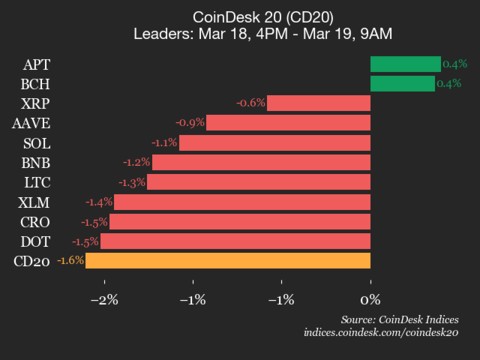
The cryptocurrency market experienced a slight pullback in today’s trading session, with the CoinDesk 20 Index—a comprehensive benchmark that tracks the performance of the digital asset market’s most significant players—closing at 2029.25 points. This represents a decline of 1.6%, or 33.09 points, from the previous day’s closing value. The moderate downturn reflects a broader sentiment of caution among investors, with the vast majority of tracked assets losing ground in what traders often refer to as a “risk-off” environment.
What makes today’s market movement particularly notable is the overwhelming prevalence of declining assets within the index. Out of the twenty cryptocurrencies that comprise this closely-watched benchmark, only two managed to finish the day in positive territory. This 90% ratio of losers to winners suggests that the selling pressure wasn’t isolated to specific projects or sectors within the crypto ecosystem, but rather represented a more systematic move away from digital assets generally. Such broad-based declines typically indicate macroeconomic concerns, profit-taking after recent gains, or a general reassessment of risk appetite among institutional and retail investors alike. The CoinDesk 20 serves as an important barometer for the overall health of the cryptocurrency market, providing traders, investors, and analysts with a diversified snapshot that goes beyond simply tracking Bitcoin or Ethereum alone.
Today’s Winners: Aptos and Bitcoin Cash Buck the Trend
In a sea of red, two digital assets managed to paddle against the current and post modest gains. Aptos (APT) and Bitcoin Cash (BCH) each registered a 0.4% increase, making them the only bright spots in an otherwise dreary trading day. While these gains might seem small in percentage terms—especially in a market known for its volatility and double-digit daily swings—their significance shouldn’t be understated. In a market environment where nearly everything else was declining, the ability of these two assets to attract buying interest or resist selling pressure speaks to specific dynamics surrounding each project.
Aptos, a relatively newer layer-1 blockchain that has been generating significant interest in the developer community, has been working to establish itself as a serious competitor in the smart contract platform space. The positive price action might reflect continued confidence in the project’s technical capabilities, upcoming ecosystem developments, or simply profit rotation from other assets into APT. Meanwhile, Bitcoin Cash, one of the original Bitcoin forks that emerged from the block size debate of 2017, has maintained a dedicated community focused on the original vision of Bitcoin as a peer-to-peer electronic cash system. The modest gain in BCH could be attributed to its positioning as a value alternative during times of market uncertainty, or potentially technical factors such as support levels holding firm while other assets broke down. Regardless of the specific catalysts, these two assets demonstrated relative strength that often proves meaningful when broader market conditions improve, as early resilience frequently translates into stronger subsequent rallies.
Market Laggards: NEAR Protocol and Hedera Take the Biggest Hits
On the opposite end of the performance spectrum, NEAR Protocol (NEAR) and Hedera (HBAR) bore the brunt of today’s selling pressure, declining 3.3% and 2.9% respectively. These losses, while not catastrophic by cryptocurrency standards, were significant enough to make these assets the worst performers within the CoinDesk 20 Index for this trading session. Understanding why certain assets underperform during market downturns can provide valuable insights into investor sentiment, project-specific concerns, or technical trading patterns.
NEAR Protocol, which has positioned itself as a developer-friendly blockchain with a focus on usability and scalability, saw its token decline by 3.3% in today’s trading. This drop might be related to profit-taking following previous gains, sector rotation away from layer-1 protocols, or concerns about competition in the increasingly crowded smart contract platform landscape. As one of the more technically ambitious projects in the space, NEAR has attracted significant developer activity, but like many proof-of-stake networks, its token price can be sensitive to changes in staking yields, network activity metrics, and broader sentiment toward alternative layer-1 blockchains. Similarly, Hedera Hashgraph, which utilizes a unique consensus mechanism distinct from traditional blockchain architecture, declined 2.9%. HBAR has carved out a niche focusing on enterprise adoption and boasts an impressive governing council of major corporations, but its token price has historically shown sensitivity to broader market movements and updates regarding enterprise partnerships and network utilization. The declines in both NEAR and HBAR may also reflect technical factors, such as breaking below key support levels or triggering stop-loss orders that accelerated the downward momentum.
Understanding the CoinDesk 20: More Than Just Another Index
The CoinDesk 20 Index represents something significant in the maturation of the cryptocurrency market: a sophisticated, broadly-accepted benchmark that provides a diversified view of digital asset performance. Unlike simply tracking Bitcoin’s price or creating a market-cap-weighted index of the top cryptocurrencies, the CoinDesk 20 is thoughtfully constructed to represent a cross-section of the crypto ecosystem, including various categories such as store-of-value assets, smart contract platforms, decentralized finance (DeFi) tokens, and other significant digital assets that have demonstrated staying power and genuine adoption.
What distinguishes this index from others is its accessibility and legitimacy. The CoinDesk 20 is traded on multiple platforms across several geographical regions, making it a truly global benchmark. This widespread availability allows institutional investors, hedge funds, and even retail traders to gain exposure to a basket of cryptocurrencies rather than picking individual winners—a strategy that has proven popular as the market has matured. The fact that the index is associated with CoinDesk, one of the most respected and longest-running cryptocurrency news and information platforms, lends additional credibility. For traditional finance professionals making their first forays into digital assets, having a recognized index with clear methodology and broad coverage reduces some of the uncertainty and reputational risk associated with cryptocurrency investment. Furthermore, the ability to trade the index across multiple platforms ensures liquidity and price discovery, two elements that have historically been challenges in cryptocurrency markets but are essential for institutional adoption.
What Today’s Performance Signals for Crypto Investors
The 1.6% decline in the CoinDesk 20, coupled with the fact that 90% of constituent assets finished lower, provides several important signals for both short-term traders and long-term investors. First, the broad-based nature of the decline suggests this wasn’t about problems specific to individual projects, but rather a more general reassessment of risk or response to external factors. These external factors might include macroeconomic data releases, regulatory news, traditional equity market movements, changes in interest rate expectations, or simply profit-taking after a period of gains.
The relatively modest magnitude of the decline—under 2%—indicates that while selling pressure was present, it wasn’t panic-driven. In cryptocurrency markets known for violent swings of 10% or more in a single day, a 1.6% pullback represents what traditional market analysts would consider normal volatility or healthy consolidation. For long-term investors with conviction in the asset class, such days often represent accumulation opportunities rather than signals to exit positions. The fact that the index is trading above the 2000 level also suggests that key psychological and technical support zones are holding, which can be important for maintaining confidence and preventing cascading liquidations that sometimes plague leveraged cryptocurrency markets.
Looking Ahead: Context and Perspective for Market Participants
As cryptocurrency markets continue to evolve and integrate with traditional financial systems, daily movements like today’s 1.6% decline become less about panic or euphoria and more about normal market functioning. The existence of comprehensive indices like the CoinDesk 20, the ability to track leaders and laggards across diverse projects, and the increasingly sophisticated analysis applied to these markets all point to a maturing asset class finding its place in global investment portfolios.
For market participants, today’s performance offers a reminder of several enduring truths about cryptocurrency investing. First, diversification matters—while the overall index declined modestly, the 0.4% gains in APT and BCH demonstrate that opportunities exist even in down markets. Second, understanding the broader context is essential—a sub-2% decline isn’t a crisis but rather a normal part of price discovery in any market. Third, the infrastructure supporting cryptocurrency investment continues to improve, with indices, derivatives, and trading platforms providing increasingly sophisticated tools for managing exposure and risk. Whether you’re a trader looking for short-term opportunities, an institutional investor seeking measured exposure to digital assets, or a long-term believer in blockchain technology, the daily performance data from indices like the CoinDesk 20 provides valuable information for decision-making. As always in markets characterized by innovation and rapid change, perspective, discipline, and a clear investment thesis remain the most valuable tools for navigating both the challenges and opportunities that lie ahead in the ever-evolving cryptocurrency landscape.