
Crypto Market Shows Resilience as Bitcoin Finds Its Footing Above Key Support Level
Bitcoin Consolidates in Narrow Trading Range
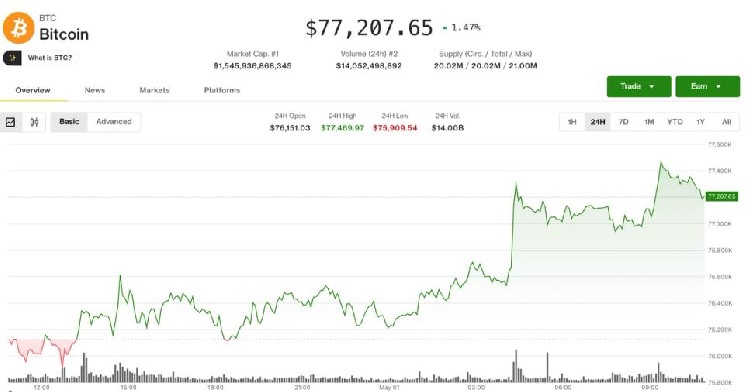
The cryptocurrency market ended the week on a positive note Friday, with Bitcoin climbing 1.25% from midnight UTC to reach $77,250, while the broader CoinDesk 20 Index gained 0.7% with fourteen of its constituent members trading in positive territory. This modest uptick represents a welcome development for traders who have been watching Bitcoin navigate a challenging period of consolidation. The world’s largest cryptocurrency has been finding solid support at the $75,000 level—a price point that previously served as stubborn resistance before Bitcoin managed to break through. Since April 19, the digital asset has been trading within a relatively narrow corridor between $75,000 and $80,000, suggesting the market is taking a breather and consolidating recent gains before potentially making its next significant move. However, not all indicators are flashing green: negative funding rates on futures exchanges reveal that many traders are actually betting on further declines, positioning themselves short despite the recent price stability. This divergence between price action and trader sentiment creates an interesting dynamic that could lead to significant moves in either direction depending on which force ultimately prevails.
Traditional Markets and Commodities Show Mixed Signals
While cryptocurrencies managed to eke out gains, traditional financial markets presented a more muted picture. U.S. equity index futures showed little movement, with Nasdaq 100 futures cooling off following a busy week of Big Tech earnings reports that had captivated investors’ attention. The S&P 500 futures barely moved into positive territory, gaining just five points in a sign that traditional market participants remain cautious about committing significant capital in either direction. The precious metals sector, often viewed as a bellwether for risk sentiment and inflation expectations, experienced modest declines with gold dropping 1% and silver falling 0.7%. These movements in traditional safe-haven assets provide important context for understanding the broader market environment in which cryptocurrencies are operating. The altcoin market, meanwhile, presented a decidedly mixed picture with winners and losers scattered across different sectors. Gaming and layer-one tokens AXS and HYPE both rallied approximately 3%, suggesting continued interest in these specific narratives within the crypto ecosystem. However, decentralized finance (DeFi) tokens MORPHO and AAVE both traded in the red, indicating that not all sectors are participating equally in the market’s modest recovery.
Derivatives Market Reveals Lack of Strong Conviction
A deeper dive into the derivatives market—where sophisticated traders place leveraged bets on future price movements—reveals a market characterized by caution rather than conviction. Open interest in Bitcoin futures remains steady at approximately $19 billion, showing virtually no change from the previous week. This stability in open interest suggests that speculative activity has largely stalled, with traders seemingly content to maintain existing positions rather than aggressively opening new ones. Funding rates, which indicate the cost of maintaining perpetual futures positions, are broadly negative across multiple trading venues at around -2% annualized—a signal that short positions are actually paying long positions, which typically occurs when bearish sentiment prevails. The notable exception to this pattern appeared on Deribit, which experienced an unusual spike to 37%, though this outlier doesn’t change the overall picture of cautious sentiment. The three-month annualized basis sits at 1.5%, essentially flat compared to the previous week, pointing to continued institutional caution about committing capital with strong directional bets. Interestingly, options market sentiment tells a somewhat different story, leaning decidedly bullish: the put/call volume ratio over the past 24 hours favored calls by 58%, meaning more traders were buying upside options than downside protection. Additionally, the one-week delta skew eased from 9.5% to 8.6%, indicating that demand for downside protection has moderated slightly.
Volatility Expectations and Liquidation Landscape
The implied volatility term structure—which shows what levels of price swings options traders expect over different time horizons—currently sits in contango, meaning longer-dated volatility is priced higher than near-term volatility. The front-end of the curve hovers around 29% implied volatility, rising progressively to approximately 45% at the March 2027 tenor. This upward-sloping structure suggests that while the market doesn’t anticipate immediate dramatic price swings or “tail risk” events, there’s significant uncertainty being priced into longer time frames. This could reflect concerns about regulatory developments, macroeconomic conditions, or other factors that might affect crypto markets over the coming years. Data from CoinGlass reveals that $149 million in positions were liquidated over the past 24 hours, with an interesting 30-70 split between long and short positions—meaning short sellers experienced more than twice the liquidations of bullish traders. Bitcoin accounted for $50 million of these forced closures, while Ethereum represented $29 million, demonstrating that these two largest cryptocurrencies continue to dominate trading activity even during periods of relatively modest price movement. The Binance liquidation heatmap—a tool that shows where clusters of leveraged positions might be forced to close—indicates that $75,400 represents a critical level to monitor should prices begin to decline, as a break below this threshold could trigger a cascade of additional liquidations.
Sector Performance and Notable Token Movements
Looking at sector-specific performance provides additional nuance to understanding Friday’s market action. The CoinDesk Memecoin Index emerged as the best-performing benchmark, surging 1.8%—a reminder that the retail-driven, sentiment-focused memecoin sector continues to attract speculative interest despite the broader market’s consolidation phase. The CoinDesk Computing Select Index, which tracks tokens related to decentralized computing and infrastructure, added 1.4%, suggesting continued optimism about the buildout of crypto’s technical foundations. In contrast, CoinDesk’s DeFi Select Index lagged behind its peers and remained essentially unchanged despite the broader market’s positive tone, highlighting that the decentralized finance sector hasn’t yet recaptured the momentum it enjoyed during previous bull cycles. At the individual token level, Monad (MON) led the altcoin market with an impressive 6.7% rally over 24 hours, though without specific catalyst news, such moves often reflect technical trading patterns or sector rotation rather than fundamental developments. Other notable performers included PENDLE, RAY, and TAO, which all gained between 4.2% and 5.35%, demonstrating that opportunity still exists for altcoins to outperform during periods when Bitcoin trades sideways. The day’s notable loser was the DeFi token associated with President Donald Trump’s family, which dropped more than 2.6% since midnight following a governance vote on token lock-ups—an event that apparently disappointed holders. This token has now plummeted more than 77% since its September introduction, serving as a cautionary tale about the risks of politically-themed tokens and the importance of fundamental value propositions beyond celebrity associations.
DeFi Market Shows Strength After Recent Challenges
On a more positive note for the decentralized finance ecosystem, CoinDesk’s Overnight Rate (CDOR)—which tracks lending and borrowing rates on Aave, one of DeFi’s largest and most established protocols—has returned to normal market conditions following the recent KelpDAO security incident. This normalization represents an important sign of resilience and maturity in the DeFi sector, demonstrating that while individual protocol exploits can create temporary disruptions, the broader ecosystem has developed sufficient depth and redundancy to absorb shocks without systemic contagion. The return to normal lending rates suggests that liquidity providers and borrowers have confidence in the security of major protocols and are willing to deploy capital despite occasional setbacks elsewhere in the ecosystem. This resilience becomes particularly important as DeFi continues its evolution from an experimental frontier to a more established component of the cryptocurrency landscape. The sector’s ability to weather individual protocol failures without broader panic or flight to centralized alternatives indicates growing maturity and suggests that the fundamental value proposition of transparent, permissionless financial services continues to resonate with users despite the inherent risks of smart contract systems. As Bitcoin consolidates between key technical levels and the broader crypto market searches for its next directional catalyst, these signs of underlying strength in DeFi infrastructure provide reason for cautious optimism about the sector’s long-term prospects.