



Bitcoin’s Path Forward: Understanding Key Resistance Levels and Market Dynamics
Introduction: A Critical Juncture for Bitcoin Investors
The cryptocurrency market stands at a pivotal moment as Bitcoin navigates through complex price territories that could determine its trajectory for months to come. Seasoned crypto analyst Michaël van de Poppe has provided investors with crucial insights into Bitcoin’s current market structure, identifying specific resistance zones that deserve close attention from both institutional and retail investors alike. His analysis draws upon historical patterns observed across multiple bull cycles, offering a framework for understanding what might lie ahead for the world’s largest cryptocurrency.
Van de Poppe’s assessment comes at a time when market participants are seeking clarity amid uncertain macroeconomic conditions and evolving regulatory landscapes. His observations about Bitcoin’s price behavior around critical technical levels provide valuable perspective for those trying to navigate the often-turbulent waters of cryptocurrency investing. By examining resistance zones through the lens of previous market cycles, Van de Poppe offers a data-driven approach to anticipating Bitcoin’s next moves, rather than relying on speculation or emotional reactions to short-term price fluctuations.
The Critical Resistance Zones: Where Bitcoin Faces Its Next Test
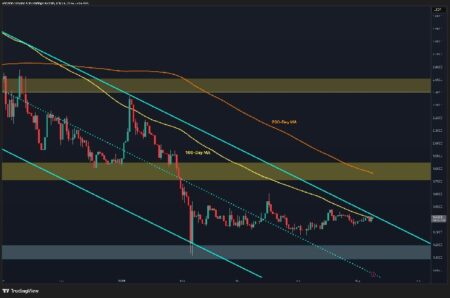
According to Van de Poppe’s technical analysis, Bitcoin currently faces two particularly significant resistance zones that could act as formidable barriers to upward momentum in the short term. The first of these critical levels spans the $86,000 to $88,000 range, representing a zone where selling pressure could intensify as previous buyers look to exit positions or take profits. This range isn’t arbitrary—it reflects a confluence of technical factors including previous support and resistance levels that have historical significance in Bitcoin’s price action.
The second major resistance zone identified by the analyst sits higher, in the $93,000 to $95,000 range. What makes this particular area especially noteworthy is its alignment with the 50-week moving average, a technical indicator that many professional traders and institutional investors monitor closely. The 50-week moving average serves as a longer-term trend indicator, smoothing out short-term volatility to reveal the underlying directional bias of the market. When price approaches this moving average after a significant move, it often encounters resistance as the market tests whether the momentum can continue or whether a period of consolidation or reversal is needed.
These resistance levels aren’t merely theoretical constructs—they represent actual zones where supply and demand dynamics could shift dramatically. At these price points, holders who purchased at higher levels during previous rallies might finally see an opportunity to break even or minimize losses, potentially flooding the market with sell orders. Simultaneously, new buyers may hesitate to enter the market at these elevated levels, creating an imbalance between buying and selling pressure that manifests as resistance. Understanding these dynamics helps investors prepare mentally and strategically for potential price stagnation or volatility at these levels.
Historical Patterns: Lessons from Previous Bull Cycles
One of the most compelling aspects of Van de Poppe’s analysis is his reference to historical precedents that support his current assessment. The analyst specifically noted that the pattern of encountering strong resistance around previous support levels or near the 50-week moving average isn’t unique to the current market cycle—it’s a recurring phenomenon that has played out consistently during the major bull cycles of 2017, 2021, and 2024. This historical consistency lends credibility to the analysis and suggests that certain market behaviors tend to repeat themselves despite changing external circumstances.
During the 2017 bull run, which saw Bitcoin eventually reach nearly $20,000, the cryptocurrency experienced similar consolidation phases when it encountered significant resistance levels. These periods of sideways price action, while frustrating for impatient investors, actually served an important market function by allowing the asset to build a stronger foundation for subsequent moves higher. The 2021 cycle demonstrated similar characteristics, with Bitcoin pausing at key technical levels before ultimately surging to its then-all-time high above $60,000. The pattern repeated again in 2024, reinforcing the idea that these aren’t random occurrences but rather predictable elements of Bitcoin’s market structure.
What makes these historical comparisons particularly valuable is that they help set realistic expectations for current market participants. New investors in the cryptocurrency space often expect continuous upward movement during bull markets, becoming discouraged or panicked when prices stall or pull back. However, understanding that consolidation at resistance levels is a normal and healthy part of bull market progression can help investors maintain perspective and avoid making emotional decisions based on short-term price action. Van de Poppe’s historical analysis serves as a reminder that patience is often rewarded in cryptocurrency markets, and that periods of apparent stagnation can actually be setting the stage for the next leg higher.
Potential Consolidation and Implications for the Broader Market
Van de Poppe’s analysis suggests that Bitcoin could enter a period of sideways consolidation as it works through these resistance zones, potentially lasting several weeks. This anticipated consolidation phase represents more than just a pause in Bitcoin’s price action—it could have significant implications for the broader cryptocurrency ecosystem, particularly for alternative cryptocurrencies commonly referred to as “altcoins.” During periods when Bitcoin’s price stabilizes or moves sideways, market dynamics often shift in ways that benefit smaller cryptocurrencies.
The relationship between Bitcoin’s price action and altcoin performance is one of the most fascinating aspects of cryptocurrency market cycles. When Bitcoin is surging rapidly, it tends to dominate market attention and capital flows, with investors focusing their resources on capturing gains from the leading cryptocurrency. However, when Bitcoin enters consolidation phases, traders and investors often begin rotating capital into altcoins, searching for opportunities that might deliver stronger percentage gains than Bitcoin in the short term. Van de Poppe’s analysis specifically argues that the consolidation he anticipates at current resistance levels could create favorable conditions for renewed strength in the altcoin market.
This potential scenario offers strategic opportunities for diversified cryptocurrency investors. Those holding positions in quality altcoin projects might see a window of opportunity for these assets to outperform Bitcoin during a consolidation phase. However, this dynamic also carries risks—if Bitcoin were to break down significantly rather than consolidating, altcoins typically suffer even more dramatic losses due to their higher volatility. Therefore, while the potential for altcoin strength during Bitcoin consolidation is real, it requires careful position management and risk awareness. Investors should remember that altcoins generally follow Bitcoin’s lead over longer timeframes, meaning that sustainable altcoin rallies typically require at least a stable or rising Bitcoin price.
The Possibility of a Pullback: Preparing for Multiple Scenarios
While Van de Poppe maintains an overall bullish outlook on Bitcoin’s long-term prospects, his analysis doesn’t shy away from discussing less optimistic short-term scenarios. The analyst has specifically mentioned the possibility that Bitcoin could experience a pullback toward the $70,000 to $75,000 range following its interactions with the resistance zones he’s identified. This acknowledgment of downside risk is an important element of responsible market analysis, reminding investors that upward movement is never guaranteed and that preparing for multiple scenarios is essential for long-term success.
A pullback to the $70,000-$75,000 range would represent a significant correction from current levels, potentially shaking out leveraged positions and testing the resolve of recent buyers. However, within the context of Van de Poppe’s broader analysis, such a move wouldn’t necessarily signal the end of the bull market or a return to bearish conditions. Instead, it could represent a healthy correction that builds a stronger foundation for future growth. Markets rarely move in straight lines, and corrections that revisit previous support levels often create buying opportunities for patient investors while also reducing the risk of overheated conditions that could lead to more dramatic crashes.
The key question for investors facing the possibility of such a pullback is how to position themselves appropriately. Conservative approaches might involve taking some profits at current levels or near identified resistance zones, while maintaining exposure to participate in potential further upside. More aggressive strategies might involve attempting to trade the volatility, though this approach carries substantially higher risk. Perhaps most importantly, investors should clarify their own time horizons and risk tolerance—those with multi-year investment horizons might view any significant pullback as a buying opportunity rather than a reason for concern, while shorter-term traders might see it as a signal to reduce exposure temporarily.
The Bigger Picture: A Bullish Long-Term Outlook Despite Short-Term Uncertainty
Despite acknowledging the possibility of near-term consolidation or pullbacks, Van de Poppe’s overall assessment of the market remains decidedly optimistic. The analyst has stated his belief that current price levels represent the bottom of what had been a long-term bear market, and that the overall market outlook has once again shifted to bullish. This perspective is crucial for investors to understand—short-term price fluctuations and technical resistance levels, while important for tactical decisions, don’t necessarily change the fundamental trajectory of the market over longer timeframes.
Van de Poppe’s bullish long-term view appears to be rooted in both technical analysis and broader market cycle theory. Bitcoin and the cryptocurrency market more broadly have historically moved in multi-year cycles, with extended bear markets followed by powerful bull markets that ultimately carry prices to new all-time highs. If the market has indeed completed a bear market bottom and entered a new bull phase, then the resistance levels and potential pullbacks discussed in the analyst’s short-term outlook become tactical considerations rather than strategic concerns. For investors with conviction in cryptocurrency’s long-term value proposition, periods of consolidation or correction might represent opportunities to accumulate positions at more favorable prices.
It’s important to note that while Van de Poppe’s analysis provides valuable insights and framework for thinking about Bitcoin’s price action, it explicitly does not constitute investment advice. Every investor must conduct their own research, understand their personal financial situation, and make decisions appropriate to their individual circumstances. Market analysis, no matter how sophisticated, cannot predict the future with certainty, and cryptocurrency investments carry substantial risks including the potential for total loss of capital. However, for those choosing to participate in cryptocurrency markets, understanding technical levels, historical patterns, and market cycles provides a more informed foundation for decision-making than acting on emotions or following hype. As Bitcoin navigates these critical resistance zones in the coming weeks and months, Van de Poppe’s framework offers a rational lens through which to interpret price action and maintain perspective amid the inevitable volatility that characterizes cryptocurrency markets.