



Federal Reserve’s Cautious Stance Shakes Financial Markets: What It Means for Investors
The Fed Holds Steady: Understanding Yesterday’s Decision
Last night, the United States Federal Reserve made a decision that, while anticipated by many market observers, carried significant implications for investors across various asset classes. The Federal Reserve opted to maintain interest rates at their current levels, a move that had been widely expected by economists and market analysts. However, what truly captured the attention of financial markets wasn’t the decision itself, but rather the accompanying commentary from Federal Reserve Chairman Jerome Powell. His carefully chosen words during the post-decision remarks painted a picture of a central bank that remains deeply concerned about inflationary pressures and is willing to keep all policy tools on the table to combat them. Powell’s statements made it abundantly clear that the Fed is not rushing toward interest rate cuts, contrary to what many investors had been hoping for. Instead, the central bank is maintaining a vigilant, data-driven approach that prioritizes economic stability over market expectations.
What made Powell’s remarks particularly noteworthy was his revelation that Federal Reserve policymakers had actually discussed the possibility of raising interest rates at their most recent meeting. This disclosure caught many off guard, as it suggested that the Fed sees potential inflationary risks that might require even tighter monetary policy rather than the loosening that markets had been anticipating. This two-pronged consideration—keeping both rate cuts and rate increases as viable options—demonstrates the Fed’s commitment to responding flexibly to economic conditions as they evolve. The central bank’s forward guidance also included projections for future rate cuts, but these were spaced remarkably far apart, with only one cut anticipated in 2026 and another in 2027. This timeline extends far beyond what many market participants had been hoping for and signals that the Fed expects to maintain restrictive monetary policy for an extended period.
Cryptocurrency Markets Bear the Brunt of Fed Caution
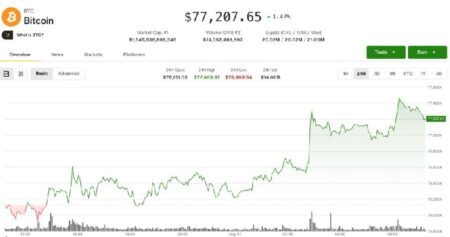
The cryptocurrency market, which has become increasingly sensitive to Federal Reserve policy decisions in recent years, experienced immediate and severe reactions to Powell’s hawkish tone. The digital asset space, which had been enjoying a period of relative strength and optimism, saw more than $100 billion in market capitalization evaporate within just 24 hours following the Fed announcement. This massive wealth destruction underscored just how dependent cryptocurrency valuations have become on broader macroeconomic conditions and monetary policy expectations. Bitcoin, the flagship cryptocurrency and bellwether for the entire digital asset ecosystem, experienced particularly volatile trading following the Fed’s decision. After climbing above the psychologically important $76,000 level in the previous trading session, Bitcoin reversed course dramatically, plunging below $70,000 as investors reassessed their positions in light of the Fed’s cautious stance on interest rates.
The selloff wasn’t limited to Bitcoin alone; the broader cryptocurrency market experienced widespread losses as investors fled riskier assets in response to the prospect of prolonged higher interest rates. Major alternative cryptocurrencies, commonly referred to as altcoins, suffered significant declines that in some cases exceeded Bitcoin’s losses. Ethereum, the second-largest cryptocurrency by market capitalization and the foundation for much of the decentralized finance ecosystem, fell alongside other prominent digital assets. Solana, which has positioned itself as a faster and more efficient alternative to Ethereum, and XRP, which has been gaining attention due to ongoing regulatory developments, both experienced losses in the 5-6% range. These declines reflected a broad-based risk-off sentiment that gripped cryptocurrency markets as traders digested the implications of potentially higher-for-longer interest rates.
The Leveraged Trading Massacre: Liquidations Reach Staggering Levels
One of the most dramatic consequences of the Fed-induced market volatility was the massive wave of liquidations that swept through cryptocurrency derivatives markets. According to comprehensive data compiled by Coinglass, a leading cryptocurrency analytics platform, the total value of liquidated positions reached an eye-watering $581 million within a 24-hour period. This figure represents the destruction of leveraged trading positions that were unable to meet margin requirements as prices moved against traders’ expectations. The breakdown of these liquidations tells a particularly painful story for bullish traders: an overwhelming $491.2 million came from long positions—traders who had bet on prices rising—while only $89.7 million came from short positions. This lopsided distribution of liquidations indicates that the market had been positioned quite optimistically before the Fed announcement, with many traders using borrowed funds to amplify their bets on rising cryptocurrency prices.
The magnitude of these liquidations serves as a stark reminder of the risks associated with leveraged trading, particularly in volatile markets like cryptocurrencies. When traders use leverage, they borrow funds to increase their position size, which amplifies both potential gains and potential losses. In rapidly moving markets, these leveraged positions can be automatically closed out by exchanges when losses exceed a certain threshold, triggering what’s known as a liquidation cascade. As prices fall and liquidations occur, the forced selling can push prices even lower, triggering additional liquidations in a self-reinforcing cycle. This phenomenon likely contributed to the severity of the price declines observed across cryptocurrency markets following the Fed announcement, as algorithmic liquidations added selling pressure beyond what organic market participants were generating.
Traditional Safe Havens Also Crumble Under Fed Pressure
The Federal Reserve’s hawkish stance didn’t confine its impact to the cryptocurrency sphere; traditional precious metals markets also experienced significant turbulence. Gold, long considered the ultimate safe-haven asset and a store of value during times of economic uncertainty, fell victim to the same forces that pressured cryptocurrencies. According to data shared by Lookonchain, a respected cryptocurrency and financial markets analytics platform, spot gold prices tumbled to approximately $4,700 per ounce, marking a decline of around 2% for the day. This price level represented the lowest point gold had reached since February 6th, breaking through technical support levels that many traders had expected to hold. The decline in gold prices might seem counterintuitive at first glance, as one might expect uncertainty and caution to drive investors toward traditional safe havens.
However, the relationship between Federal Reserve policy and gold prices is more complex than simple safe-haven dynamics. Gold pays no interest or dividends, making it less attractive relative to interest-bearing assets when interest rates are high or expected to remain elevated. When the Fed signals that it will maintain higher interest rates for longer, the opportunity cost of holding gold increases, as investors can earn attractive returns from safer alternatives like Treasury bonds. This dynamic helps explain why gold fell despite the overall sense of caution emanating from the Fed. Silver, gold’s more industrially-oriented precious metals cousin, experienced even more dramatic declines. Spot silver prices plunged below $70 per ounce on March 19th, with intraday losses exceeding 7%. Like gold, silver reached its lowest level since February 6th, demonstrating that the Fed’s policy stance was exerting broad pressure across multiple asset classes that had previously been performing well.
Understanding the Fed’s Data-Dependent Approach
The Federal Reserve’s current policy stance represents what financial professionals call a “data-dependent” approach to monetary policy. Rather than committing to a predetermined path of interest rate changes, the Fed is signaling that it will adjust policy in response to incoming economic data, particularly inflation metrics. This approach offers the central bank maximum flexibility to respond to changing economic conditions, but it also creates significant uncertainty for market participants who must make investment decisions without clear forward guidance. Jerome Powell’s comments about considering both rate increases and rate decreases at recent meetings underscore this flexible, reactive posture. The Fed is essentially telling markets that it hasn’t made up its mind about the future direction of policy because it genuinely doesn’t know what the data will show in coming months.
This uncertainty is particularly challenging for risk assets like cryptocurrencies and growth stocks, which tend to perform best in environments of falling interest rates and ample liquidity. When the Fed was aggressively cutting rates or maintaining ultra-low rates with quantitative easing, capital flowed freely into speculative investments, driving valuations higher. The current environment represents the opposite dynamic: the Fed is maintaining restrictive policy with the explicit goal of cooling economic activity and bringing inflation under control. For investors, this creates a difficult environment where traditional relationships between assets may not hold, and where sudden policy shifts could trigger rapid repricing across multiple markets simultaneously. The Fed’s projection of only one rate cut in 2026 and another in 2027 suggests that this challenging environment could persist for years, fundamentally altering the landscape for investment strategies that worked well during the previous era of ultra-low rates.
What This Means for Investors Going Forward
For investors navigating these turbulent waters, several important lessons emerge from the Fed’s latest policy communication and the market reactions that followed. First and foremost, it’s crucial to recognize that this information should not be construed as investment advice—individual investors should always consult with qualified financial professionals before making investment decisions based on their personal circumstances, risk tolerance, and financial goals. That said, the recent events highlight the continued importance of Federal Reserve policy as a dominant force shaping financial market performance across virtually all asset classes. The days when cryptocurrency enthusiasts could dismiss macroeconomic factors as irrelevant to digital asset valuations are clearly over; cryptocurrencies now rise and fall in tandem with traditional risk assets in response to monetary policy signals.
The severity of the market reactions also underscores the dangers of excessive leverage and the importance of risk management in volatile markets. The hundreds of millions of dollars in liquidated positions represent real losses for traders who may have been over-extended, using borrowed money to amplify their market exposure beyond prudent levels. For longer-term investors, the Fed’s cautious stance suggests that patience may be required before the next sustained bull market in risk assets emerges. If the central bank maintains restrictive policy for the extended timeline it has outlined, markets may face a prolonged period of volatility and range-bound trading rather than the steady upward trajectory that characterized much of the post-2009 period. Diversification across asset classes, maintaining adequate liquidity for unexpected needs, and avoiding excessive concentration in any single investment theme become even more critical in this environment. The synchronized decline in cryptocurrencies, gold, and silver following the Fed announcement demonstrates that traditional diversification strategies may offer less protection than expected when monetary policy shifts drive broad market movements.