


Market Sentiment Shifts: What Prediction Markets Say About Crypto’s Near-Term Future
The Rollercoaster Ride Continues for Digital Assets
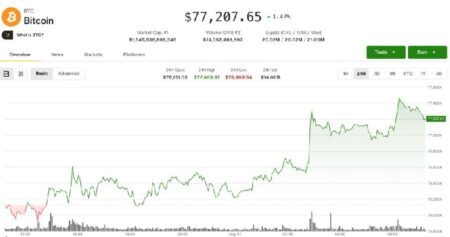
The cryptocurrency market has been keeping investors on their toes lately, delivering the kind of volatility that has become synonymous with digital assets. Last week brought a welcome relief for those who had been watching their portfolios shrink since October, as Bitcoin and the broader altcoin market staged an impressive comeback. Bitcoin, the flagship cryptocurrency, momentarily broke through the psychologically significant $76,000 threshold, sparking optimism among traders and enthusiasts alike. However, true to crypto’s unpredictable nature, this euphoric moment proved fleeting. The rally lost steam almost as quickly as it began, with Bitcoin retreating to settle around the $71,000 mark. This quick reversal serves as a reminder of the market’s inherent unpredictability and the challenges investors face in navigating these turbulent waters. Despite the recovery from October’s lows, the inability to maintain higher price levels has left many wondering whether this was merely a temporary bounce or the beginning of a more sustained upward trend.
Competing Narratives and Market Uncertainty
In the aftermath of these price swings, the cryptocurrency community finds itself divided between two camps with vastly different visions of what lies ahead. On one side, bullish analysts and traders point to various technical indicators, adoption metrics, and macroeconomic factors that they believe will push prices higher in the coming weeks and months. They see the recent dip as nothing more than a healthy correction within a larger upward trend. On the other side, bearish voices warn of potential further declines, citing concerns about regulatory headwinds, market overvaluation, or broader economic uncertainties that could weigh on risk assets like cryptocurrencies. This tug-of-war between optimism and pessimism is nothing new in the crypto space, where passionate believers and skeptical critics have long battled over the future direction of digital assets. What makes the current moment particularly interesting, however, is that we now have sophisticated prediction markets like Polymarket that can aggregate these diverse opinions into concrete probability estimates, giving us a unique window into collective market expectations.
Bitcoin’s Uncertain Path Forward
When we look at what traders are actually betting on through Polymarket, a fascinating picture emerges for Bitcoin. The prediction market data reveals that the crowd is leaning toward caution in the near term, specifically for March. The most popular bet, capturing 35% of the probability weight, is that Bitcoin will fall below $65,000 sometime during the month. This represents a decline of roughly 8-10% from current levels and suggests that many investors are bracing for continued downward pressure. Interestingly, the second most likely scenario, with 22% probability, sits at the opposite end of the spectrum—Bitcoin surging above $80,000. This split reflects the genuine uncertainty in the market, where participants acknowledge that dramatic moves in either direction remain possible. Perhaps most telling is that the probability of a more severe decline—Bitcoin dropping below $60,000—sits at just 14%, suggesting that while traders expect some downside, they don’t anticipate a catastrophic collapse. This nuanced probability distribution illustrates that the market isn’t uniformly bearish or bullish but rather acknowledging the wide range of possible outcomes that could unfold over the coming weeks.
Ethereum Shows More Optimistic Expectations
The story looks considerably brighter when we turn our attention to Ethereum, the second-largest cryptocurrency by market capitalization. Here, the prediction market reveals a notably more optimistic sentiment among traders. The dominant scenario, commanding a substantial 53% probability, has Ethereum trading above $2,400 in March. This represents a vote of confidence in Ethereum’s ability to maintain or improve upon recent price levels. Building on this optimism, there’s a 23% probability assigned to Ethereum climbing even higher, above $2,600. These two scenarios combined suggest that roughly three-quarters of prediction market participants expect Ethereum to either hold steady or move higher in the coming weeks. The bearish scenarios carry much less weight in the collective consciousness—only 8% probability is assigned to Ethereum either surging above $2,800 or falling below $1,800, and a mere 3% probability is given to the cryptocurrency breaking above the $3,000 mark. This distribution suggests that while traders are generally positive on Ethereum’s near-term prospects, they also recognize that the path forward will likely be gradual rather than explosive, with most expectations clustering in the $2,400-$2,600 range rather than anticipating dramatic breakouts to new highs.
Solana Faces a Crossroads
Solana, which has emerged as one of the most closely watched altcoins in recent years due to its high-performance blockchain and growing ecosystem of decentralized applications, presents perhaps the most interesting case study in current market sentiment. The prediction market data reveals a community that’s genuinely split on where SOL is headed in March. The slightly dominant scenario, with 43% probability, has Solana trading below $80—a bearish outcome that would represent continued pressure on the token. However, running almost neck-and-neck with this bearish view is the scenario of Solana climbing above $100, which carries a 41% probability. This near-even split between these two opposing outcomes illustrates just how uncertain traders are about Solana’s immediate future. There’s clearly a battle playing out between those who see further downside and those who believe the cryptocurrency is poised for a rebound. Adding another layer to this picture, 18% of the probability is assigned to Solana surging even higher, above $110. This distribution suggests that while opinion is divided, there’s a slight lean toward caution, with the combined probability of outcomes below $100 (43%) slightly exceeding the combined probability of outcomes above $100 (41% + 18% = 59%). Still, the closeness of these figures indicates that any number of catalysts—positive or negative—could tip the scales decisively in either direction.
Reading the Tea Leaves: What This Means for Investors
As we digest these prediction market insights, it’s crucial to maintain perspective on what they do and don’t tell us. These probability estimates represent a fascinating aggregation of collective wisdom from traders who are literally putting money behind their beliefs, which gives them more weight than casual opinions expressed on social media or in comment sections. However, they are not crystal balls, and the cryptocurrency market has repeatedly demonstrated its ability to defy even the most confident predictions. The data does suggest that for the immediate future—specifically March—traders are adopting a somewhat cautious stance, particularly regarding Bitcoin and Solana, while maintaining relatively more confidence in Ethereum’s stability. This cautious optimism (or optimistic caution, depending on how you look at it) likely reflects the complex interplay of factors currently influencing the market: recovering from October’s decline, uncertainty about broader economic conditions, anticipation of potential regulatory developments, and the ever-present technical factors that drive short-term price movements. For individual investors, this information should serve as one data point among many in their decision-making process. It’s worth noting that prediction markets have been wrong before, sometimes spectacularly so, but they do offer valuable insight into what informed participants actually expect rather than what they hope for or fear. As always in the volatile world of cryptocurrency, caution, diversification, and personal research remain essential. The disclaimer that this information does not constitute investment advice isn’t just legal boilerplate—it’s a genuine reminder that in markets as unpredictable as crypto, even the smartest predictions can be upended by tomorrow’s news.