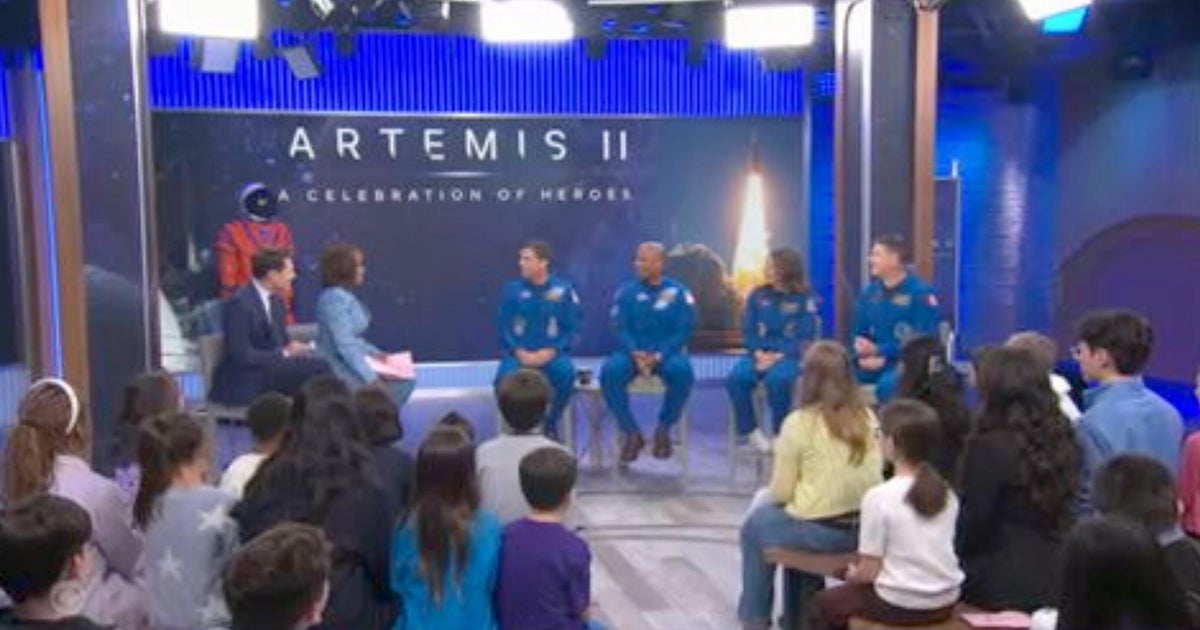

The Artemis II Astronauts Share Their Historic Journey: A Celebration of Heroes
The Ultimate Thrill Ride: Returning to Earth
Canadian astronaut Jeremy Hansen found the perfect way to describe the crew’s dramatic return to Earth after their historic journey around the moon – comparing it to “the best roller coaster ride you’ve ever been on.” Speaking at a special CBS Mornings town hall event titled “Artemis II: A Celebration of Heroes,” Hansen painted a vivid picture of their re-entry experience that captivated an audience of young students eager to learn about space exploration. The landing sequence was nothing short of spectacular, filled with intense visual phenomena and physical sensations that pushed the limits of human experience. Hansen described seeing plasma forming outside the spacecraft windows, creating a mesmerizing fireball that shifted colors from red to blue to green, resembling someone welding with brilliant flashes of light. The astronauts were subjected to tremendous G-forces that pushed them back into their seats while being “thrashed around” during the descent. Despite the intense physical challenges, Hansen characterized the entire experience as “really exhilarating.” Mission specialist Christina Koch shared his enthusiasm, describing her feelings at splashdown as complete elation and overwhelming joy. The two astronauts even managed to fist-bump each other during the final moments of their journey, a gesture that perfectly captured their triumph and camaraderie.
A Historic Mission Comes Full Circle
On April 10th, the four-member crew of Artemis II completed their groundbreaking mission when their Orion capsule splashed down in the Pacific Ocean off the coast of San Diego. The crew consisted of Commander Reid Wiseman, pilot Victor Glover, and mission specialists Christina Koch and Jeremy Hansen, who together made history by traveling farther from Earth than any humans before them. Their journey covered an astounding 700,000 miles and lasted just over a week, during which they became the first humans to witness certain parts of the moon’s far side with their own eyes. They also experienced the rare phenomenon of viewing a solar eclipse from deep space, watching as the moon passed between their spacecraft and the sun, creating an ethereal glow around the entire lunar horizon. The mission represented a monumental achievement in human space exploration, marking the return of crewed missions beyond low Earth orbit after decades. The Friday town hall brought together not just the astronauts but also special guests including Ron Howard, the acclaimed director of “Apollo 13,” and Bill Nye “The Science Guy,” who serves as chief ambassador of The Planetary Society. Perhaps most memorably, the crew got to meet Jack, a five-year-old aspiring astronaut from Atlanta who had gone viral for his infectious enthusiasm while watching the launch.
Bonding Moments and Simple Pleasures
One of the most endearing stories from the mission came from Commander Reid Wiseman, who shared a touching moment of crew bonding immediately after splashdown. While floating in the Pacific Ocean, waiting for rescue crews to arrive and open the hatch of their spacecraft, Christina Koch surprised her crewmates by pulling out a bag of peanut M&Ms from her spacesuit pocket. The four astronauts, who had just completed one of the most ambitious space missions in history, found themselves leaning against the side of their spacecraft, casually eating candy and basking in the satisfaction of their accomplishment. This simple, human moment perfectly illustrated how even the most extraordinary achievements are punctuated by ordinary pleasures. The image of four space explorers, fresh from circling the moon, sharing M&Ms while bobbing in the ocean waiting for pickup, serves as a reminder that astronauts, despite their incredible achievements, remain fundamentally human. These moments of levity and camaraderie were essential to the crew’s success, providing relief from the intense pressures and challenges they faced throughout their mission. The story resonated with the student audience, showing that space exploration, while serious and dangerous, also includes moments of joy and connection.
Adjusting to Life With and Without Gravity
When an 18-year-old student named Levi asked about their favorite thing about gravity that they missed in space, Jeremy Hansen’s answer surprised many. He honestly couldn’t think of anything he missed about gravity, declaring that he had “the most amazing time in microgravity.” Hansen enthusiastically encouraged anyone who gets the chance to experience microgravity to take it, calling it “so much fun.” He acknowledged that certain everyday tasks become more challenging without gravity – doing chores, using the restroom, and other routine activities require different approaches in space. However, he emphasized that these inconveniences were “just so worth it” for the incredible experience of floating freely. Christina Koch provided insight into the opposite challenge: readjusting to Earth’s gravity after spending more than a week in space. She explained how the human body adapts remarkably quickly to microgravity, causing disorientation when gravity returns. The astronauts needed time to relearn basic skills like walking and maintaining balance because their bodies had adapted to orienting themselves without gravitational reference. Fortunately, because their mission lasted only nine days – relatively short compared to months-long stays on the International Space Station – their readjustment period was manageable. Koch, who holds the record for the longest single spaceflight by a female astronaut at 11 months, had unique perspective on this adjustment process, having experienced both short and extended duration missions.
Crisis Management and Critical Decisions in Space
When 13-year-old Piya asked about the toughest decision the crew had to make during their mission, Commander Wiseman shared a harrowing story that highlighted the dangers of space exploration and the importance of training and teamwork. In the middle of the night, all four sleeping astronauts were jolted awake by what’s called a “run box warning” – a critical alarm indicating that fuel was potentially leaking from their spacecraft. Because this was the first crewed flight of this particular spacecraft design, they were essentially test pilots encountering unknown scenarios. Wiseman described the scene: all four astronauts floating in their sleeping bags when the dramatic alarm sounded, immediately grabbing everyone’s attention. The situation was particularly serious because fuel loss in space could leave them stranded or unable to complete critical maneuvers. Jeremy Hansen, who was sleeping near the control system, immediately moved into position and began preparing to execute emergency procedures that would shut down the fuel system to preserve whatever propellant remained in the spacecraft. However, the crew noticed something unusual – the alarm was intermittently turning on and off rather than staying constantly illuminated as would be expected with an actual fuel leak. In those critical moments, the crew had to make a difficult decision: follow standard emergency procedures that would shut down their entire fuel system, or trust their training and judgment that something else was happening. After rapid discussion and analysis, they chose not to execute the shutdown procedures. This decision to not act – to hold back and assess rather than immediately respond – turned out to be correct, demonstrating that sometimes the hardest and most important decisions involve restraint rather than action.
Teamwork, Inspiration, and the Future of Space Exploration
When 17-year-old Lizzy asked about the role of teamwork in mission success, Christina Koch emphasized that teamwork wasn’t just important – it was everything. She pointed out that the real heroes of Artemis II weren’t just the four astronauts who flew around the moon, but the countless engineers, scientists, mission controllers, and support personnel who worked for years on the ground to make the mission possible. Koch noted that in human spaceflight, as in most worthwhile endeavors, individual achievement is impossible without collective effort. She reflected on how witnessing the most amazing sights in the universe had a humbling effect, making the crew realize that “we are nothing without each other.” This message particularly resonated with the student audience, many of whom represent the next generation of space explorers. The town hall’s most heartwarming moment came when five-year-old Jack, the aspiring astronaut from Atlanta who had captured hearts nationwide with his enthusiastic reaction to the launch, joined the event. He was presented with his own spacesuit matching the ones worn by the Artemis crew, and his simple declaration – “It says ‘NASA!'” – brought smiles to everyone present. Ron Howard, whose film “Apollo 13” has inspired generations of space enthusiasts, asked the astronauts to compare this mission to longer stays aboard the International Space Station. Koch explained that while ISS missions follow well-established procedures developed over two decades, the Artemis crew had to “figure it out as we went,” working hand-in-hand with engineers as active team members rather than just trainees. Jeremy Hansen shared how “Apollo 13” had guided him throughout his career, particularly the film’s message about perseverance through failure. He emphasized that their success came not from never failing, but from refusing to stop when failures occurred, constantly learning and adapting as a team to overcome challenges together – a fitting message for the young students who may one day follow in their footsteps to the moon and beyond.