

Putin Declares Ukraine War Is “Coming to an End” During Subdued Victory Day Celebration
A Surprising Announcement on Russia’s Most Sacred Military Holiday
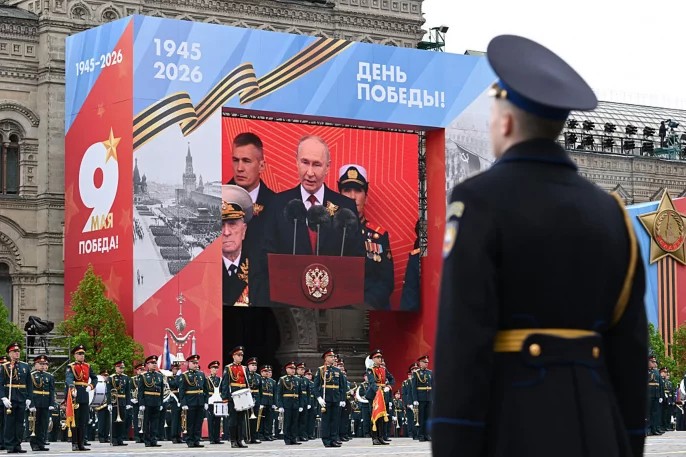
On May 9, 2026, Russian President Vladimir Putin made a cautiously optimistic statement that caught the world’s attention: he believes the war in Ukraine is finally winding down. His remarks came during Russia’s annual Victory Day parade in Moscow, a deeply symbolic event that commemorates the Soviet Union’s triumph over Nazi Germany in World War II. For Russians, this isn’t just another national holiday—it’s a sacred remembrance of the estimated 27 million Soviet citizens who perished during that devastating conflict. The 81st anniversary celebration this year, however, was markedly different from previous years, featuring a noticeably scaled-back military display that seemed to mirror the exhausted state of a nation that has been at war for more than four years. “I think that the matter is coming to an end,” Putin declared, choosing his words carefully while addressing the nation from a platform historically reserved for celebrating military victories. The timing and location of this announcement were far from coincidental, representing a carefully choreographed message to both domestic and international audiences about how Russia wants this painful chapter of its history to be remembered.
The Symbolic Weight of Victory Day and This Year’s Restrained Celebration
Victory Day holds a unique place in the Russian national consciousness, serving as the country’s most important military holiday and a cornerstone of national identity. The parade traditionally showcases Russia’s military might with tanks rolling through Red Square, fighter jets screaming overhead, and thousands of troops marching in perfect formation. It’s a day when the entire nation reflects on the enormous sacrifice made during what Russians call the Great Patriotic War, a conflict that touched virtually every family in the country. This year’s celebration, however, broke from tradition with its notably restrained presentation. While Putin’s remarks didn’t explicitly explain why the parade was scaled back, the reduced spectacle spoke volumes about Russia’s current circumstances. After more than four years of grinding warfare in Ukraine, the contrast between celebrating past military glory and acknowledging present military struggles created an almost uncomfortable tension. The decision to tone down the usual triumphalist display might reflect practical constraints—military resources diverted to the ongoing conflict—or it could represent a more nuanced messaging strategy, acknowledging that modern warfare doesn’t lend itself to the same kind of clear-cut victory narratives that defined World War II.
A Fragile Three-Day Ceasefire Offers a Glimmer of Hope
Coinciding with Putin’s statement and the Victory Day parade, US President Donald Trump announced a three-day ceasefire that would take effect on May 9. While three days might seem insignificant in the context of a war that has stretched across more than 1,500 days, the ceasefire carried symbolic importance and at least one concrete humanitarian benefit. Trump characterized the temporary halt in fighting as potentially the “beginning of the end” of the conflict, echoing Putin’s more cautious phrasing with slightly more optimism. The ceasefire included provisions for prisoner exchanges, with each side agreeing to return 1,000 captured personnel. For the families of these prisoners, this announcement represented the end of an agonizing wait filled with uncertainty about whether their loved ones were even alive. Soldiers who had languished in captivity, often in harsh conditions and cut off from any contact with home, would finally have the chance to return. These 2,000 individuals represent just a fraction of the casualties and displaced persons this war has created, but for each of them and their families, the prisoner exchange means everything—answers to desperate questions, reunions long feared impossible, and the first steps toward rebuilding shattered lives.
The Reality Behind the Rhetoric: A War Without Clear Resolution
Despite the hopeful rhetoric from both Putin and Trump, it’s crucial to understand what this ceasefire actually represents—and what it doesn’t. Russia’s full-scale invasion of Ukraine began in February 2022, launching a conflict that has devastated cities, displaced millions, reshaped European security architecture, and sent economic shockwaves around the globe. A three-day ceasefire is not a peace treaty. It’s not even a comprehensive armistice. It’s a temporary pause, fragile and conditional, that could evaporate as quickly as it materialized. The war has created deep wounds that won’t heal with a simple cessation of hostilities. Entire Ukrainian cities have been reduced to rubble. Millions of people have fled their homes, with many unlikely to return for years, if ever. The economic costs run into the hundreds of billions of dollars. War crimes allegations have created legal and moral complications that will take generations to fully address. Both sides have suffered enormous casualties, though exact numbers remain disputed and obscured by wartime propaganda. The international community has been deeply divided, with Western nations supporting Ukraine while many other countries have tried to remain neutral or have tacitly supported Russia. Against this backdrop, Putin’s carefully worded statement that “the matter is coming to an end” sounds less like a definitive conclusion and more like wishful thinking or strategic positioning.
Putin’s Calculated Message: Victory Day as Political Theater
Putin’s decision to make this announcement on Victory Day, from the platform of Russia’s most important military commemoration, was anything but random. It represents a calculated attempt to shape how Russians—and the world—understand this conflict and its eventual conclusion. By linking the current war in Ukraine to the sacred memory of the Great Patriotic War, Putin is drawing a parallel that suggests Russia is once again defending itself against existential threats, fighting a necessary battle against overwhelming odds, and ultimately destined for victory because that’s what Russia does. This narrative framing matters enormously for domestic political purposes. After four-plus years of war, the Russian population is weary. The economy has been strained by international sanctions and the enormous costs of sustaining military operations. Casualty numbers, while officially downplayed, have affected communities across the country. By suggesting the conflict is “winding down” on Victory Day, Putin is offering his people a narrative bridge between the current difficult reality and a historical tradition of ultimate triumph over adversity. He’s positioning whatever comes next—whether it’s an actual peace deal, a frozen conflict, or something else entirely—as a victory comparable to 1945, regardless of what the actual terms might be. This is political theater at its most deliberate, using historical memory as a tool to shape present-day perceptions and future historical interpretation.
What Comes Next: Uncertain Steps Toward an Unclear Destination
As the three-day ceasefire takes effect and prisoner exchanges begin, the world watches with cautious skepticism mixed with desperate hope. The human dimension of the prisoner returns cannot be understated—1,000 families on each side will experience relief and joy that seemed impossible just days ago. These reunions represent genuinely good news in a conflict that has produced precious little of it. But beyond this humanitarian gesture, the path forward remains shrouded in uncertainty. Will the three-day ceasefire hold? Will it be extended? Can it evolve into more substantive negotiations? What would the terms of an actual peace agreement look like, and would either side accept them? Ukraine has insisted on the return of all its territory, including Crimea, annexed by Russia in 2014. Russia has sought recognition of its territorial gains and security guarantees that effectively limit Ukrainian sovereignty. These positions seem irreconcilable, suggesting that even if active fighting decreases, a genuine resolution remains distant. International involvement from Trump and other world leaders could provide the diplomatic framework necessary for progress, but only if both sides are genuinely ready to make painful compromises. Putin’s statement that the war is “coming to an end” might prove prescient, or it might simply be another chapter in a conflict that continues to defy predictions and resist resolution. For now, the world can only watch, hope, and prepare for whatever comes next in this tragic and transformative conflict.