



Retired Astronauts on the ‘Magical’ Moment They Said Goodbye to Space
The Profound Experience of Leaving the Final Frontier
When astronauts return from space after spending months orbiting Earth, they experience something that only a select few humans will ever know—the bittersweet moment of saying goodbye to the cosmos and hello again to gravity, fresh air, and the familiar pull of home. In a recent conversation with ABC News’ Stephanie Ramos, retired NASA astronauts Cady Coleman and Dr. Scott Parazynski opened up about their deeply personal experiences of leaving space behind and readjusting to life on Earth. Their reflections paint a picture of what it’s like to transition from the extraordinary environment of space back to the ordinary world that most of us inhabit every day. Both astronauts described the return journey as filled with mixed emotions—a cocktail of relief, sadness, wonder, and profound gratitude that lingers long after they’ve touched down on solid ground.
These veteran space travelers have collectively spent significant time aboard the International Space Station (ISS), conducting experiments, performing spacewalks, and experiencing the unique privilege of viewing Earth from hundreds of miles above its surface. Coleman, who spent nearly six months in space during her 2010-2011 mission, and Parazynski, who flew on five shuttle missions and completed challenging spacewalks, both described the moment of leaving orbit as “magical”—a word that might seem simple but captures the complex blend of awe and melancholy that accompanies their final views of space. For these astronauts, the return to Earth wasn’t just a physical journey of re-entry and landing; it was an emotional transition that required them to process the remarkable experience they’d just completed while preparing to rejoin a world that had continued spinning without them.
The Emotional Journey: Between Two Worlds
The emotional landscape of returning from space is far more complex than most people might imagine. Coleman and Parazynski both shared that the descent back to Earth carried a profound sense of loss alongside the anticipation of reunion with loved ones. Coleman described looking out the window during the return journey and feeling a deep connection to the space she was leaving behind—a place that had been her home, her workplace, and her window to the universe for months. “There’s this moment when you realize you’re saying goodbye to something truly special,” she explained, noting that despite the discomfort and challenges of living in microgravity, space becomes a part of you in ways that are difficult to articulate to those who haven’t experienced it.
Dr. Parazynski echoed these sentiments, describing how each return to Earth brought its own unique emotional signature. After his final mission, he felt a particular poignancy knowing that he would never again float weightlessly through the ISS modules or gaze out at Earth’s curve against the black velvet of space. Both astronauts mentioned the peculiar sensation of nostalgia mixed with presence—being physically in the spacecraft heading home while mentally still processing the experiences they’d just lived through. They talked about missing the simplicity of life in space, where your entire world is contained within the station’s walls, where every task has been planned and coordinated, and where the view out the window never fails to take your breath away. Yet simultaneously, they felt a growing excitement about the prospect of hugging family members, feeling rain on their skin, and experiencing the rich sensory diversity of Earth that space simply cannot provide.
Physical Realities: When Your Body Remembers Gravity
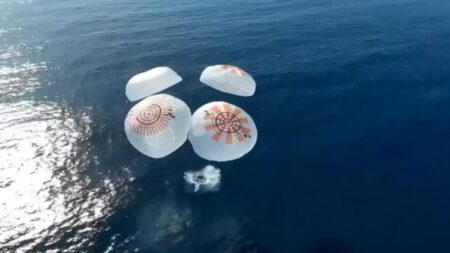
Beyond the emotional adjustment, the physical realities of returning to Earth present their own set of challenges that can be both jarring and humbling for astronauts. Coleman and Parazynski both described the re-entry process and the immediate aftermath of landing as physically demanding in ways that prepare as they might, astronauts can never fully anticipate until they experience it. After months of floating in microgravity, where muscles don’t need to fight against Earth’s pull and where the cardiovascular system adapts to the absence of gravity, the human body undergoes significant changes. When gravity suddenly returns with full force during landing, astronauts must confront the reality that their bodies have temporarily forgotten how to function in Earth’s environment.
Coleman vividly recalled the sensation of her suit and helmet suddenly feeling incredibly heavy during the descent, and the strange experience of her arms falling to her sides when she stopped actively holding them up—something that never happens in microgravity. Parazynski described the immediate post-landing period as disorienting, with the inner ear struggling to recalibrate to Earth’s gravity, making simple movements feel uncoordinated and causing a sensation similar to seasickness. Both astronauts mentioned that standing up for the first time after months in space requires assistance, as the body needs time to remember how to balance and support its own weight. Even something as simple as holding a pen or a cup of coffee requires relearning, as astronauts have spent months adapting to an environment where objects float rather than fall.
The recovery period extends far beyond those first few hours or days. Coleman explained that it took weeks for her body to fully readjust, with muscle soreness, fatigue, and balance issues gradually improving as her system remembered how to function under Earth’s gravitational influence. Parazynski noted that despite rigorous in-flight exercise programs designed to minimize muscle and bone loss, astronauts still experience significant deconditioning that requires dedicated rehabilitation. Yet both astronauts emphasized that these physical challenges were a price they’d gladly pay again for the privilege of experiencing space, describing the discomfort as temporary and manageable compared to the lasting impact of their time in orbit.
The Magic of Perspective: Seeing Earth With New Eyes
Perhaps the most profound and lasting effect of spaceflight, according to both Coleman and Parazynski, is the shift in perspective that comes from seeing Earth from space—an experience that fundamentally changes how astronauts view our planet and their place in the universe. This phenomenon, often called the “overview effect,” describes the cognitive shift that occurs when seeing Earth as a whole, borderless sphere floating in the darkness of space. Both astronauts spoke passionately about how this perspective stays with them long after they’ve returned home, influencing their priorities, their understanding of global issues, and their appreciation for the fragility and interconnectedness of life on our planet.
Coleman described the experience of looking down at Earth and seeing no borders, no divisions between nations, just one beautiful, integrated ecosystem supporting all of humanity. She talked about watching weather systems move across continents, seeing the thin blue line of the atmosphere that protects all life, and recognizing how artificial many of our human-created divisions truly are when viewed from that vantage point. Parazynski shared similar reflections, describing how seeing Earth from space made him acutely aware of the planet’s vulnerability and the urgent need for global cooperation on issues like climate change and resource management. For both astronauts, the return to Earth carried an implicit responsibility—to share this perspective with others and to advocate for the kind of planetary stewardship that their unique viewpoint had shown them was necessary.
This shift in perspective also manifested in more personal ways. Both Coleman and Parazynski mentioned finding themselves more appreciative of Earth’s sensory richness after returning—the smell of flowers, the feeling of wind, the sound of birds, the taste of fresh food. These simple pleasures, taken for granted before spaceflight, became sources of profound joy after months in the sterile, enclosed environment of the space station. They also described a renewed sense of connection to other people and to the natural world, recognizing that all of Earth’s inhabitants share the same small planet and face the same ultimate challenges of survival and flourishing in the cosmic environment.
Life After Space: Carrying the Experience Forward
Transitioning back to regular life on Earth presents its own unique challenges for astronauts, extending far beyond the initial physical readjustment period. Coleman and Parazynski both spoke candidly about the process of integrating their extraordinary experiences into the rhythm of everyday life and finding meaningful ways to carry forward the lessons they learned in space. For many astronauts, the return to Earth raises profound questions: How do you resume normal life after experiencing something so exceptional? How do you make sense of the contrast between the cosmic perspective you’ve gained and the daily concerns that occupy most people’s attention? How do you channel the inspiration and insight from spaceflight into productive work back on the ground?
Both astronauts emphasized that their space experiences continue to shape their post-NASA careers and personal lives in fundamental ways. Coleman has focused on science education and outreach, working to inspire the next generation of explorers and to share the wonder of space with audiences around the world. She described how her time in space gave her a platform and a passion for communicating the importance of STEM education and for encouraging young people, especially girls, to pursue careers in science and engineering. Parazynski, who has transitioned to a career involving exploration in different contexts—including climbing Mount Everest and diving to the deepest parts of the ocean—credits his space experience with instilling a drive to continue pushing boundaries and exploring extreme environments, always seeking new perspectives on our planet and our capabilities as humans.
Both astronauts also stressed the importance of community in processing and integrating the space experience. They described the unique bond shared among astronauts—a small group of people who have experienced something that defies easy explanation and that creates a permanent shift in worldview. This community provides essential support during the readjustment period and throughout their post-space lives, offering a space where the full meaning and emotional weight of their experiences can be understood and shared. Yet both Coleman and Parazynski also emphasized their commitment to sharing aspects of this experience with the broader public, believing that the insights gained from space—about our planet’s fragility, humanity’s potential, and the importance of exploration—are too valuable to remain within the astronaut community alone. Through speaking engagements, educational programs, and advocacy work, they continue to translate their cosmic perspective into language and action that can benefit everyone, helping to bring a piece of that magic back down to Earth for those who will never leave its atmosphere.