



Artemis II: Humanity Returns to the Moon After Five Decades
A Historic Launch Brings Dreams to Life
Wednesday marked a momentous occasion in human space exploration as the Artemis II mission successfully lifted off from Kennedy Space Center in Florida, carrying four astronauts on an extraordinary 10-day journey around the moon. Commander Reid Wiseman, pilot Victor Glover, and mission specialists Christina Koch and Jeremy Hansen blasted off at 6:35 p.m. ET, witnessed by millions around the globe who watched history unfold. This mission represents the first time humans have ventured beyond low-Earth orbit since the legendary Apollo 17 mission touched down on the lunar surface in 1972—a gap of more than five decades. As the massive Space Launch System rocket roared to life, it wasn’t just four individuals ascending into the cosmos; it was humanity’s renewed commitment to exploration, discovery, and pushing the boundaries of what’s possible. The crew is embarking on an ambitious 685,000-mile journey in what’s known as a lunar fly-by, traveling farther from Earth than any humans have in generations and paving the way for future missions that will eventually return astronauts to the moon’s surface.
The Unforgettable Moment of Departure
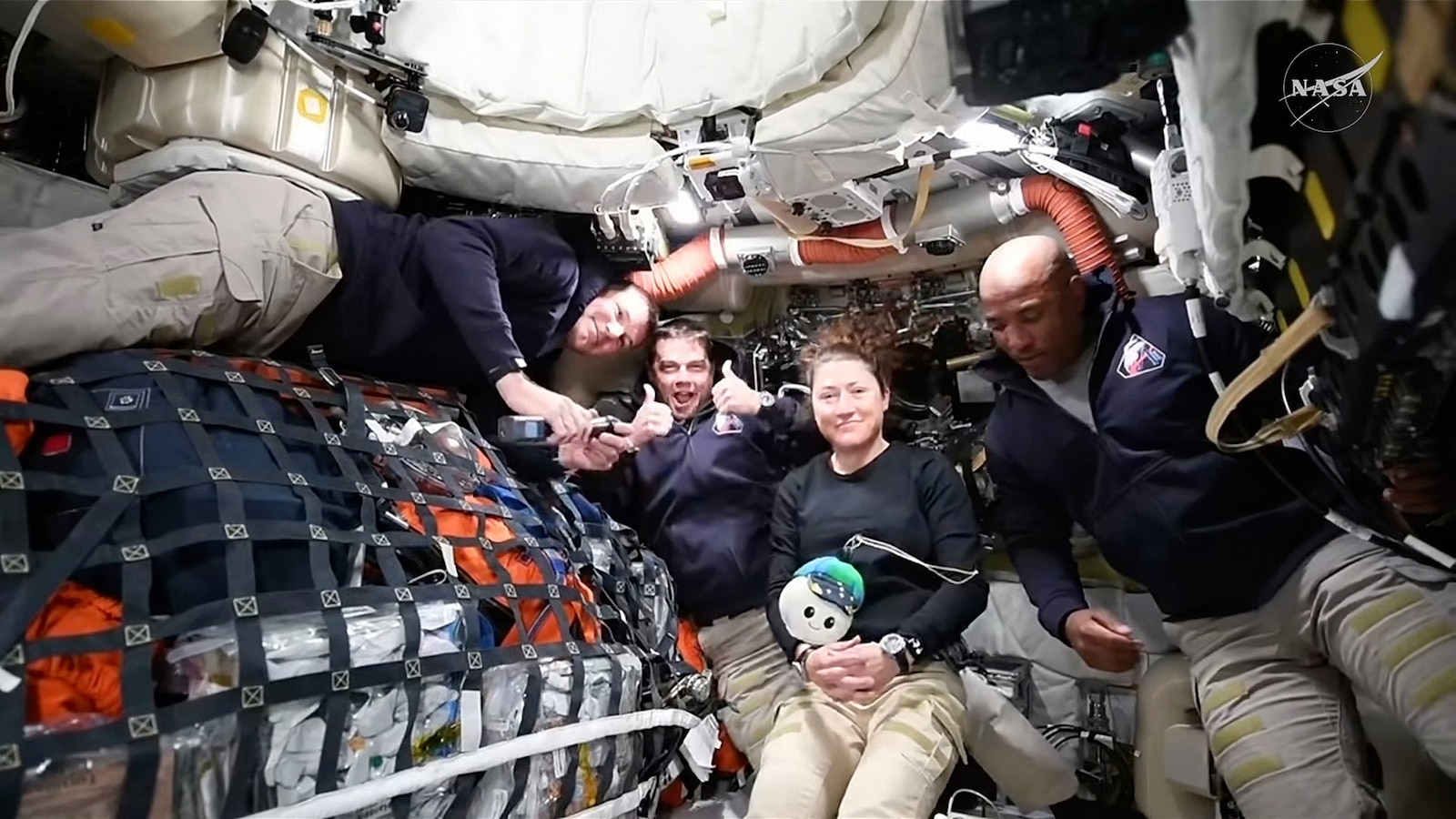
Just a day after their departure, the crew spoke with ABC News correspondent Gio Benitez from their Orion spacecraft, sharing their experiences and emotions from this incredible journey. Canadian Space Agency astronaut Jeremy Hansen captured the surreal nature of launch day perfectly when he described that even though the crew had trained extensively and knew exactly what to expect, the actual moment the rocket boosters ignited and they left the launch pad created “a moment of disbelief.” According to Hansen, despite all the preparation and anticipation, when the launch actually happened, “it just totally takes you by surprise, even though you’re expecting it, at least for me anyway, and just had a huge smile across my face.” This honest reflection reveals the profoundly human side of space exploration—that even the most prepared and trained professionals in the world still experience awe and wonder when facing the extraordinary. The mix of rigorous preparation and childlike excitement perfectly encapsulates what makes these missions so special, reminding us that behind the technical achievements are real people experiencing something almost no one else ever has.
Earth as You’ve Never Seen It Before
Among the most powerful moments shared by the crew was their description of viewing Earth from space—a perspective that only a select few humans have ever experienced. Commander Wiseman spoke about how none of them quite knew what to expect, but the reality exceeded their imaginations: “You could see the entire globe, from pole to pole,” he explained. The crew could see Africa and Europe in a single view, and if they looked carefully, they could even spot the northern lights dancing across the polar regions. Wiseman described it as “the most spectacular moment” that stopped all four astronauts in their tracks, leaving them momentarily speechless despite all their training and preparation. This overview effect—the cognitive shift that astronauts experience when viewing Earth from space—has been described by many space travelers as life-changing, providing a perspective on our planet as a single, fragile entity floating in the vast darkness of space. The ability to see multiple continents simultaneously, to observe natural phenomena like the aurora borealis from above, and to witness our world without the political boundaries we draw on maps creates a profound understanding of our shared humanity and the precious nature of our home planet.
Space Plumbing and Problem-Solving
While space travel involves cutting-edge technology and high-minded scientific goals, the crew’s conversation also touched on more down-to-earth concerns—literally. Christina Koch, who holds the record for the longest single spaceflight by a woman at 328 days, addressed an issue that arose shortly after launch involving the spacecraft’s toilet system. With characteristic good humor, Koch proudly declared herself “the space plumber,” noting that the toilet “is probably the most important piece of equipment on board.” The Universal Waste Management System, as NASA officially calls it, had displayed a blinking fault light during testing, causing understandable concern among the crew. Fortunately, Koch and her colleagues were able to resolve the issue, and as she put it, “we were all breathing a sigh of relief when it turned out to be just fine.” This incident, while seemingly mundane, highlights an important aspect of space exploration that often goes unmentioned: astronauts must be jacks-of-all-trades, capable of solving any problem that arises, whether it involves complex navigation systems or basic plumbing. It’s a reminder that space missions, for all their grandeur and technical sophistication, still depend on fundamental systems working properly, and that the astronauts themselves must be resourceful problem-solvers ready to tackle any challenge that comes their way.
One People, One Planet, One Dream
Perhaps the most moving reflections came from pilot Victor Glover, who is making history as the first person of color to journey to the moon. From high Earth orbit, Glover observed that all the divisions we create on Earth—the borders, boundaries, and separations that often define our terrestrial existence—simply vanish from view. “Trust us, you look amazing, you look beautiful,” Glover said of Earth. “You also look like one thing. Homo sapiens is all of us, no matter where you’re from or what you look like. We’re all one people.” He went on to explain why humanity refers to extraordinary achievements as “moonshots”—because this kind of ambitious endeavor brings people together and demonstrates what we can accomplish when we not only put our differences aside but actively bring them together, using all our collective strengths to achieve something great. Glover’s words carry particular weight given his historic role in this mission and the broader significance of diversity in space exploration. His presence on this crew represents progress and inclusion, showing that space exploration belongs to all of humanity, not just a select few. The message resonates far beyond the confines of the Orion spacecraft: when we work together, when we pool our talents and perspectives, when we focus on common goals rather than our differences, there’s virtually nothing humanity cannot achieve.
A Flawless Trajectory Toward the Moon
Before conducting their interview with ABC News, the Artemis II crew successfully completed one of the mission’s most critical maneuvers—the translunar injection burn. This precisely calculated engine firing boosted the Orion spacecraft out of Earth’s orbit and set it on its trajectory toward the moon, a make-or-break moment that had to be executed perfectly. During a press conference following this milestone, Lori Glaze, acting associate administrator at NASA, described the burn as “flawless,” words that surely brought relief and celebration to mission control and space enthusiasts worldwide. “From this point forward, the laws of orbital mechanics are going to carry our crew to the moon, around the far side and back to Earth,” Glaze explained. This successful maneuver means the crew is now committed to their journey, following a path governed by physics and celestial mechanics that will take them around the far side of the moon—that mysterious region never visible from Earth—before bringing them safely home. The Artemis II mission serves as a crucial stepping stone in NASA’s broader Artemis program, which aims to establish a sustainable human presence on and around the moon, eventually using it as a launching point for missions to Mars and beyond. As Wiseman, Glover, Koch, and Hansen continue their historic journey, they carry with them not just scientific instruments and mission objectives, but humanity’s dreams of exploration, our capacity for wonder, and our hope for a future where the cosmos is within our reach.