


Millions Under Fire Weather Alerts as Dangerous Conditions Sweep Central United States
A Perfect Storm of Fire-Prone Conditions
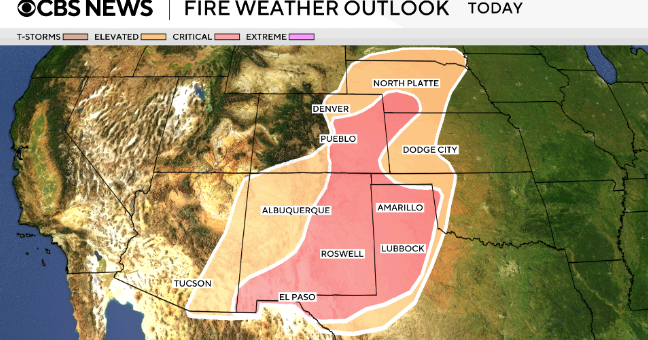
More than 15 million Americans living across the central United States are waking up to a frightening reality this week: they’re living under fire weather alerts that will persist through Friday. It’s not just one weather factor causing concern—it’s a dangerous trio of extreme heat, bone-dry air, and powerful winds that meteorologists say are creating the perfect conditions for wildfires to explode out of control. Among those 15 million people, approximately 3.8 million face what weather experts call “critical fire weather” conditions on Thursday, according to the National Oceanic and Atmospheric Administration’s Storm Prediction Center. This isn’t just another weather advisory to scroll past on your phone—this is a serious warning that conditions are ripe for wildfires to develop rapidly and spread in ways that could be nearly impossible to contain once they start.
Understanding the Geography of Danger
The critical risk zone cuts a wide swath through America’s heartland, affecting major portions of Colorado, Kansas, Nebraska, New Mexico, Oklahoma, and Texas, according to forecasters at the prediction center. But the danger doesn’t stop there—broader sections of these same states, along with parts of Arizona, South Dakota, and Wyoming, are experiencing what meteorologists classify as “elevated fire weather” conditions, which are slightly less severe but still deeply concerning. Several cities with substantial populations find themselves squarely in the danger zone, including Albuquerque, Denver, and El Paso, as well as Amarillo in Texas and Pierre, South Dakota’s capital. For the millions of residents in these areas, the alerts mean taking extra precautions, staying vigilant about any signs of fire, and being prepared to evacuate if authorities issue orders.
What Makes These Conditions So Critical
When meteorologists use the term “critical fire weather conditions,” they’re describing a specific and dangerous combination of environmental factors that create an ideal breeding ground for wildfires. The criteria is straightforward but deadly: high temperatures that dry out vegetation, extremely low humidity that removes moisture from the air and anything it touches, and gusty winds that can carry embers for miles and fan flames to inferno-level intensity. When all three of these elements converge, weather services issue red flag warnings—their way of telling communities that the danger is immediate and real. The National Weather Service explains that these red flag warnings, or the slightly less urgent fire weather watches, go into effect “when the combination of dry fuels and weather conditions support extreme fire danger.” Currently, both types of alerts are active across the middle of the country, with red flag warnings indicating that critical conditions are either happening right now or expected within hours, while fire weather watches signal that these dangerous conditions are coming but remain a bit further out in the forecast.
The Weather Systems Driving the Danger
This particular episode of fire-prone weather isn’t random—it’s being driven by a storm system that’s pushing into the central states on Thursday, according to CBS News meteorologist Nikki Nolan. This system is bringing with it wind gusts that could reach 50 to 60 miles per hour across the Southern Plains, powerful enough to knock down tree limbs and send sparks flying for miles if a fire ignites. At the same time, relative humidity values in the region are expected to plummet to single-digit percentages, meaning the air will be extraordinarily dry—so dry that any moisture in vegetation, dead leaves, or even wooden structures will be sucked away, leaving everything vulnerable to combustion. Making matters worse, these dangerous conditions are layering on top of widespread warmth blanketing the central and eastern United States on Thursday. Temperatures are forecast to soar between 15 and 25 degrees above what’s considered normal for this time of year, depending on the specific location. This unseasonable heat further dries out the landscape and creates what fire experts describe as a tinderbox environment.
Why “Extreme” Fire Danger Means Real Threat
The fire danger assessment isn’t being labeled as “extreme” for dramatic effect—it’s a technical designation that means wildfires, if they develop, can grow with frightening speed and spread in ways that are virtually impossible to control. When fires ignite in these conditions, they don’t smolder or advance slowly, giving firefighters time to build containment lines. Instead, they explode across the landscape, jumping roads and firebreaks, spotting new fires miles ahead of the main blaze through windborne embers, and overwhelming suppression efforts despite the best equipment and most experienced crews. The dry, arid land that characterizes much of the central United States right now acts like kindling, ready to burst into flame at the slightest spark—whether from lightning, a discarded cigarette, equipment malfunction, or even the chain of a vehicle dragging on pavement. For residents in the affected areas, this means even routine activities like mowing the lawn, using power tools, or driving off-road could inadvertently trigger a catastrophic fire.
A National Crisis Already Underway
These fire weather risks in the central states aren’t emerging in a vacuum—they’re developing against the backdrop of an already alarming wildfire situation unfolding across the nation. More than 100 wildfires were already burning in Florida and Georgia as these new alerts were issued, with flames destroying homes, authorities implementing burn bans, and emergency officials ordering hundreds of evacuations to protect lives. The situation has become so serious that weather data now show drought conditions in the United States have reached record levels, creating a situation meteorologists describe as primed for a more destructive wildfire season than in recent years. This convergence of factors—historic drought, record-breaking temperatures, and the dangerous weather pattern now settling over the central states—represents what fire experts consider a perfect storm for disaster. For the millions of Americans under these alerts, the message from authorities is clear: take these warnings seriously, avoid any activities that could spark a fire, prepare emergency evacuation kits, stay informed about changing conditions, and be ready to leave home at a moment’s notice if fire threatens your community. The combination of extreme conditions means that 2026 could be remembered as one of the most challenging wildfire seasons on record, making vigilance and preparation more important than ever.