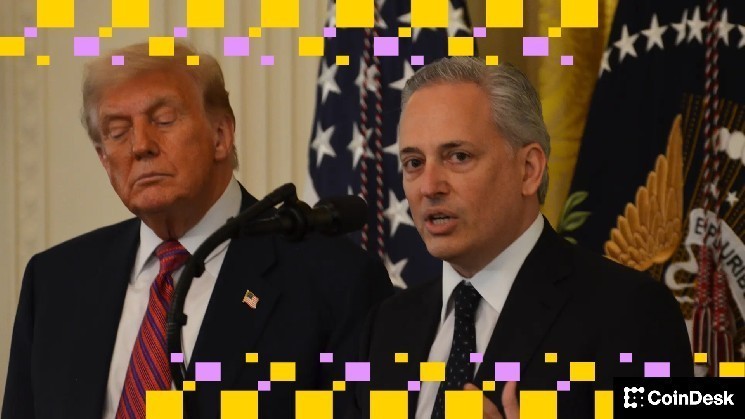

White House Pushes for Breakthrough on Controversial Crypto Legislation
High-Stakes Meeting Tackles Stablecoin Yield Debate
The White House recently convened a crucial meeting aimed at breaking the deadlock surrounding America’s crypto market structure legislation, bringing together an unlikely mix of cryptocurrency advocates and traditional banking representatives. Led by President Donald Trump’s crypto adviser Patrick Witt, the gathering took place in the prestigious Diplomatic Reception Room and stretched beyond two hours as participants grappled with one of the most contentious issues facing the digital asset industry: whether stablecoins should be allowed to generate yield and offer rewards to users. According to sources close to the discussions, while the conversation touched on these sensitive topics, representatives from the traditional banking sector didn’t bring any fresh compromises to the table. The White House has made clear that time is of the essence, urging all parties to reach practical solutions by the end of the month as the legislation continues to face significant hurdles in advancing through the Senate.
The meeting’s composition revealed the administration’s priorities, with crypto industry representatives outnumbering their traditional banking counterparts. Major players from the digital asset world were in attendance, including delegates from household names like Coinbase, Circle, Ripple, and Crypto.com, alongside policy experts from various cryptocurrency advocacy groups. The White House has made its expectations crystal clear: this isn’t just another talking session, but rather a working group tasked with finding genuine common ground. Moving forward, discussions will continue with a more focused group of participants, and the administration has specifically requested that attendees come prepared to agree on concrete changes to the bill’s actual language rather than simply debating philosophical positions. This signals a shift from exploratory conversations to serious legislative drafting, reflecting the urgency the Trump administration feels about moving crypto regulation forward.
Industry Leaders Express Cautious Optimism
Reactions from crypto industry leaders who participated in the meeting struck a tone of measured hope mixed with determination. Cody Carbone, who heads the Digital Chamber—a prominent lobbying organization advocating for cryptocurrency-friendly policies in Washington—characterized the gathering as “exactly the kind of progress needed to find a resolution to one of the biggest issues blocking next steps in market structure legislative progress.” His statement emphasized that the industry views the status quo as unacceptable, stressing that “inaction is not an option.” Carbone’s comments reflected the broader crypto community’s frustration with regulatory uncertainty while acknowledging the genuine effort being made to break through the impasse. He committed his organization to “rolling up our sleeves and doing the hard work” to ensure that whatever legislation emerges doesn’t unfairly penalize innovators or the millions of Americans who have embraced digital assets as part of their financial planning and investment strategies.
Summer Mersinger, CEO of the Blockchain Association, echoed this sentiment of cautious progress, describing Monday’s White House session as “an important step forward in finding solutions to deliver bipartisan digital asset market structure legislation.” She specifically praised Patrick Witt and the Trump administration for taking leadership in bringing diverse stakeholders together to tackle what she identified as “one of the key remaining issues: stablecoin rewards.” These public statements from industry leaders serve multiple purposes—they acknowledge the administration’s efforts, signal to their members and investors that progress is being made, and maintain pressure on all parties to continue working toward a resolution. The fact that these executives chose to make public statements immediately following the meeting suggests they believe momentum is building, even if significant disagreements remain unresolved.
The Core Dispute: Stablecoin Yield and Banking Competition
At the heart of the legislative standoff lies a fundamental disagreement about stablecoin yield—the ability of stablecoin issuers to offer interest or rewards to users who hold these digital dollars. This might sound like an arcane technical detail, but it represents an existential question for both the crypto industry and traditional banking. From the traditional banking perspective, allowing stablecoins to pay yield directly to holders could fundamentally undermine the deposit-gathering business that sits at the very foundation of American banking and credit creation. Banks collect deposits from customers, typically paying relatively modest interest rates, and then lend that money out at higher rates, with the difference representing a core profit center. If stablecoins—which can be held in digital wallets without needing a bank account—start offering competitive or superior yields, banks fear a massive migration of deposits away from the traditional banking system.
The cryptocurrency industry, meanwhile, argues that stablecoin yield represents innovation and consumer choice, giving Americans more options for their money and potentially better returns than traditional savings accounts currently offer. They point out that stablecoins have already proven enormously popular, with hundreds of billions of dollars in value now circulating in digital dollar form, and that restricting yield would artificially handicap this technology to protect an incumbent industry. The crypto advocates also argue that stablecoins serve different purposes than traditional bank accounts—they’re designed for digital transactions, cross-border payments, and participation in decentralized finance platforms, not necessarily as direct competitors to checking and savings accounts. This philosophical divide between protecting the existing banking system and embracing financial innovation represents one of the defining policy debates of our digital age, with implications that extend far beyond just the crypto industry to touch on questions of American competitiveness, financial inclusion, and technological leadership.
Political Complications Beyond the Technical Details
While the stablecoin yield question represents the most prominent technical disagreement, the legislation faces additional political headwinds that complicate its path forward. Democratic lawmakers have attached several other demands that reflect broader concerns about the cryptocurrency industry and the Trump administration’s involvement in it. These include anti-corruption provisions specifically designed to address potential conflicts of interest arising from Trump’s own crypto business ventures—a particularly sensitive issue given the president’s direct involvement in the space. Democrats are also insisting on a requirement that the Commodity Futures Trading Commission, which would have expanded authority over crypto markets under the proposed legislation, be fully staffed with commissioners representing both political parties before taking on these new responsibilities. Additionally, they’re pushing for stronger illicit-finance protections to ensure that cryptocurrency platforms can’t be easily exploited for money laundering, terrorist financing, or sanctions evasion.
These Democratic concerns gained new urgency following a Wall Street Journal report that an intelligence chief from the United Arab Emirates secretly acquired nearly half of World Liberty Financial Inc., a company with direct ties to Trump. This revelation has intensified scrutiny of the ethics provisions Democrats are demanding and raised fresh questions about foreign influence in the crypto sector. The situation illustrates how crypto legislation has become entangled with broader political battles over Trump’s business interests, government ethics, and partisan control of regulatory agencies. Meanwhile, all of this delicate negotiation is taking place against the backdrop of yet another partial government shutdown, after Congress failed to approve a funding plan to keep federal operations running. This raises practical questions about how much progress White House and congressional staff can actually make on complex legislative drafting when many government offices are supposed to be closed and staff furloughed.
The Legislative Road Ahead Remains Challenging
The crypto market structure bill has already cleared some significant hurdles, having passed the House of Representatives last year and advancing through one of two necessary Senate committees just last week. But what lies ahead represents what legislative insiders describe as a “complicated gauntlet” of additional steps before the bill could reach President Trump’s desk for signature. Most critically, the legislation must still advance through the Senate Banking Committee, where many of the most contentious disagreements first came to light during preliminary discussions. The Banking Committee’s jurisdiction puts it at the center of questions about how crypto regulation intersects with traditional finance, making it a natural battleground for the stablecoin yield debate and other issues that pit digital innovation against established banking interests.
The multi-party nature of these negotiations—involving Republican and Democratic lawmakers with different priorities, the crypto industry with its growth agenda, traditional bankers defending their business model, and a White House trying to deliver on campaign promises to the crypto community—means that achieving consensus requires threading an extraordinarily narrow needle. Each stakeholder group has specific concerns and red lines they’re unwilling to cross, creating a complex puzzle where solving one problem can create new conflicts elsewhere. The White House’s decision to impose an end-of-month deadline for finding common ground reflects an understanding that without artificial urgency, these negotiations could drag on indefinitely as each side waits for the others to blink first. Whether this timeline is realistic given the complexity of the issues and the current government shutdown remains an open question that will be answered in the coming weeks as the various working groups reconvene and attempt to translate Monday’s discussions into actual legislative language that can command bipartisan support and satisfy both innovation advocates and financial stability concerns.