



Bitcoin’s Historic $3.2 Billion Loss: Understanding the Market’s Largest Capitulation Event
A Record-Breaking Week for Bitcoin Losses
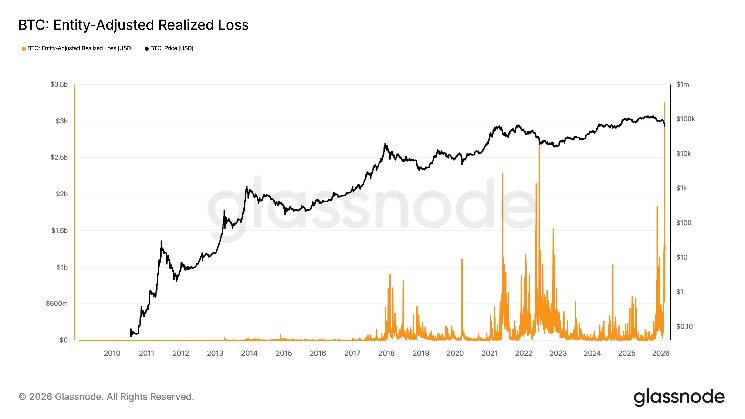
The cryptocurrency market experienced a gut-wrenching moment last week that will be remembered as a pivotal point in Bitcoin’s history. When Bitcoin’s price took a nosedive from $70,000 to $60,000 on February 5th, it triggered the largest realized loss the digital currency has ever witnessed. According to blockchain analytics firm Glassnode, the Entity-Adjusted Realized Loss reached an eye-watering $3.2 billion during this market downturn. To put this in perspective, this wasn’t just another bad day in crypto – it was the worst financial bloodletting Bitcoin has experienced since its inception. The Entity-Adjusted Realized Loss is a sophisticated metric that tracks only the actual losses from coins that were sold below their original purchase price, carefully filtering out routine transfers between wallets owned by the same person or organization. This means the $3.2 billion figure represents real money lost by real investors who bought high and were forced or chose to sell low during the panic.
Surpassing the Darkest Days of Crypto History
What makes this event particularly striking is that it overshadowed some of the most catastrophic moments in cryptocurrency history. The previous record for realized losses stood at $2.7 billion, set during the LUNA collapse in 2022 – an event that still haunts the crypto community as one of its most spectacular failures. The LUNA incident involved the implosion of an entire ecosystem, wiping out billions in market value virtually overnight and leaving countless investors devastated. Yet even that disaster pales in comparison to last week’s Bitcoin sell-off in terms of absolute realized losses. This comparison highlights just how significant the recent market movement was and suggests that the amount of capital now flowing through Bitcoin markets has grown substantially since 2022. The fact that a traditional price correction could generate larger losses than a major ecosystem collapse demonstrates both the maturation of the Bitcoin market and the increased stakes involved in cryptocurrency investing today.
Anatomy of a Textbook Capitulation
According to Checkonchain, a respected data analytics platform in the cryptocurrency space, last week’s sell-off exhibited all the classic characteristics of what market analysts call a “capitulation event.” In market terminology, capitulation occurs when investors give up hope and sell their holdings in a panic, often at the worst possible time. The platform noted that this particular event happened rapidly, on exceptionally heavy trading volume, and crystallized losses primarily from what they termed “the lowest-conviction holders” – essentially, investors who didn’t have strong confidence in their positions or the long-term prospects of Bitcoin. These are typically the traders who bought in during moments of market euphoria, perhaps influenced by fear of missing out (FOMO), and who lack the emotional fortitude or financial cushion to weather significant downturns. When the market turned against them, these weak hands folded, dumping their holdings and accepting substantial losses rather than riding out the volatility.
The Scale of Financial Pain
The daily net losses during this period exceeded $1.5 billion, a figure that represents the most significant absolute USD loss ever crystallized in Bitcoin’s entire network history. To understand what this means, imagine a small country’s GDP evaporating in a matter of hours. This wasn’t money that simply moved from one account to another – these were actual realized losses, meaning investors sold their Bitcoin holdings for less than they paid for them, locking in financial damage that can’t be undone. The scale of this event reflects several factors: the growing institutional involvement in Bitcoin markets, the increasing price per Bitcoin that amplifies both gains and losses, and the sheer number of people now participating in cryptocurrency trading. When Bitcoin was worth hundreds or even thousands of dollars, similar percentage drops resulted in smaller absolute losses. Now, with Bitcoin trading in the tens of thousands of dollars range, even moderate percentage declines translate into massive dollar amounts. This capitulation event effectively transferred wealth from panicked sellers to opportunistic buyers who saw value in the lower prices.
Reading the Tea Leaves: Bear Market Bottom Signals
Interestingly, while a $3.2 billion loss might sound like apocalyptic news for Bitcoin, many market analysts interpret such capitulation events as positive long-term indicators. The logic behind this seemingly counterintuitive perspective is straightforward: major capitulation events typically occur near market bottoms, not market tops. When weak hands exit the market en masse, accepting painful losses, it removes selling pressure from the system. Those who remain are generally the more committed, long-term believers who won’t easily be shaken out by future volatility. This creates a more stable base from which prices can eventually recover and advance. Historical data from traditional financial markets and previous cryptocurrency cycles supports this interpretation. Some of the best buying opportunities have occurred immediately after major capitulation events, when sentiment is darkest and most investors have given up hope. The fact that this sell-off happened rapidly and intensely, rather than grinding out over weeks or months, suggests that the pain was concentrated and might resolve more quickly.
Current State and Future Outlook
As of the latest market data, Bitcoin has already shown remarkable resilience, rebounding to trade around $67,600. This recovery from the $60,000 low represents a significant bounce and suggests that buyers stepped in aggressively at lower price levels. The rapid recovery underscores the strength of demand that exists for Bitcoin at more attractive valuations and demonstrates that the market hasn’t lost faith in the fundamental value proposition of the world’s largest cryptocurrency. For investors trying to make sense of these wild swings, it’s important to remember that volatility has always been a defining characteristic of Bitcoin and cryptocurrency markets generally. The asset class is still relatively young, markets aren’t as deep or sophisticated as traditional financial markets, and sentiment can shift dramatically on relatively little news. What separates successful long-term cryptocurrency investors from those who get washed out is typically their ability to maintain perspective during these turbulent periods, avoiding panic selling during capitulation events and recognizing that market cycles are inevitable. While nobody can predict with certainty whether Bitcoin has truly found its bottom or whether more volatility lies ahead, the record-breaking capitulation event suggests that significant clearing has occurred. Weak holders have been flushed from the system, and those who remain are likely to provide a more stable foundation for whatever comes next in Bitcoin’s ongoing evolution as a financial asset.