


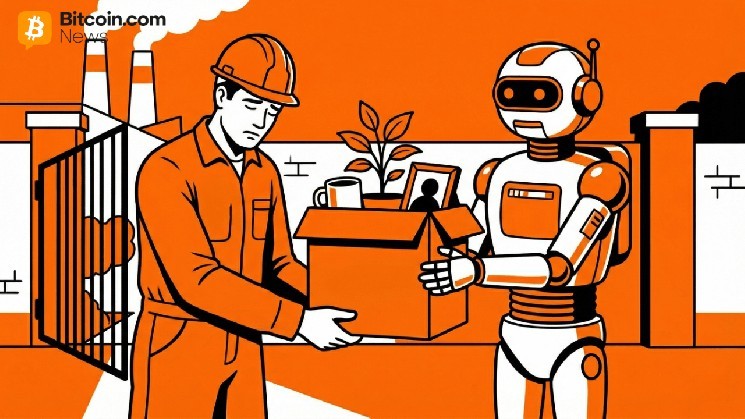

The Rising Tide of AI Job Displacement: Over 90,000 Americans Already Affected
A Wake-Up Call for American Workers
The future of work that experts have been warning about has arrived, and the numbers are more sobering than many anticipated. According to recently compiled data from The Alliance for Secure AI, a nonprofit organization dedicated to helping the public understand the far-reaching implications of artificial intelligence, more than 90,450 American workers have lost their jobs to AI automation since the beginning of 2025. This isn’t a distant dystopian scenario—it’s happening right now, affecting real people, real families, and real communities across the country. These figures represent individuals who woke up one day to find that their skills, experience, and years of dedicated service had been deemed less valuable than algorithmic efficiency. The data encompasses layoff announcements from major corporations that have become household names: Atlassian, Amazon, Morgan Stanley, Crypto.com, and Block, among others. What makes this tracking particularly noteworthy is its methodology—these aren’t just any layoffs being counted, but specifically those where artificial intelligence has been “either explicitly cited or credibly blamed as a material factor” in the decision to eliminate positions. This careful approach to data collection, which began on January 1, 2025, provides a clear-eyed view of how AI is fundamentally reshaping the American employment landscape in real-time.
The Human Cost Behind Corporate Efficiency
When companies announce layoffs attributed to AI implementation, they often frame it in terms of operational efficiency, cost savings, and technological advancement. But behind each of those 90,000-plus job losses is a person facing very human concerns: mortgage payments, children’s education expenses, healthcare costs, and the psychological toll of suddenly finding oneself without employment through no fault of their own. The Alliance for Secure AI’s tracking methodology is comprehensive and thoughtful—it includes not only announcements where companies explicitly blame AI for workforce reductions but also situations where AI is mentioned as one of several contributing factors to layoffs. This inclusive approach provides a more accurate picture of AI’s role in employment decisions, acknowledging that corporate communications often obscure the primary drivers of workforce reductions. The reality is that when a company invests millions in AI systems capable of performing tasks previously done by human employees, the writing is on the wall, whether or not executives state it plainly in press releases. These aren’t abstract statistics; they represent customer service representatives replaced by chatbots, data analysts supplanted by machine learning algorithms, content creators whose work is now generated by AI writing tools, and countless other professionals who’ve watched their roles become automated.
Leadership Calls for Political Action
Brendan Steinhauser, CEO of The Alliance for Secure AI, hasn’t minced words when discussing the implications of this data. He views these figures not merely as interesting economic indicators but as a clarion call demanding immediate attention from policymakers and the public alike. Steinhauser launched this tracking dashboard specifically to serve as a warning system—a way to make visible what might otherwise remain scattered across individual news stories and corporate announcements. His concern extends beyond just documenting the problem; he’s frustrated by what he perceives as a lack of urgency among political leaders. “Politicians are not thinking as seriously as they should about how AI will whittle away at our country’s labor force,” Steinhauser stated bluntly. “Jobs, both blue and white collar, are being replaced by AI right before our eyes.” His words carry a sense of urgency born from watching this transformation accelerate without corresponding policy responses. The traditional political debates about job creation and economic policy seem quaintly outdated when the fundamental question has shifted to how humans can maintain any economic value in an increasingly automated world. Steinhauser’s concluding observation cuts to the heart of the matter: “We do not yet have solutions to ensure that Americans can continue to provide for their families in the era of advanced AI.” This isn’t just about finding new jobs or retraining programs—it’s about whether our economic and social structures can adapt quickly enough to a transformation unlike any we’ve seen in modern history.
Expert Predictions Paint a Troubling Picture
The current situation, alarming as it is, may be just the beginning of a much larger transformation. Industry insiders and researchers are sounding alarms about what’s coming in the near future, and their predictions range from concerning to genuinely frightening. Dario Amodei, co-founder of Anthropic, one of the leading AI development companies, has warned of what he describes as an upcoming “labor bloodbath.” His prediction? AI systems will eliminate approximately half of all white-collar entry-level positions within the next five years. Think about what that means: college graduates emerging with degrees, student loan debt, and career aspirations may find that the entry-level positions that have traditionally been the first rung on the career ladder simply no longer exist. The implications extend far beyond immediate unemployment—they threaten the entire concept of career development and professional advancement that has defined middle-class achievement for generations. These aren’t just the warnings of industry insiders either; academic research supports these troubling forecasts. A study released by MIT in November delivered similarly stark findings: over 11% of the entire U.S. labor market could feasibly be replaced by AI systems, potentially wiping out more than $1 trillion in wages across white-collar sectors. The sectors identified as particularly vulnerable include finance, healthcare, and professional services—precisely the industries that have been viewed as stable, well-compensated career paths requiring significant education and expertise.
The Expanding Scope of AI Displacement
What makes this wave of AI displacement particularly significant is its departure from historical patterns of technological disruption. Previous waves of automation primarily affected manufacturing and routine manual labor—jobs that involved repetitive physical tasks that machines could be programmed to perform. Workers displaced from these roles could theoretically retrain for knowledge work, customer service, creative professions, or other positions that required human judgment, empathy, or complex problem-solving. The current AI revolution overturns this paradigm entirely. Today’s artificial intelligence systems are targeting precisely those roles that were supposed to be safe from automation: the jobs requiring analysis, communication, creativity, and decision-making. AI can now draft legal documents, generate marketing copy, analyze financial data, create visual art, write computer code, and even engage in customer service conversations with increasing sophistication. The traditional advice to “learn to code” or “develop soft skills” offers little comfort when AI systems are demonstrating competence in these very areas. What makes this particularly challenging for workers is the speed of change. Where previous technological transitions unfolded over decades, allowing time for gradual adaptation, AI capabilities are advancing at a pace that leaves little time for individuals or institutions to adjust. A skill set that seemed marketable and secure one year may be partially or fully automatable the next, leaving workers in a constant state of uncertainty about their professional futures.
The Path Forward: Questions Without Easy Answers
As we confront this reality of AI-driven job displacement, we’re left with profound questions about the structure of our economy and society. If a significant portion of the workforce can no longer contribute economically in traditional ways, how do we ensure people can meet their basic needs? Do we need to reimagine concepts like universal basic income, significantly shortened work weeks, or entirely new models of economic participation? How do we preserve human dignity and sense of purpose in a world where many traditional sources of both—productive employment—may no longer be available? These aren’t just economic questions; they’re fundamentally about what kind of society we want to build. The current situation demands more than incremental policy adjustments or expanded job training programs, though both may have roles to play. We need a comprehensive rethinking of the social contract between employers, workers, government, and technology companies. Should companies that deploy AI systems to replace workers bear some responsibility for those displaced? Should AI development be regulated to protect employment, or would that simply handicap American companies in global competition? How do we balance the genuine benefits AI can bring—increased productivity, lower costs, solutions to complex problems—with the very real human cost of widespread displacement? The 90,450 jobs already lost to AI represent just the opening chapter of this story. Whether the narrative that follows is one of managed transition and broadly shared prosperity or widespread disruption and economic insecurity will depend on choices we make right now. Steinhauser’s call for political engagement reflects an understanding that market forces alone won’t produce outcomes that serve the broader public interest. As this technology continues its rapid advancement, the window for proactive, thoughtful policy responses is closing. The question isn’t whether AI will continue to displace workers—that trajectory seems clear—but rather what we’re prepared to do about it.