


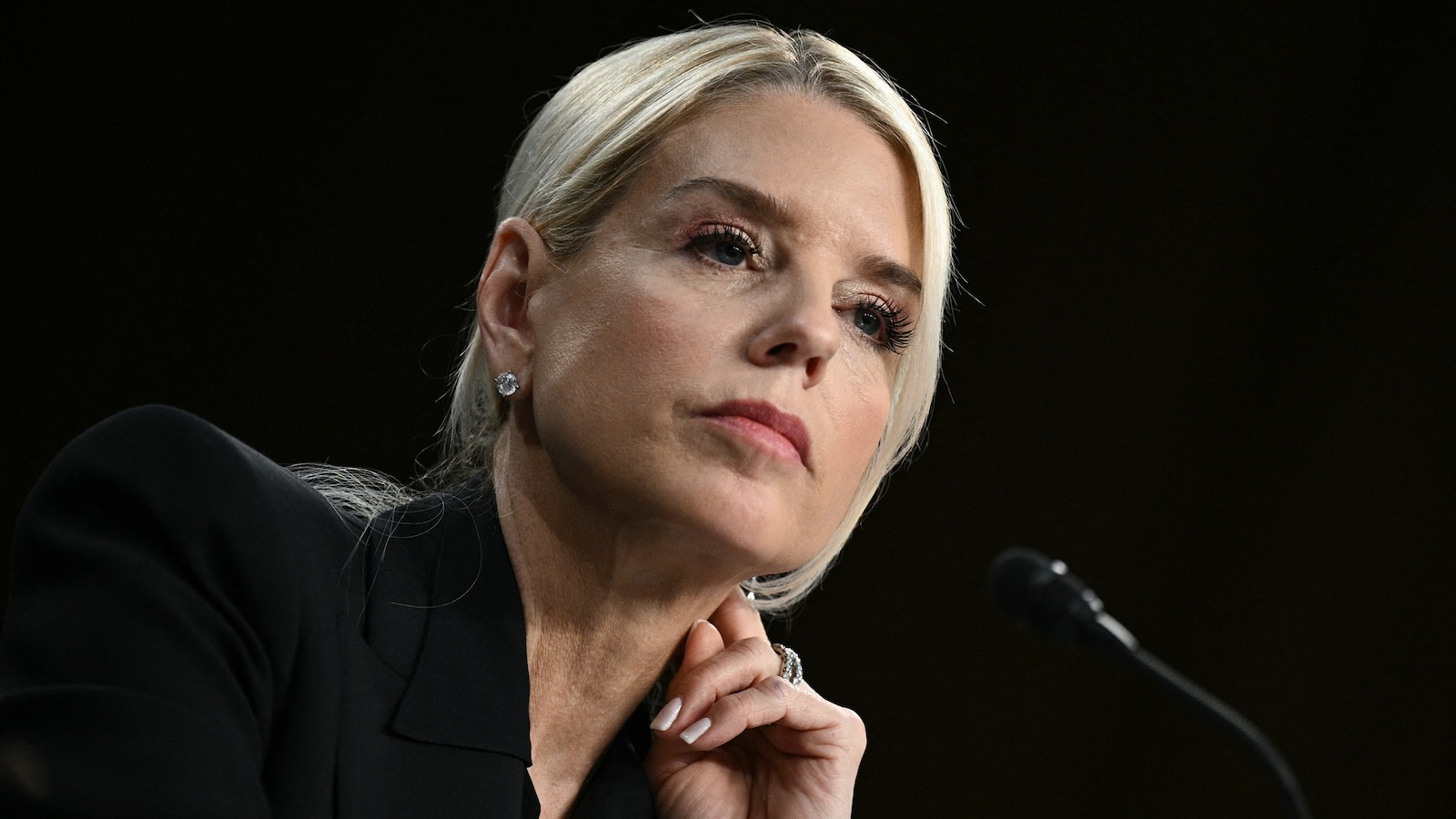

The Ousting of Attorney General Pam Bondi: A Turbulent Chapter in Trump’s Justice Department
A Sudden Leadership Change at the Justice Department
In a move that sent shockwaves through Washington, President Donald Trump announced on Thursday via his social media platform that Attorney General Pam Bondi would be stepping down from her position. The announcement, while framed in positive terms, marked the end of what had been an increasingly controversial tenure at the helm of the nation’s top law enforcement agency. Trump’s message attempted to soften the blow, expressing affection for Bondi and indicating she would be transitioning to what he described as “a much needed and important new job in the private sector.” The details of this new role remain vague, with Trump promising that specifics would be revealed at some future date. Taking the reins as acting attorney general will be Todd Blanche, Trump’s deputy attorney general and former personal attorney—a choice that underscores the president’s preference for loyalty and personal connections in his administration’s most sensitive positions.
The timing and manner of Bondi’s departure tell a story that goes beyond the carefully crafted public statements. According to sources who spoke with ABC News, Trump had been discussing the possibility of removing Bondi for some time, with conversations intensifying in recent days. The underlying issue? The president’s growing frustration that the Justice Department wasn’t moving aggressively enough to prosecute his political adversaries. This tension between presidential expectations and prosecutorial realities had been building for months, creating an increasingly untenable situation for Bondi, who found herself caught between institutional norms and political pressure. For her part, Bondi responded to the announcement with grace, at least publicly, stating that she would work “tirelessly” over the coming month to ensure a smooth transition to Blanche while preparing for her mysterious new private sector role, where she promised to continue supporting Trump and his administration.
Todd Blanche: From Trump’s Defense Attorney to Nation’s Top Law Enforcement Official
The elevation of Todd Blanche to acting attorney general represents a remarkable journey for a man who, not long ago, was defending Trump in criminal proceedings. Blanche served as Trump’s defense attorney in cases brought by Manhattan District Attorney Alvin Bragg and former special counsel Jack Smith—high-profile prosecutions that the president and his supporters characterized as politically motivated “witch hunts.” Since being confirmed by the Senate in March of the previous year, Blanche has served as the nation’s number two law enforcement official, bringing with him experience as an assistant U.S. attorney in the prestigious Southern District of New York. However, his path from defense attorney to prosecutor, and now to the top job, raises questions about the blurring lines between personal loyalty to the president and the traditional independence expected of the Justice Department.
Like Bondi before him, Blanche has been remarkably vocal about his personal allegiance to President Trump—a characteristic that would have been considered highly unusual in previous administrations but has become increasingly normalized in Trump’s government. Just last week, Blanche appeared at the Conservative Political Action Conference, where he enthusiastically defended the dismissal of prosecutors who had previously investigated Trump and pushed back against criticism from within the MAGA base that the Justice Department wasn’t doing enough to pursue the president’s agenda. In a particularly revealing moment, Blanche embraced pressure from Trump supporters, saying, “When people say, ‘Why aren’t you doing more?’ I welcome that criticism. Keep on putting pressure on us. Do you think it makes me upset when you go on X and say, ‘Come on, Blanche, why aren’t we doing more?’ You don’t know me. That’s what motivates me.” These comments offer a window into the mindset of someone who sees public pressure and political demands not as threats to prosecutorial independence but as motivation to act more aggressively—a philosophy that alarms those who believe in the traditional separation between politics and law enforcement.
A Rocky Tenure Marked by Controversy and Norm-Breaking
Pam Bondi’s time as attorney general will be remembered as a period when the Justice Department underwent fundamental changes in its relationship with the White House. From her earliest days in office, Bondi made clear that she saw her primary allegiance as being to President Trump rather than to abstract principles of prosecutorial independence. She consistently echoed Trump’s longstanding complaints that the DOJ and FBI had been “weaponized” against him—a narrative that justified, in her view, a wholesale reimagining of these institutions. This represented a sharp departure from the post-Watergate norms that had encouraged at least some distance between the White House and prosecutorial decision-making. During Trump’s first term, he had encountered resistance from Justice Department and FBI officials who were unwilling to use their agencies’ vast powers to punish the president’s perceived enemies. Bondi, however, publicly embraced Trump’s demands for specific prosecutions, signaling a new era in which political considerations would play a more explicit role in law enforcement decisions.
The results of this approach were decidedly mixed, with several high-profile cases ending in embarrassing setbacks for the administration. The department’s attempts to prosecute former FBI Director James Comey and New York Attorney General Letitia James—both frequent targets of Trump’s criticism—fell apart when a federal judge ruled that the Trump-appointed prosecutor who indicted them had been appointed unlawfully. Subsequent efforts to revive the case against James were rejected not once but twice by grand juries, according to sources familiar with the matter. Similarly, an ambitious attempt by Washington, D.C. U.S. attorney Jeanine Pirro to indict six Democratic lawmakers who posted a video encouraging military service members to refuse unlawful orders was also shot down by a grand jury, despite Trump’s inflammatory accusation that the group was guilty of “treason.” Additionally, the department found itself in a legal battle with the chief judge in Washington over its attempt to launch a criminal investigation into Federal Reserve Chairman Jerome Powell, another frequent target of presidential anger, with the judge putting that effort on hold. These failures, combined with concerns about the pace of prosecutions, fueled Trump’s mounting frustration with Bondi’s leadership.
The Epstein Files: A Source of Particular Frustration
Among the many controversies that marked Bondi’s tenure, perhaps none consumed more attention or generated more backlash than her handling of files related to deceased sex offender Jeffrey Epstein. The management of these sensitive documents became a lightning rod for criticism, attracting months of negative media coverage and prompting anger even among some of Trump’s most devoted supporters, who had hoped for more transparency and accountability regarding Epstein’s crimes and his connections to powerful individuals. The situation became so contentious that it contributed significantly to the erosion of confidence in Bondi’s leadership. Annie Farmer, a witness who testified at the 2021 criminal trial of Epstein associate Ghislaine Maxwell, captured the frustration felt by many survivors when she responded to news of Bondi’s departure with a statement emphasizing that the issue transcended any single person: “This is not about a single person; it is about a government and judicial system that has repeatedly failed Epstein survivors. Regardless of who holds power, survivors deserve accountability, transparency, protection from retaliation, and assurance that those who enabled Epstein, Maxwell, and others will be investigated and, if appropriate, prosecuted.”
The controversy reached new heights following Bondi’s appearance before the House Judiciary Committee in February, where her performance drew criticism even from within the White House, according to sources. During that hearing, Bondi repeatedly raised her voice at lawmakers and deflected questions about the Justice Department’s handling of the Epstein files and other sensitive matters. Her confrontational approach, while publicly praised by Trump on social media as “fantastic,” was privately viewed by some administration officials as counterproductive and unnecessarily combative. The situation deteriorated further when a bipartisan group of lawmakers on the House Oversight Committee took the unusual step of voting to subpoena Bondi, demanding that she sit for a deposition on the Epstein files in mid-April. Following Trump’s announcement of her departure, Oversight Committee Ranking Member Robert Garcia made clear that Bondi’s change in employment status wouldn’t exempt her from compliance: “The Oversight Committee subpoena is for Pam Bondi, whether she is the Attorney General or not.” This ongoing obligation ensures that the controversies of her tenure will continue to follow her even as she exits government service.
Broader Concerns About Democracy and Election Integrity
The leadership shakeup at the Justice Department comes at a particularly sensitive moment, with Democrats and voting rights organizations expressing deep concern about the potential for political interference in the upcoming November midterm elections. There are widespread fears that the White House might attempt to use the DOJ and FBI to influence electoral outcomes or to intimidate political opponents. These concerns aren’t merely theoretical—they’re grounded in the administration’s demonstrated willingness to use law enforcement powers for political purposes and in the president’s repeated statements suggesting that his opponents deserve prosecution. The installation of Todd Blanche, someone who has openly embraced political pressure as motivation for his work, does little to alleviate these anxieties. Critics worry that the midterms could see unprecedented federal intervention, with investigations strategically opened or closed, with politically motivated prosecutions timed to damage Democratic candidates, or with law enforcement resources deployed in ways that could suppress voter turnout or create confusion at the polls.
The transformation of the Justice Department under Bondi’s leadership, and the likely continuation of that trajectory under Blanche, represents a fundamental shift in American governance. The post-Watergate reforms that established at least some independence for the Justice Department were based on hard-learned lessons about what happens when law enforcement becomes an extension of a president’s political operation. The erosion of those norms doesn’t happen all at once but rather through a series of individual decisions that, taken together, create a new reality. Each politically motivated prosecution, each refusal to investigate potential wrongdoing by allies, each public statement of personal loyalty over institutional responsibility—these accumulate to reshape what Americans can expect from their government. The concern isn’t just about any particular case or any specific individual; it’s about the precedents being set and the guardrails being dismantled. As the nation moves toward another election cycle with a Justice Department leadership that has explicitly rejected traditional independence in favor of political alignment, the questions about the health of American democratic institutions become more urgent. What Pam Bondi’s departure ultimately reveals isn’t just the story of one official’s troubled tenure, but rather a window into the larger transformation of American governance and the ongoing debate about the proper relationship between political power and the rule of law.