


Public Trust in Trump’s Crypto Leadership Remains Shaky Despite Pro-Industry Promises
Growing Skepticism Among American Voters
When Donald Trump promised to transform the United States into the “crypto capital of the world,” it sparked excitement throughout the digital currency industry. After years of strict regulatory oversight under the previous administration, many in the crypto sector saw Trump’s election as a turning point—a chance to finally operate under friendlier rules and clearer guidelines. The administration moved quickly to make good on these promises, appointing a dedicated crypto czar, issuing executive orders outlining industry priorities, and backing legislation aimed at creating the first comprehensive crypto regulatory framework in U.S. history. However, despite these aggressive pro-crypto moves, a recent survey commissioned by CoinDesk reveals a troubling reality: the majority of American voters simply don’t trust Trump to oversee the cryptocurrency industry. According to the poll of 1,000 registered voters, 62% expressed discomfort with the president’s administration handling crypto regulation. This lack of confidence appears to mirror Trump’s declining overall approval rating, which the survey pegged at just 40%. What makes these numbers particularly significant is that the survey split respondents evenly between Trump and Kamala Harris supporters from the 2024 election, suggesting that even some of Trump’s own voters have grown skeptical about his crypto leadership.
The Conflict of Interest Problem
At the heart of public skepticism lies a fundamental concern about conflicts of interest. The survey uncovered that 45% of respondents are aware that President Trump and his family have built substantial personal financial stakes in the cryptocurrency industry. Their business ventures include partial ownership and control of World Liberty Financial, along with various other digital asset interests. When asked about senior government officials having personal business dealings in industries they regulate, an overwhelming 73% of Americans expressed opposition—without any specific officials being mentioned in the question. This opposition wasn’t limited to Democrats or independents; even among Republican voters, a solid 59% majority said they couldn’t support such arrangements. The discomfort cuts across party lines, revealing a broadly shared belief that those making the rules shouldn’t personally profit from them. Interestingly, while nearly half of voters know Trump has crypto investments, only 17% are aware of the specific details, such as his family’s involvement in launching World Liberty Financial. This knowledge gap suggests that as more information becomes public about the extent of Trump’s crypto holdings, public concern could potentially deepen even further.
Trump’s Crypto Empire and World Liberty Financial
World Liberty Financial has become the most visible and controversial element of the Trump family’s crypto portfolio. While the Trumps have multiple investments in the digital currency space, World Liberty has attracted particular scrutiny due to potential conflicts of interest and various controversies surrounding its operations. When asked to respond to the polling data showing public distrust, a World Liberty spokesman defended the arrangement by emphasizing Trump’s campaign promises: “The president pledged to make the United States the crypto capital of the world, and World Liberty wholeheartedly supports this vision.” The spokesman added that Trump “has continually delivered on his promise to ensure that one of the most important technological breakthroughs of the century develops and thrives in America.” Despite these assurances, the optics remain problematic for both the administration and the cryptocurrency industry. The crypto sector finds itself in an awkward position—celebrating Trump’s regulatory appointments and favorable policy decisions while quietly dealing with the complications his personal business interests create for their lobbying efforts. This tension has become particularly acute as the industry pursues its biggest legislative goal in Washington: a comprehensive law that would formalize U.S. cryptocurrency regulation and provide the legal clarity businesses have long sought.
The Legislative Battle Over the Clarity Act
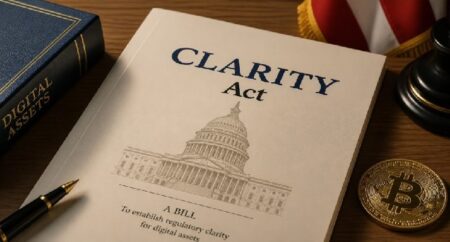
The Digital Asset Market Clarity Act represents the cryptocurrency industry’s best chance at establishing a clear regulatory framework in the United States. The legislation has already passed the House of Representatives and is moving through the Senate, but Trump’s personal crypto ties have created a significant obstacle. Democratic lawmakers have requested that the bill include provisions banning senior government officials from holding personal cryptocurrency interests—language that clearly targets the president. These bipartisan negotiations have dragged on for months, with lawmakers exchanging proposed language back and forth in recent days trying to find compromise ground. The White House has previously indicated it won’t accept legislation that specifically targets Trump or his family members, creating a seemingly impossible puzzle: how to craft a conflict-of-interest provision that satisfies Democrats’ ethics concerns without affecting the president. The stakes are high because the bill will likely need 60 Senate votes to pass—the typical threshold for major legislation—meaning substantial Democratic support is essential. Trump’s political opponents argue that the entire legislative effort primarily benefits his personal financial interests, making it harder to build the broad coalition needed for passage. The crypto industry worked hard to position itself as a bipartisan issue, but the president’s business entanglements have re-politicized the debate in ways that complicate the path forward.
Crypto Remains Outside the Mainstream
Despite Trump’s recent claims at a gathering of top investors in his $TRUMP memecoin that cryptocurrency “has become mainstream” and that the U.S. is the “leader in crypto,” the CoinDesk survey paints a different picture of American attitudes. The data reveals that cryptocurrency remains a niche interest, having become a regular part of life for only a small segment of the population. Most Americans continue to view digital currencies with distrust or, at best, uncertainty about their proper role in the economy and political system. This perspective stands in sharp contrast to the enthusiasm Trump expressed to a few hundred elite investors in his branded token last weekend. The survey, conducted by research firm Public Opinion Strategies with a credibility interval of about 3.5%, provides a snapshot of where public opinion actually stands as the country heads toward the 2026 midterm elections. Additional findings show that cryptocurrency ranks at the bottom of voters’ priorities and that Americans still prefer traditional banks over crypto for financial access—hardly the endorsement of mainstream adoption that industry boosters claim. These attitudes suggest that while crypto may have secured more favorable treatment from regulators, it hasn’t yet won over the general public.
The Road Ahead for Crypto and Politics
The relationship between the Trump administration and the cryptocurrency industry remains complicated as both parties try to navigate conflicting interests. The industry has benefited enormously from Trump’s regulatory appointments and policy direction, getting the friendly oversight they desperately wanted after years of enforcement actions and regulatory uncertainty. Yet this support comes at a cost—the president’s personal financial involvement creates ethical questions that undermine public confidence and complicate legislative efforts. As the 2026 midterm elections approach, crypto’s political influence will face a real test. The industry spent heavily in the 2024 election cycle, helping elect pro-crypto candidates, but maintaining that political momentum may prove difficult if voters remain skeptical about industry leaders’ motives. The survey’s findings suggest that Trump has not succeeded in becoming the trusted face of crypto oversight that the industry might have hoped for when he made his campaign promises. Moving forward, the cryptocurrency sector must decide whether to continue its close alignment with Trump and his family’s business interests, or to distance itself in hopes of building broader, more sustainable political support. The fate of the Digital Asset Market Clarity Act may depend on that choice, as lawmakers struggle to separate legitimate regulatory reform from personal financial enrichment. For now, American voters have sent a clear message: they’re not comfortable with the current arrangement, even if they don’t fully understand all its details.