



Bitcoin’s Remarkable Recovery: A Deep Dive Into the Recent Market Surge
Understanding Bitcoin’s Recent Price Movement Amid Global Uncertainty
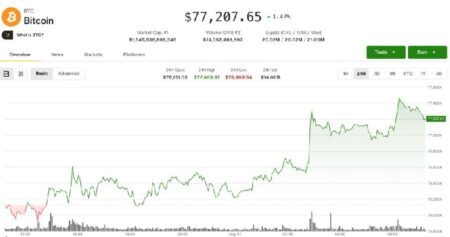
The cryptocurrency market has shown remarkable resilience in recent days, with Bitcoin leading an impressive recovery that has captured the attention of investors worldwide. Despite the looming shadow of geopolitical tensions between the United States and Iran—a situation that would typically send traditional markets into a tailspin—Bitcoin has demonstrated its growing maturity as an asset class by surging past the $74,000 mark. This recovery hasn’t been limited to Bitcoin alone; the entire cryptocurrency ecosystem has benefited from this upward momentum. Ethereum, the second-largest cryptocurrency by market capitalization, experienced a healthy 7.9% increase, climbing to $2,270. XRP, often considered a bridge between traditional finance and blockchain technology, rose by 3.9% to reach $1.47, while Solana, the high-performance blockchain platform that has captured significant developer interest, jumped 6.2% to trade at $93.7. This across-the-board recovery has reignited discussions about cryptocurrency’s role as both a speculative asset and a potential hedge against traditional market volatility. The cryptocurrency community finds itself asking: what’s driving this remarkable turnaround, and can it be sustained?
Bernstein’s Analysis: The Institutional Foundation Behind Bitcoin’s Strength
While market participants debate the various factors contributing to Bitcoin’s recent price appreciation, prestigious US investment bank Bernstein has provided a comprehensive analysis that sheds light on the underlying dynamics at play. According to their research team, the primary driver behind Bitcoin’s impressive recovery isn’t speculative retail trading or short-term market sentiment, but rather a fundamental strengthening of Bitcoin’s long-term investor base. This represents a significant maturation of the cryptocurrency market from its earlier days when price movements were largely driven by retail speculation and social media hype. Bernstein’s analysts, led by Gautam Chhugani, have identified two key institutional trends that are reshaping Bitcoin’s market structure: increased inflows into spot Bitcoin Exchange-Traded Funds (ETFs) and substantial accumulation by corporate entities. These institutional investment vehicles have provided traditional investors with regulated, accessible pathways to gain Bitcoin exposure without the technical complexities of directly holding cryptocurrency. The significance of this shift cannot be overstated—it represents a fundamental transformation in who owns Bitcoin and why they’re holding it, moving from speculative day traders to long-term institutional investors with multi-year investment horizons.
Bitcoin’s Outperformance in a Volatile Geopolitical Landscape
One of the most striking aspects of Bitcoin’s recent performance is its ability to outperform traditional major assets during a period of heightened geopolitical uncertainty. Historically, when tensions rise in geopolitically sensitive regions like the Middle East, traditional markets experience significant volatility, with investors typically fleeing to established safe-haven assets like gold, US Treasury bonds, or the Swiss franc. However, Bitcoin’s recent behavior suggests that the narrative around cryptocurrency as “digital gold” may be gaining empirical support. While stock markets have shown nervousness in response to US-Iran tensions, Bitcoin has charted its own course, demonstrating relative independence from traditional market correlations. This divergence is particularly noteworthy because it challenges the conventional wisdom that Bitcoin behaves purely as a risk-on asset that rises and falls with equity markets. Instead, Bitcoin’s resilience during this geopolitical uncertainty period suggests that at least some investors are beginning to view it as a hedge against both traditional market volatility and geopolitical risk. This evolution in Bitcoin’s market behavior represents a potential turning point in its journey toward becoming a legitimate alternative asset class that deserves a place in diversified investment portfolios.
The ETF Effect and Corporate Accumulation: Building a Stable Foundation
The report from Bernstein highlights two interrelated trends that are fundamentally reshaping Bitcoin’s market structure: spot Bitcoin ETF inflows and corporate Bitcoin accumulation strategies. Since the approval of spot Bitcoin ETFs in the United States, these investment vehicles have provided a flood of new capital into the Bitcoin market. Unlike previous Bitcoin investment products that relied on futures contracts or other derivatives, spot ETFs actually purchase and hold Bitcoin directly, creating genuine demand for the underlying asset. This direct purchasing pressure has a tangible impact on Bitcoin’s price dynamics, particularly when combined with Bitcoin’s fixed supply schedule. Meanwhile, corporate Bitcoin accumulation—led by companies that view Bitcoin as a treasury reserve asset—has added another layer of consistent buying pressure. These corporations, ranging from publicly-traded business intelligence firms to payment processors, are implementing Bitcoin strategies that involve regular, systematic purchases regardless of short-term price fluctuations. According to Bernstein’s analysis, this combination of ETF inflows and corporate buying is gradually reducing short-term selling pressure in the market. As more Bitcoin moves from short-term speculators into the hands of long-term institutional holders, the available supply for trading diminishes, potentially creating conditions for more stable price appreciation with reduced volatility.
The Long-Term Holder Phenomenon: 60% of Supply Locked Away
Perhaps the most striking statistic revealed in Bernstein’s analysis is that approximately 60% of Bitcoin’s total supply is currently held by long-term investors who haven’t sold their holdings for more than a year. This figure represents a significant milestone in Bitcoin’s evolution and provides crucial insight into the changing composition of Bitcoin ownership. When such a substantial portion of an asset’s supply is held by investors with strong conviction and long time horizons, it fundamentally changes the asset’s price dynamics. These long-term holders—often referred to in the crypto community as “HODLers,” a playful misspelling of “holders” that has become a badge of honor—serve as a stabilizing force in the market. During periods of price volatility, these investors are far less likely to panic sell, which reduces the cascading effect of downward price spirals that plagued earlier cryptocurrency market cycles. The presence of this substantial long-term holder base also means that a smaller percentage of Bitcoin’s supply is available for active trading, which can amplify price movements in both directions but also suggests that significant selling pressure may be diminishing. This metric effectively demonstrates that Bitcoin is increasingly being viewed not as a speculative trading vehicle but as a long-term store of value worthy of multi-year holding periods, similar to how investors might approach real estate, precious metals, or blue-chip equities.
Looking Ahead: Bernstein’s Bold Price Prediction and Market Implications
Despite recent volatility and the various headwinds facing the cryptocurrency market, Bernstein’s analysts have reiterated their confidence in Bitcoin’s long-term trajectory with a bold prediction. The investment bank maintains its price target of $150,000 for Bitcoin by the end of 2026, a figure that represents more than double the current price levels. Interestingly, Bernstein frames the recent market conditions as representing Bitcoin’s “weakest bearish scenario in history,” suggesting that the downside risks are more limited than in previous market cycles. This optimistic outlook is grounded in the structural changes the analysts have identified: the growing institutional adoption, the strengthening long-term holder base, and the continued development of regulated investment products that make Bitcoin accessible to mainstream investors. However, it’s crucial for readers to understand that such price predictions, even from respected financial institutions, should not be taken as investment advice or guarantees of future performance. The cryptocurrency market remains inherently volatile and subject to regulatory changes, technological developments, macroeconomic conditions, and shifting investor sentiment. What makes Bernstein’s analysis valuable isn’t necessarily the specific price target but rather their identification of fundamental structural changes in Bitcoin’s market dynamics that suggest growing maturity and stability. As traditional financial institutions continue to build infrastructure around Bitcoin and as the asset class gains legitimacy in the eyes of regulators and institutional investors, the market may indeed be entering a new phase characterized by reduced volatility, stronger hands holding the asset, and a gradual decoupling from the extreme boom-and-bust cycles that defined cryptocurrency’s earlier years. Whether Bitcoin reaches $150,000 by 2026 remains to be seen, but the trends identified by Bernstein suggest that the cryptocurrency market is evolving in ways that could support sustained long-term growth.