



The Cryptocurrency Market’s Uncertain Recovery: A Deep Dive into Recent Trends
A Tale of Two Markets: Winners and Losers in the Crypto Space
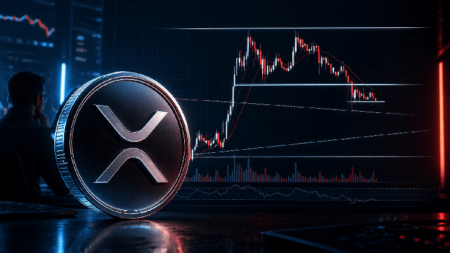
The cryptocurrency market has always been known for its volatility, but recent weeks have painted a particularly complex picture of what’s happening beneath the surface. While some digital assets are showing signs of life, others are struggling to maintain momentum, creating a landscape where not all cryptocurrencies are created equal. XRP emerged as the week’s standout performer, climbing 2.98% to reach $1.43, demonstrating a resilience that has caught many traders’ attention. This positive movement stands in stark contrast to Ethereum’s struggles, which faced significant headwinds after experiencing unprecedented outflows from its exchange-traded funds totaling $136 million. This divergence in performance highlights a critical reality in today’s crypto market: investors are becoming increasingly selective about where they place their bets, moving away from broad-market enthusiasm toward more strategic, asset-specific decisions.
TRON also managed to post moderate gains alongside XRP, suggesting that certain altcoins are finding favor with investors who are carefully picking their positions. However, the enthusiasm around these gains is tempered by a noticeable lack of conviction that became apparent when prices attempted to push higher mid-week. The market’s inability to sustain those mid-week highs has raised important questions about whether genuine institutional capital is flowing back into these assets or if we’re merely witnessing technical bounces driven by short-term traders. The weakness in follow-through buying suggests that while some investors are willing to take positions at current levels, there isn’t the kind of strong, sustained demand that typically characterizes the beginning of a new bull market phase.
The Volume Crisis: When Trading Activity Tells the Real Story
Perhaps the most concerning signal coming from the cryptocurrency market isn’t what’s happening with prices, but rather what’s happening with trading volumes. Binance, the world’s largest cryptocurrency exchange by volume, has seen its daily trading activity plummet to just $7.7 billion—a staggering 85% decline from the peaks witnessed in February 2025. To put this in perspective, when the market was firing on all cylinders earlier this year, Binance alone was processing volumes that reflected genuine market-wide interest and participation. The current situation, however, tells a very different story. This dramatic collapse in trading activity suggests that retail investors—the backbone of cryptocurrency market participation—have largely stepped away from active trading.
The broader picture across all major exchanges is equally sobering. Total global exchange volume has contracted to approximately $18.8 billion, a far cry from the $91 billion in daily volume recorded in January. This represents a decline of nearly 80% in just a few months, indicating that we’re not just seeing reduced activity on one platform but a systemic withdrawal of participation across the entire cryptocurrency ecosystem. Binance currently accounts for roughly 40% of this diminished total volume, which actually represents an increase in its market share—not because Binance is growing, but because other exchanges are seeing even steeper declines in activity. This concentration of what little volume remains on a single platform raises concerns about market liquidity and the ability of traders to enter and exit positions without significantly impacting prices.
The reasons behind this volume collapse are multifaceted. Geopolitical uncertainty has made risk assets less attractive across the board, and cryptocurrencies, despite their maturation as an asset class, remain firmly in the “risk-on” category for most institutional and retail investors. Additionally, Bitcoin’s continued dominance in capturing what little new capital is entering the crypto space has left altcoins fighting over a shrinking pie. When uncertainty rises, investors tend to consolidate their positions in what they perceive as the safest available options, and within the crypto world, Bitcoin still holds that title for most participants.
Technical Indicators Paint a Mixed Picture of Market Health
Diving into the technical analysis of major altcoins reveals a market in limbo, searching for direction. Solana, which had been one of the previous cycle’s star performers, now shows a Relative Strength Index (RSI) of 36, placing it near oversold territory. The RSI is a momentum indicator that measures the speed and magnitude of price changes, with readings below 30 typically considered oversold and above 70 considered overbought. Solana’s current reading suggests that selling pressure has been intense, and the asset may be approaching levels where bargain hunters traditionally begin to show interest. However, being near oversold doesn’t automatically translate to an immediate rebound—assets can remain oversold for extended periods during strong downtrends.
In contrast, both Ethereum and XRP are displaying RSI readings hovering around 49, placing them squarely in neutral territory. This neutrality is somewhat deceptive, as it masks the significant struggle Ethereum has faced recently. After attempting to reclaim the psychologically important $2,400 level mid-week, Ethereum retreated to $2,133, failing to maintain its upward momentum. This failed breakout attempt is concerning for bulls, as it suggests that sellers are still firmly in control at higher price levels. The neutral RSI reading for Ethereum, despite this price action, indicates that the asset is neither definitively bullish nor bearish at current levels—a state of equilibrium that often precedes significant moves in either direction.
The Moving Average Convergence Divergence (MACD), another widely followed technical indicator, remains in negative territory for most major altcoins. The MACD measures the relationship between two moving averages of an asset’s price and helps identify potential trend changes. When the MACD is negative, it suggests that short-term momentum is weaker than longer-term momentum, typically a bearish signal. The persistence of negative MACD readings across the altcoin sector reinforces the notion that despite some price stability, the underlying momentum remains weak. For traders and investors, this technical setup suggests that the path of least resistance—the direction prices are most likely to move without significant new catalysts—remains sideways to slightly lower rather than decisively upward.
Understanding the Volume Paradox: Weakness or Opportunity?
The dramatic collapse in trading volumes presents what market analysts call a paradox—a situation where the same data can be interpreted in fundamentally different ways depending on your perspective and time horizon. On the surface, plummeting volumes alongside weak price action appears unmistakably bearish, suggesting that interest in cryptocurrencies is waning and that the market may face further downside as remaining participants lose patience. However, seasoned market veterans know that some of the best accumulation opportunities occur precisely when volumes are at their lowest and sentiment is most pessimistic. The logic here is straightforward: when selling pressure exhausts itself and volumes dry up, there are fewer sellers left to push prices lower, creating a foundation from which new uptrends can eventually emerge.
Historical market cycles across various asset classes have demonstrated that periods of extremely low volume and widespread disinterest often mark or closely precede significant market bottoms. During these quiet periods, informed investors—often referred to as “smart money”—can accumulate positions without driving prices significantly higher, building substantial holdings that position them advantageously for the next bull phase. The challenge, of course, is distinguishing between a healthy consolidation that’s setting the stage for future growth and a genuine loss of interest that could lead to prolonged stagnation or further decline.
The current situation in the cryptocurrency market shows characteristics of both scenarios. The positive interpretation points to the fact that despite low volumes, prices have remained relatively stable, and certain assets like XRP are actually posting gains. This price resilience in the face of minimal buying pressure could indicate that selling has indeed exhausted itself and that a base is forming. The negative interpretation, however, emphasizes that without a meaningful catalyst to bring participants back to the market, this low-volume environment could persist indefinitely, with occasional downward pressure easily overwhelming what little buying interest exists. The truth likely lies somewhere in between, with the market in a genuine transition phase where the next major move will be determined by external factors—regulatory developments, macroeconomic conditions, or technological breakthroughs—rather than current technical positioning alone.
Critical Support Levels and What They Mean for Market Direction
For traders and investors trying to navigate this uncertain environment, identifying and monitoring key support and resistance levels becomes paramount. Support levels represent price points where buying interest has historically emerged to prevent further declines, while resistance levels mark prices where selling pressure has previously capped advances. Ethereum’s current position makes the $2,100 level particularly critical for the broader altcoin market. This price point has served as significant support in recent months, and a decisive break below it would likely trigger additional selling as stop-loss orders are activated and as the technical breakdown attracts momentum-based short sellers.
If Ethereum can hold above $2,100 and eventually reclaim the $2,400 level with conviction—meaning on strong volume and with sustained follow-through—it would provide a significant boost to market sentiment and could signal that the current consolidation phase is indeed laying the groundwork for a new upward leg. However, given the weak volume environment and the neutral-to-negative technical indicators currently in play, such a scenario would likely require a substantial catalyst rather than emerging from the market’s internal dynamics alone.
For XRP, maintaining its current momentum above the $1.40 level will be crucial to validate its recent outperformance. Should XRP continue to show relative strength while other major altcoins struggle, it could attract additional capital from traders looking to position themselves in the market’s leaders. Conversely, if XRP’s gains prove short-lived and the asset retreats back toward the $1.20-$1.30 range, it would reinforce the notion that the current bounce lacks substance and that the broader market weakness will eventually pull down even the relative outperformers.
The Road Ahead: Patience and Perspective in Uncertain Times
As the cryptocurrency market navigates this transition phase, participants would be well-served by maintaining both patience and perspective. The contrast between XRP’s resilience and the fragility displayed by assets like Solana and Ethereum underscores that we’re in a stock-picker’s market—or perhaps more accurately, a coin-picker’s market—where individual asset selection matters far more than broad market exposure. The days of “a rising tide lifts all boats,” where virtually any cryptocurrency investment would generate positive returns, appear to be behind us, at least for the immediate future.
The current environment demands more sophisticated analysis and greater selectivity. Investors need to look beyond simple price charts to understand the fundamental factors driving different assets, the strength of their respective communities and development teams, and their positioning relative to broader trends in technology adoption and regulatory evolution. The collapse in trading volumes, while concerning in isolation, may ultimately prove healthy for the market’s long-term development by shaking out speculative excess and leaving behind participants with genuine conviction and longer time horizons.
Whether this quiet period of sideways price action and minimal volume represents the calm before a storm or the foundation-building phase of a new bull market remains to be seen. What’s clear is that the market is at an inflection point, and the decisions made by investors, developers, regulators, and institutions in the coming weeks and months will likely determine the trajectory of cryptocurrencies for the next major cycle. For now, careful monitoring of technical levels, particularly Ethereum’s critical $2,100 support, alongside attention to volume trends and momentum indicators, offers the best path forward for those looking to navigate these uncertain waters successfully.