

Bad Bunny’s Historic Super Bowl Halftime Show Sparks Unprecedented Spotify Success
Dominating the Charts After a Groundbreaking Performance
The morning after Bad Bunny’s electrifying Super Bowl halftime show, the music world witnessed something truly extraordinary. The 31-year-old Puerto Rican superstar didn’t just make an impact—he completely dominated Spotify’s Top 50 U.S. chart, claiming an impressive six of the top spots. By 10 a.m. on Monday morning, fans had already streamed his music enough to push “DtMF” into the coveted number one position. This wasn’t just a good day for Bad Bunny; it was a historic moment that demonstrated the incredible power of his performance and the deep connection he’s forged with audiences across America and beyond. His other hits quickly filled out the top positions, with “BAILE INoLVIDABLE,” “NUEVAYoL,” “EoO,” and “VOY A LLeVARTE PA PR” securing the second through fifth spots, while “Titi Me Pregunto” from his fourth solo studio album “Un Verano Sin Ti” claimed the sixth position. Even more remarkably, his collaboration with Colombian superstar J Balvin, “LA CANCION,” climbed to eighth place, and eleven additional Bad Bunny tracks earned places on the same chart—a testament to how his performance resonated with millions of viewers.
Breaking Barriers with the First Spanish-Language Halftime Show
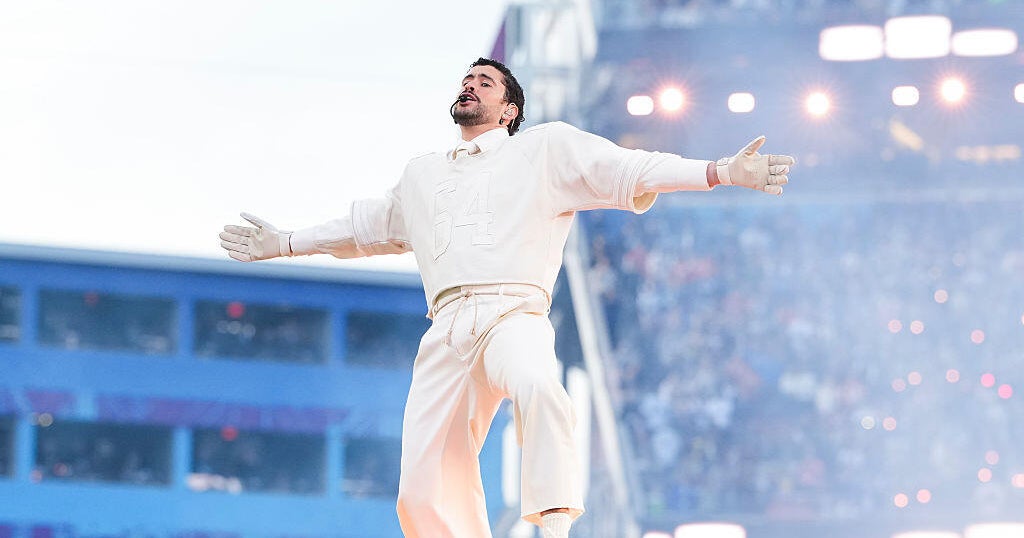
What made Sunday night’s performance truly groundbreaking wasn’t just the spectacle—it was the cultural significance. For the first time in Super Bowl history, the halftime show at America’s most-watched sporting event was performed primarily in Spanish. This wasn’t merely a performance; it was a statement, a celebration, and a moment of recognition for the Latino community in the United States and around the world. Bad Bunny, born Benito Antonio Martínez Ocasio, took the stage in Santa Clara, California, and delivered a show that was deeply personal and culturally rich. He performed hits from his Grammy-winning album “DeBÍ TiRAR MáS FOToS,” weaving together music, heritage, and pride in a way that captivated over 135 million viewers. The performance included heartfelt tributes to Puerto Rico and Latino culture more broadly, celebrating the traditions, sounds, and spirit that have shaped his music and identity. By choosing to perform in Spanish on such a massive platform, Bad Bunny made a powerful statement about representation, visibility, and the growing influence of Latino artists in mainstream American culture.
Star-Studded Surprises and Unforgettable Moments
The halftime show was packed with surprises that kept viewers on the edge of their seats. Bad Bunny didn’t take the stage alone—he brought along some of music’s biggest names to join him in this historic moment. Lady Gaga made a surprise appearance, adding her star power to an already electric atmosphere. Ricky Martin, a fellow Puerto Rican icon and trailblazer for Latin music in the American mainstream, also joined the performance, creating a powerful intergenerational moment that honored the path Latin artists have walked and the doors they’ve opened for artists like Bad Bunny. But perhaps the most unexpected and touching moment of the entire show was when a real wedding took place right there on the Super Bowl stage. This blend of music, culture, celebration, and genuine human emotion created a halftime show that was unlike anything audiences had seen before. It wasn’t just entertainment—it was a cultural event, a celebration of love, heritage, and the power of music to bring people together across languages, backgrounds, and borders.
The Numbers Tell an Incredible Story
While the performance itself was unforgettable, the aftermath has been equally remarkable. Early figures indicate that Bad Bunny’s halftime show was the most-watched Super Bowl halftime performance of all time, drawing more than 135 million viewers. To put that in perspective, that’s more people than live in Mexico, and nearly half the population of the United States. The impact on his streaming numbers was immediate and massive. Beyond the six songs dominating the top of the charts, Bad Bunny had eleven other tracks scattered throughout Spotify’s Top 50 U.S. chart, meaning he occupied nearly a third of the entire top 50. This kind of chart dominance is extraordinarily rare and speaks to both the quality of his performance and the enthusiasm of his fanbase. Among the other artists in the top ten were Olivia Dean with “Man I Need you,” Ella Langley with “Choosin’ Texas,” and Taylor Swift with “Opalite,” but even these established and popular artists were overshadowed by Bad Bunny’s post-Super Bowl surge.
Already the Biggest Artist on the Planet
This Super Bowl performance came at a moment when Bad Bunny was already at the peak of his career. He was Spotify’s most-streamed artist of 2025, a distinction that reflects his incredible global reach and the devoted fanbase he’s cultivated over the years. His music transcends language barriers, blending reggaeton, Latin trap, and other genres in ways that feel fresh, authentic, and deeply connected to his Puerto Rican roots. The Grammy-winning album “DeBÍ TiRAR MáS FOToS” that formed the centerpiece of his halftime performance showcases his growth as an artist—someone who can deliver club-ready hits while also creating deeply personal and politically conscious music. His fourth solo studio album, “Un Verano Sin Ti,” similarly demonstrated his versatility and his ability to create summer anthems that dominate not just Latin charts but mainstream American charts as well. The Super Bowl performance simply amplified what millions of fans already knew: Bad Bunny is one of the most important and influential artists working today, and his impact extends far beyond music into culture, representation, and social consciousness.
A Cultural Milestone with Lasting Impact
The significance of Bad Bunny’s Super Bowl halftime show will be felt for years to come. For Latino communities across the United States and throughout the world, seeing one of their own take the Super Bowl stage and perform primarily in Spanish was a moment of pride and recognition. It represented a shift in American culture—an acknowledgment that Latino voices, Spanish-language music, and Latin culture are not separate from the American mainstream but are integral parts of it. For young Latino artists, it was proof that they don’t have to change who they are, hide their heritage, or sing in English to reach the biggest stages in the world. Bad Bunny’s journey from a working-class neighborhood in Puerto Rico to the Super Bowl stage is inspirational, but what makes it even more powerful is that he made that journey on his own terms, staying true to his language, his culture, and his values. The streaming numbers—with his music dominating Spotify’s charts the very next morning—prove that authenticity resonates with audiences. In an era when music is increasingly global and listeners are open to sounds from every corner of the world, Bad Bunny’s success demonstrates that excellence transcends language. His Super Bowl performance wasn’t just a great show; it was a cultural milestone that will be remembered as the moment when Latino music and culture claimed their rightful place at the very center of American popular culture. The impact of that moment, measured in streams, views, and inspired young artists, will ripple forward for generations.