


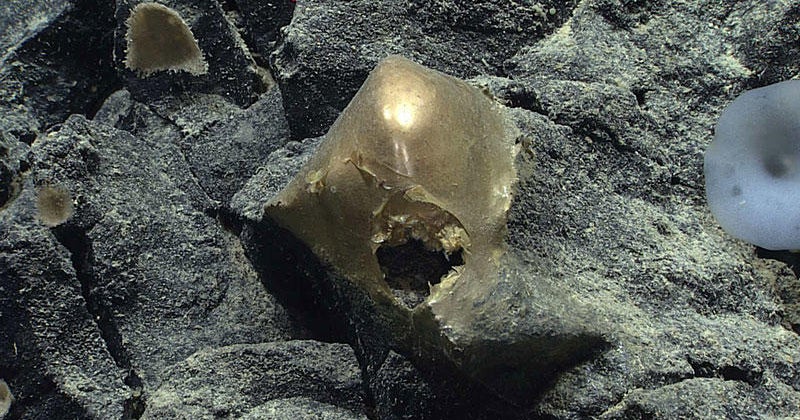

The Mystery of the Golden Orb: Scientists Crack the Case of a Deep-Sea Enigma
A Stunning Discovery in Alaska’s Ocean Depths
In 2023, researchers from the National Oceanic and Atmospheric Association (NOAA) stumbled upon something truly extraordinary while exploring the murky depths of the Gulf of Alaska. Using a remotely operated underwater vehicle diving more than two miles beneath the ocean’s surface, the team spotted what appeared to be a bizarre, golden, dome-shaped object with a hole in its center, firmly attached to a rock on the seafloor. The mysterious orb immediately captured the imagination of scientists and the public alike, sparking widespread curiosity about what this strange specimen could be. The shimmering golden object seemed almost otherworldly in appearance, raising questions about whether it was biological, geological, or something entirely unexpected. The team carefully collected the specimen and transported it to the prestigious Smithsonian National Museum of Natural History, where experts could examine it more closely. What initially seemed like a straightforward identification task would soon become one of the most challenging mysteries that deep-sea researchers had encountered in recent years, requiring months of intensive investigation and the collaborative efforts of specialists from multiple scientific disciplines.
An Unexpectedly Complex Scientific Challenge
When Allen Collins, the director of NOAA Fisheries’ National Systematics Laboratory and an experienced zoologist, first received the golden orb for examination, he expected that standard identification procedures would quickly reveal its nature. After all, scientists have sophisticated tools and extensive databases of known marine species at their disposal. However, the golden orb refused to yield its secrets easily. As Collins later explained, this case transformed from what should have been a routine identification into “a special case that required focused efforts and expertise of several different individuals.” The mystery demanded a comprehensive approach, bringing together experts in morphology (the study of physical structure), genetics, deep-sea biology, and bioinformatics—a field that uses computer technology to analyze biological data. This interdisciplinary collaboration highlights how modern marine science often requires scientists from various specialties to work together, combining their unique perspectives and methodologies to solve complex puzzles from the ocean’s depths. The case of the golden orb became a perfect example of how even experienced researchers can encounter specimens that challenge their assumptions and push the boundaries of current scientific knowledge.
Unraveling the Mystery Through Microscopic Investigation
The scientific team began their investigation by carefully studying the physical structure of the mysterious golden orb under powerful microscopes. Their initial findings were intriguing: the object wasn’t actually an animal, at least not in the conventional sense. Instead, researchers discovered it was composed of a “fibrous material” that was covered with specialized stinging cells, similar to those found on sea anemones and corals. These cells were specifically identified as spirocysts—highly specialized cellular structures that serve as capture mechanisms for prey. This discovery was significant because spirocysts exist in only one particular group of aquatic invertebrates known as cnidarians, which includes jellyfish, corals, sea anemones, and their relatives. This finding immediately narrowed down the possibilities and gave researchers a crucial starting point for their investigation. As the team continued their examination, they realized that the stinging cells on the golden orb looked remarkably similar to those found on another specimen that had been collected in 2021 during a different expedition. This connection provided the breakthrough the scientists needed, leading them to conduct a direct comparison between the golden orb and the earlier specimen to determine if they might be related or even represent the same species.
Genetic Analysis Reveals the Truth
With their morphological observations pointing toward a connection between the two specimens, the research team turned to genetic analysis to confirm their suspicions. They first attempted standard DNA testing procedures on both the golden orb and the 2021 specimen, but these initial genetic tests proved inconclusive, unable to provide the definitive answers the scientists were seeking. Undeterred, the team decided to employ more advanced techniques, specifically whole-genome sequencing—a comprehensive method that examines an organism’s complete genetic blueprint rather than just selected portions. This cutting-edge approach yielded remarkable results: the genetic analysis revealed that both specimens were “genetically almost identical” to a specific type of cnidarian called Relicanthus daphneae. With further detailed analysis, the team finally cracked the case. The golden orb that had mystified researchers for months wasn’t a complete organism at all—it had once been part of the base of a giant sea anemone. This revelation explained why the object appeared so unusual: it was actually a component that’s typically hidden beneath the anemone’s body and rarely seen in isolation. The golden coloration and distinctive structure were characteristics of this particular species’ anchoring system, which normally remains concealed from view as it secures the anemone to rocky surfaces on the ocean floor.
The Missing Anemone: An Ongoing Mystery
While scientists successfully identified what the golden orb actually was, a new question emerged: what happened to the rest of the anemone? According to NOAA’s explanation, this golden base is normally completely hidden underneath the living anemone, making it unusual to find one exposed and seemingly abandoned on the seafloor. The research team proposed several theories to explain this peculiar situation. The upper portion of the anemone might have died from natural causes, disease, or predation, with the more durable base persisting longer before decomposing. Alternatively, the anemone might have somehow detached from its base and relocated to a new spot—though this would be unusual behavior for these typically sessile creatures that remain anchored to one location throughout their lives. Understanding the complete lifecycle and behavior of these deep-sea anemones remains an ongoing challenge for marine biologists. When fully intact, these impressive creatures possess a pink-colored, cylindrical body that can grow to an astonishing three feet in diameter, with tentacles extending up to six feet in length. Their spirocysts—those specialized stinging cells—are actually the largest among all known cnidarians, making them formidable predators in their deep-sea environment. The discovery of this isolated base component provides valuable insights into the anatomy and structure of these remarkable but poorly understood creatures.
The Importance of Deep-Sea Exploration and Discovery
The successful identification of the golden orb represents more than just solving a single scientific puzzle—it demonstrates the vital importance of continued deep-sea exploration and the application of advanced technologies to understand our planet’s most mysterious environments. William Mowitt, NOAA Ocean Exploration’s acting director, emphasized this broader significance when he stated, “So often in deep ocean exploration, we find these captivating mysteries, like the ‘golden orb.’ With advanced techniques like DNA sequencing, we are able to solve more and more of them.” His words highlight how modern scientific tools are revolutionizing our ability to identify and understand organisms from environments that remain largely unexplored and unknown to humanity. The deep ocean, which covers more than 70% of Earth’s surface, remains one of the least explored frontiers on our planet, with scientists estimating that we’ve only examined a tiny fraction of what exists in these dark depths. Each expedition, like the one that discovered the golden orb, has the potential to reveal new species, ecosystems, and biological processes that expand our understanding of life on Earth. Mowitt further explained that this research serves multiple important purposes: “This is why we keep exploring—to unlock the secrets of the deep and better understand how the ocean and its resources can drive economic growth, strengthen our national security, and sustain our planet.” These discoveries aren’t merely academic exercises; they have practical implications for resource management, biotechnology development, pharmaceutical research, and environmental conservation. As humanity faces increasing challenges from climate change, ocean acidification, and ecosystem degradation, understanding deep-sea environments and their inhabitants becomes ever more critical for making informed decisions about how we interact with and protect these vital marine ecosystems for future generations.