



Bitcoin Holds Steady as Network Activity Reaches Historic Low: What This Means for Investors
Weekend Calm Before the Storm?
As the cryptocurrency market settled into its weekend routine on Saturday, March 4th, Bitcoin found itself in a familiar holding pattern, hovering around the $67,000 mark without much fanfare. This kind of subdued price action has become almost expected during weekends, when the hustle and bustle of institutional trading takes a breather. Traditional market investors typically step away from their desks, leaving the crypto markets in a quieter state. However, beneath this calm surface, something interesting is brewing in the blockchain data that has caught the attention of market analysts and could be signaling an important shift in Bitcoin’s trajectory. The latest on-chain metrics reveal that Bitcoin’s network utilization has dropped to unprecedented lows since records began, creating a pattern that historically has appeared just before significant market turning points. This development has sparked debate among traders and analysts about whether Bitcoin is gearing up to make another run at the psychologically important $70,000 threshold, or if further consolidation lies ahead.
Understanding the RVTS Ratio and What It Tells Us
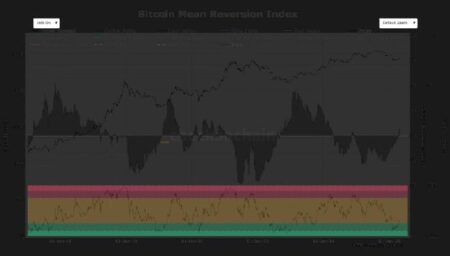
To grasp what’s happening with Bitcoin right now, we need to understand a somewhat technical but incredibly revealing metric called the RVTS ratio. Over a 28-day tracking period, blockchain analysts have observed this ratio reaching its highest level ever recorded since monitoring began. In simple terms, the RVTS ratio compares Bitcoin’s market capitalization to the adjusted volume of actual economic activity happening on the network. When this ratio climbs higher, it means that despite Bitcoin maintaining or increasing its overall market value, the actual movement and transfer of Bitcoin across the network has significantly decreased. Think of it like a highway system: the infrastructure might be worth billions, but if very few cars are actually driving on it, that tells you something about how actively it’s being used. This dramatic decline in network activity suggests that Bitcoin is experiencing its quietest period in its entire history when it comes to actual on-chain transactions and value transfers. The underlying cause points to a substantial reduction in adjusted transaction volumes, which form the foundation of this calculation and paint a picture of a network in an unusually dormant state.
Historical Patterns Point to Potential Market Bottoms
Here’s where things get particularly interesting for anyone following Bitcoin’s price movements. When analysts look back at previous Bitcoin market cycles, they find that similar peaks in the RVTS ratio have appeared during some of the most significant turning points in the cryptocurrency’s history. Specifically, these patterns emerged around the market cycle bottoms in 2012, 2015, 2019, and 2022 – years that marked the end of bearish periods and the beginning of new bull runs. Even beyond these major cycle troughs, the same signature has shown up during local lows within longer-term bull and bear market phases. What makes this pattern so compelling is its consistency across different market environments and time periods. It suggests that when network utilization drops to these extreme lows while the market cap remains stable or elevated, the asset may be approaching a point of maximum pessimism or disinterest – precisely the conditions that have historically preceded significant upward price movements. However, there’s an important context to consider in today’s environment. The current cryptocurrency trading ecosystem has evolved dramatically compared to earlier cycles. Modern Bitcoin trading is heavily dominated by derivative markets, futures contracts, and various liquidity mechanisms that don’t necessarily require actual Bitcoin to move on the base blockchain layer. This means transactions can happen “off-chain” through exchanges and derivative platforms, naturally reducing the volume of on-chain activity while not necessarily reflecting reduced interest in Bitcoin itself.
Technical Recovery Shows Promising Signs Amid Cautious Momentum
Looking at Bitcoin’s price action over the recent two-month period tells a story of gradual, methodical recovery rather than explosive growth. From a low of $59,930, Bitcoin has climbed steadily to its current trading level around $67,410, representing a respectable 12.6% gain. This kind of measured upward movement suggests that buyers are slowly but surely regaining confidence, even if they’re not rushing in with overwhelming enthusiasm just yet. Technical analysts watching the momentum indicator known as the Relative Strength Index (RSI) have noted its rise to the 45% level, which is significant because it suggests the downward correction momentum that had been dominating the market is beginning to lose steam. However, there’s a catch that hasn’t escaped the notice of experienced traders. While the RSI slope is pointing upward – usually a positive sign – the corresponding price action hasn’t shown the same level of conviction. This divergence indicates that buyers are making attempts to push prices higher, but they’re not yet succeeding in creating sustained upward pressure. The market seems to be in a state of equilibrium between cautious buyers and patient sellers, with neither side willing to make an aggressive move. What’s particularly noteworthy from a technical analysis perspective is that this recent price increase is forming what chartists call a “fresh bull cycle” within a larger falling channel pattern visible on the daily price charts.
The Falling Channel Pattern: Bitcoin’s Technical Crossroads
Since August 2025, Bitcoin’s price has been moving within a clearly defined falling channel pattern, bounded by two descending trendlines that act as dynamic barriers to price movement. The upper trendline serves as resistance, capping upward moves, while the lower trendline provides support, preventing prices from falling further. These aren’t static horizontal lines but rather diagonal boundaries that have been guiding Bitcoin’s price action for months, creating a predictable range for traders to work within. At the current price of approximately $67,270, Bitcoin finds itself in an interesting position – it’s just 5.3% away from testing the upper resistance trendline of this channel pattern. This proximity to resistance makes the next few days or weeks potentially crucial for determining Bitcoin’s direction in the near term. The upcoming retest of this resistance level will likely serve as a pivotal moment, a decision point that could determine whether Bitcoin breaks free from this months-long pattern of lower highs and lower lows, or whether it will respect the pattern and turn back downward once again. If selling pressure continues to defend this dynamic resistance successfully, technical analysts expect Bitcoin could reverse its recent gains and head back toward the nearest support level around $62,500, with a further potential decline to $57,500 if that support fails to hold.
What Comes Next: Breaking Out or Breaking Down?
The million-dollar question – or perhaps more appropriately, the $70,000 question – is whether Bitcoin can break free from this technical pattern and resume a stronger uptrend. The bearish scenario would see sellers successfully defending the upper trendline of the falling channel, forcing Bitcoin back into the lower reaches of its current range. In this case, traders would be watching those support levels at $62,500 and potentially $57,500 as areas where buyers might step back in to prevent further declines. This outcome would extend the consolidation period and suggest that the market needs more time before it’s ready for another sustained rally. On the other hand, the bullish scenario presents a much more exciting possibility for Bitcoin enthusiasts. A decisive breakout above the resistance trendline of the channel pattern would signal that buyers have finally gained enough strength to overcome months of selling pressure. Such a breakout would likely trigger renewed buying momentum, potentially pushing Bitcoin not just above the immediate resistance but through the psychologically significant $70,000 level that has been an important marker for the cryptocurrency. When combined with the historic low in network utilization that the RVTS ratio is revealing, there’s a case to be made that Bitcoin might be coiling up for a significant move. The extremely low on-chain activity could represent the quiet before the storm, a period of accumulation and disinterest that historically has preceded major price movements. As institutional investors return to their desks after the weekend and as we move further into March, all eyes will be on whether Bitcoin can muster the strength to challenge that resistance trendline and potentially kick off the next leg of its journey toward new highs. For now, patience remains the watchword as the market decides its next direction.