





Bitcoin’s Bear Market Reality: Understanding the Current Downturn and What Experts Really Think
The Current State of Bitcoin’s Market Performance
Bitcoin has been on quite a rollercoaster ride lately, and depending on who you ask, we’re either witnessing a temporary setback or the beginning of something more serious. The world’s largest cryptocurrency has managed to claw back some losses this month, gaining nearly 15% in recent trading sessions. That sounds encouraging on the surface, but here’s the sobering reality: Bitcoin is still sitting about 40% below its all-time high, which has left many investors and industry watchers questioning whether we’ve truly seen the worst of this bear market that started back in October. The cryptocurrency that once seemed unstoppable has been humbled, and the community is split on what comes next. Some remain optimistic that this is just another dip in Bitcoin’s famously volatile journey, while others are bracing for potentially deeper losses ahead. The uncertainty has created an atmosphere where speculation runs wild, and everyone from seasoned analysts to casual observers has an opinion about where the digital currency is headed.
The Alarming $40,000 Prediction and Its Origins
Among the various predictions circulating in the cryptocurrency community, one particularly eye-catching forecast has gained attention: the possibility of Bitcoin dropping to $40,000. If this were to happen, it would represent a staggering 70% decline from Bitcoin’s all-time peak, a drop that would send shockwaves through the entire crypto ecosystem and likely trigger panic selling among retail investors. This dramatic prediction hasn’t come from just one source but appears to be circulating among several unidentified forecasters in the industry. However, it’s important to note that not everyone is buying into this doomsday scenario. James Check, a respected Bitcoin analyst, has been one of the voices of reason pushing back against this extreme bearish outlook. While he acknowledges that such a dramatic drop isn’t technically impossible—after all, we’ve learned that anything can happen in the wild world of cryptocurrency—he emphasizes that it would be “statistically extraordinary” for Bitcoin to fall that far. Check’s analysis suggests that while bears have every right to express their concerns and make their predictions, this particular forecast deserves much closer scrutiny before being accepted as a likely outcome.
Understanding Bitcoin’s Recent Price Journey
To truly appreciate where Bitcoin might be heading, we need to understand where it’s been. The cryptocurrency’s recent history reads like a thriller novel, with dramatic ups and downs that have tested the nerves of even the most seasoned investors. Back in October, Bitcoin was riding high, having climbed above the impressive $126,000 mark. At that point, the future looked bright, and many believers in the cryptocurrency thought the sky was the limit. But what goes up must come down, especially in the volatile world of digital currencies. By February, Bitcoin had experienced a brutal correction, sliding more than 50% to hover around the $60,000 level. That’s when things seemed to stabilize somewhat, giving investors a chance to catch their breath and reassess their positions. As of the most recent trading sessions on Friday, Bitcoin was changing hands near $78,000, representing a significant recovery from those February lows but still a far cry from the October heights. This journey from $126,000 to $60,000 and back to $78,000 illustrates the kind of extreme volatility that has always characterized Bitcoin trading, reminding us why cryptocurrency investment isn’t for the faint of heart.
The Science Behind Check’s Analysis: The Mean Reversion Index Explained
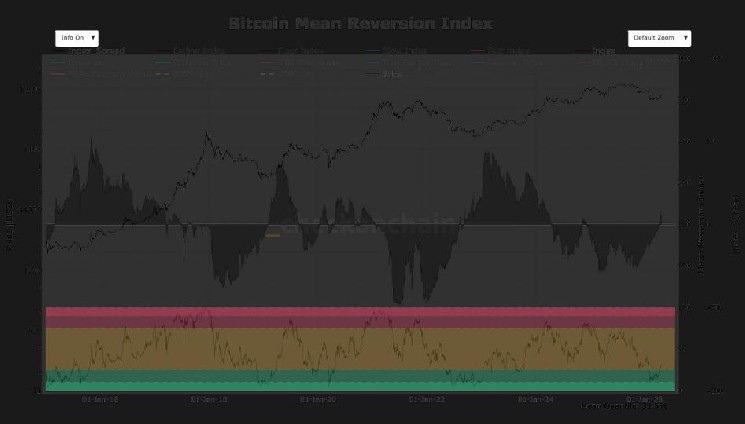
James Check isn’t just throwing out gut feelings or making wild guesses about Bitcoin’s future—his analysis is grounded in sophisticated mathematical modeling and historical data analysis. At the heart of his argument against the $40,000 prediction is something called the Bitcoin Mean Reversion Index, which sounds complex but is actually a clever way of understanding where Bitcoin’s price stands relative to its historical norms. This composite model doesn’t rely on just one indicator but instead averages together multiple key valuation metrics to create a more comprehensive picture. Among the factors considered are the 200-week moving average, which smooths out short-term volatility to reveal longer-term trends; the realized price, which reflects the average price at which all bitcoins last moved; the power law trend, which examines Bitcoin’s long-term growth pattern; and various volume-weighted average price measures that account for trading volume in price calculations. By combining these different anchors—some technical, some based on blockchain data, some fast-moving and others slow—the index can rank Bitcoin’s current price on a historical percentile basis. This approach provides a much more nuanced view than simply looking at price charts and trying to guess what comes next based on recent patterns alone.
The Statistical Improbability of Extreme Bear Scenarios
When Check ran the numbers on a hypothetical $40,000 Bitcoin price through his Mean Reversion Index, the results were striking. At that price level, Bitcoin would register as what he calls a “0.4 event,” meaning it would fall in the 0.4th percentile of all daily closes throughout Bitcoin’s entire trading history. To put that in perspective, this would place such a price level below any meaningful deviation across all the major valuation anchors that analysts typically use to assess Bitcoin’s fair value. Check offers a fascinating historical comparison to help people understand just how extreme this would be: a drop to $40,000 today would be roughly equivalent, on a relative basis, to Bitcoin trading below $2 back in 2011. For those who remember Bitcoin’s early days, that was when the cryptocurrency was still largely experimental, known only to a small community of enthusiasts, and lacking the institutional adoption and mainstream awareness it enjoys today. By contrast, Bitcoin’s current price around $78,000 sits at approximately the 31.5th percentile historically—certainly weak and indicative of a correction, but well within the range of normal market movements that Bitcoin has experienced during previous bear markets. This is a crucial distinction: the difference between a healthy correction and a catastrophic collapse.
Market Realism: Acknowledging Possibilities While Maintaining Perspective
Check’s final words on the matter strike an important balance between acknowledging reality and maintaining perspective. “There’s no zero probability in markets,” he wisely notes, reminding us that in the unpredictable world of cryptocurrency trading, we should never say never. Black swan events happen, unexpected regulatory changes can shake markets, macroeconomic factors beyond anyone’s control can trigger massive sell-offs, and technological issues could theoretically undermine confidence in Bitcoin. All of these scenarios, however unlikely, remain within the realm of possibility. However, Check emphasizes that a drop to $40,000 “would be a near-unprecedented outcome”—not impossible, but so statistically unlikely based on historical patterns and current market fundamentals that it shouldn’t be the base case scenario that investors plan around. This kind of measured analysis is exactly what the cryptocurrency market needs more of: expert voices that can cut through the noise of both excessive hype and unwarranted fear. For investors trying to navigate these turbulent waters, the message is clear: while caution is always warranted in cryptocurrency investment, panicking over extreme predictions that lack statistical support isn’t a sound strategy. Bitcoin has weathered numerous storms since its creation, recovering from multiple bear markets that many thought would be its end. While past performance never guarantees future results, the statistical analysis suggests that reports of Bitcoin’s impending doom to $40,000 are greatly exaggerated. The current price levels, while certainly down from the highs, remain within historically normal correction ranges, suggesting that patience rather than panic might be the most appropriate response for long-term believers in Bitcoin’s fundamental value proposition.









