


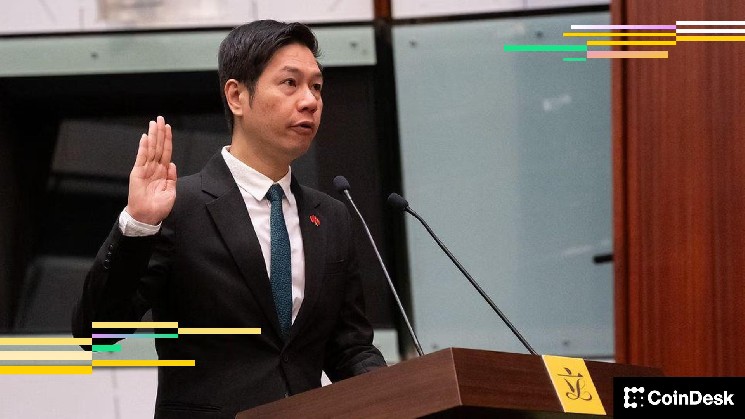

Johnny Ng: Building Bridges in the Global Crypto Landscape
A Pragmatic Voice in Hong Kong’s Digital Asset Evolution
In the rapidly evolving world of cryptocurrency and digital assets, Johnny Ng stands out as a refreshingly pragmatic figure. As a legislator representing Hong Kong’s technology sector in the Legislative Council, Ng has deliberately distanced himself from the divisive political theatrics that often characterize cryptocurrency regulation debates. While regulators in Washington and Beijing pursue their own, often conflicting, approaches to digital assets, Ng is charting a different course entirely. His vision isn’t about winning territorial battles or claiming dominance in the crypto space—it’s about something far more collaborative and potentially transformative. He’s focused on creating connections between markets, technologies, and jurisdictions that have historically operated in isolation from one another. Set to speak at CoinDesk’s Consensus Hong Kong conference, Ng has established himself as one of the city’s most passionate and articulate champions for Web3 and digital assets. His approach reflects a mature understanding that the future of digital finance won’t be won through zero-sum competition, but through thoughtful integration of traditional financial systems with crypto-native innovation.
Building on Solid Foundations: Hong Kong’s Unique Position
Over the past two years, Johnny Ng’s legislative achievements have been substantial and strategic. He’s successfully pushed through comprehensive stablecoin legislation, supported the licensing framework for crypto exchanges, and helped position Hong Kong as an early adopter of regulated crypto finance. But these accomplishments, impressive as they are, represent tactical victories in service of a much larger strategic vision. Ng sees Hong Kong not as a competitor to other financial centers, but as a critical bridge between East and West, and between the established world of traditional finance and the emerging frontier of cryptocurrency innovation. In his interview with CoinDesk from his legislative office, Ng emphasized a fundamental truth that some crypto enthusiasts overlook: “Crypto and Web3 are really highly linked with the traditional financial system.” This recognition shapes his entire approach to regulation and development. Hong Kong’s advantages, in Ng’s assessment, begin with its existing institutional strengths—a well-established common law system that’s easily understood internationally, English-language courts that provide clarity and accessibility, unrestricted capital flows that allow money to move freely, and perhaps most importantly, a dense concentration of global financial institutions including banks, asset managers, law firms, and auditing companies. These aren’t flashy cryptocurrency-specific advantages, but they provide something arguably more valuable: a stable, credible foundation upon which to build innovative financial infrastructure. As one of the world’s largest international finance centers, Hong Kong can leverage this foundation to develop a crypto ecosystem that is, in Ng’s words, “safe, secure and moving along the way.”
The Greater Bay Area: Connecting Capital with Innovation
Ng’s vision extends beyond Hong Kong’s borders to encompass the Greater Bay Area initiative, an ambitious government program designed to increase economic integration between Hong Kong, major mainland Chinese cities like Shenzhen and Guangzhou, and Macau, China’s other Special Administrative Region. This geographic and economic perspective is central to understanding Ng’s strategy. He doesn’t see Hong Kong as needing to compete with or replicate the capabilities of neighboring mainland cities—particularly Shenzhen’s renowned engineering and manufacturing culture. Instead, he envisions a complementary relationship where each region contributes its unique strengths to a larger whole. Shenzhen, often called “the workshop of the world,” churns out cutting-edge electronics and technology products at scale. What excites Ng is the possibility of connecting Hong Kong’s financial and legal infrastructure with mainland China’s manufacturing depth and youthful, technically skilled workforce. “In Shenzhen, the average age of the people is really young, under 30,” Ng observed, describing a city populated by engineers and technologists who possess the practical skills to transform abstract ideas into tangible products. The synergy he envisions is straightforward but powerful: “Hong Kong can be a bridge,” he explained. “We can think something, and then we realize something by their human capital.” Hong Kong brings common law legal structures, open capital markets, and global market access. Mainland cities contribute scale, manufacturing capacity, and an enormous pool of talented young workers. Ng even points to cryptocurrency history to validate this model, noting that Ethereum founder Vitalik Buterin spent considerable time in Zhuhai, Shenzhen, and Hong Kong during Ethereum’s formative years. The region has long been fertile ground for blockchain experimentation at the protocol level. What Hong Kong adds to this existing innovative capacity is regulatory clarity and financial credibility—the institutional legitimacy that can help transform experimental technology into mainstream financial infrastructure.
A Global Perspective: Invitation, Not Competition
Johnny Ng’s bridge-building philosophy extends well beyond the Greater Bay Area to encompass a genuinely global outlook on cryptocurrency regulation and development. In 2023, during a period when U.S. regulators were launching aggressive enforcement actions against cryptocurrency companies, Ng made international headlines with a bold public gesture. He openly invited Coinbase and other major exchanges to consider relocating to Hong Kong, offering to personally assist with applications for official trading platform status and development plans. At the time, many observers interpreted this move as competitive signaling—Hong Kong trying to capitalize on regulatory uncertainty in the United States by poaching American crypto businesses. But Ng now frames that invitation quite differently, revealing a more nuanced worldview. “I’m not going to see the competition with any countries,” he stated clearly. “Crypto cannot be easily divided by country or economy. It is one world.” This perspective represents a fundamental departure from the nationalist approach that often characterizes regulatory discussions. Rather than viewing cryptocurrency regulation as a zero-sum game where one jurisdiction’s gain is another’s loss, Ng advocates for regulatory coordination and predictability across different legal systems. His goal isn’t to win businesses away from other financial centers through regulatory arbitrage, but to help create a more coherent global framework. “I want the Hong Kong government to make more connections with different jurisdictions, the governing bodies together,” he explained, emphasizing the need for clearer international standards that would allow cryptocurrency to integrate more seamlessly with real-world economic activity. This collaborative approach acknowledges a practical reality: cryptocurrency networks operate globally and don’t respect national borders. Attempting to contain them within rigid jurisdictional boundaries is not only futile but potentially counterproductive. What the industry needs, according to Ng, is coordination that provides businesses and users with regulatory predictability while still maintaining appropriate oversight and consumer protections.
The Road Ahead: Infrastructure and Integration
As Hong Kong’s Legislative Council begins a new session following fall elections, Ng is looking toward the next phase of regulatory development with characteristic focus on practical infrastructure. The coming year will see the implementation of custody and over-the-counter (OTC) trading regulations, along with potential reforms that could allow higher-volume trading for professional investors. These aren’t headline-grabbing announcements, but they represent the essential plumbing that connects cryptocurrency markets with traditional financial systems. Ng describes this work as being about infrastructure—the unglamorous but absolutely critical regulatory and operational frameworks that make sophisticated financial activity possible. Just as modern cities require robust sewage systems and electrical grids that most residents never think about, mature financial markets require custody arrangements, trading infrastructure, and regulatory frameworks that provide security and clarity without unnecessary friction. Hong Kong’s regulatory roadmap reflects this understanding, building out the fundamental infrastructure necessary for institutional participation in digital asset markets. Beyond cryptocurrency-specific regulations, Ng also sees important convergence happening at the intersection of digital assets and artificial intelligence. Hong Kong, he argues, occupies a uniquely advantageous position in the emerging AI landscape, capable of working with both Western and Chinese datasets and serving as a neutral ground where AI companies from around the world can collaborate. This positioning mirrors his broader vision for Hong Kong’s role in cryptocurrency—not as a dominant player that excludes others, but as a connector that facilitates collaboration and integration across different technological and jurisdictional spheres.
A Vision of Connection in an Era of Division
Johnny Ng’s ultimate bet on Hong Kong’s future isn’t based on the city outbuilding or outmuscling other cryptocurrency or AI hubs through sheer scale or resources. Instead, his wager is that by remaining open, well-regulated, and connected to both traditional finance and emerging technology sectors, Hong Kong can position itself at the center of systems that are still very much under construction. This strategy recognizes several important realities about the current moment in financial technology development. First, it acknowledges that cryptocurrency and Web3 technologies are not replacing traditional finance but rather integrating with it in complex ways that require both technological innovation and institutional credibility. Second, it accepts that no single jurisdiction has all the necessary components to build comprehensive digital asset infrastructure alone—success requires collaboration and complementary strengths. Third, it understands that in an increasingly fragmented geopolitical environment, there is tremendous value in serving as a trusted intermediary that can work across different regulatory and technological ecosystems. In an era characterized by increasing division—between East and West, between traditional finance and crypto natives, between different regulatory philosophies—Ng’s emphasis on bridge-building offers a refreshing and potentially more sustainable path forward. Rather than viewing cryptocurrency development as a competition to be won, he frames it as a collaborative construction project where different participants bring different strengths to the table. Hong Kong’s contribution, in this vision, is not dominance but connection—providing the legal clarity, financial infrastructure, and open markets that can help link innovative technology with capital, regulatory legitimacy, and global market access. Whether this vision will succeed remains to be seen, but it represents a thoughtful alternative to the zero-sum crypto politics that have characterized too much of the regulatory debate in recent years.