



CoinDesk 20 Index Daily Market Update: Understanding Today’s Crypto Downturn
Market Overview: A Sea of Red Across the Board
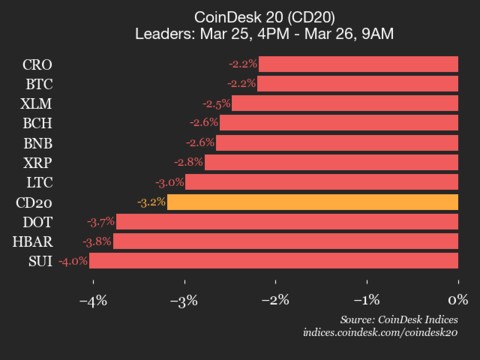
The cryptocurrency market is experiencing a challenging trading session today, with the CoinDesk 20 Index painting a predominantly bearish picture that has left investors and traders reassessing their positions. As of the latest update, the CoinDesk 20 Index is currently valued at 1985.11, representing a notable decline of 3.2% or 65.39 points since 4 p.m. Eastern Time on Wednesday. What makes today’s market movement particularly significant is the uniformity of the downturn – remarkably, not a single one of the 20 assets included in this comprehensive index is trading in positive territory. This kind of universal decline is relatively rare in the cryptocurrency market, which typically sees at least some assets moving against the prevailing trend, and it suggests broader market forces at play rather than asset-specific concerns.
The CoinDesk 20 Index serves as a critical barometer for the overall health and direction of the cryptocurrency market. Unlike narrow indices that focus on just a handful of major cryptocurrencies, this broad-based index provides a more comprehensive view of the digital asset ecosystem by tracking 20 of the most significant and liquid cryptocurrencies available to investors. The index’s design allows market participants – from institutional investors to individual traders – to quickly gauge market sentiment and make informed decisions about their cryptocurrency holdings. The fact that this index is traded on multiple platforms across several global regions underscores its importance as a standardized benchmark for cryptocurrency performance, much like traditional market indices such as the S&P 500 or the Dow Jones Industrial Average serve for equities.
Understanding Today’s Relative Outperformers
Even in a down market, some assets demonstrate relative strength by declining less than their peers, and today’s session is no exception. Leading the pack in terms of relative performance are Cronos (CRO) and Bitcoin (BTC), both showing a decline of 2.2%. While these assets are certainly trading lower, their ability to limit losses to just over 2% in an environment where the broader index is down 3.2% demonstrates a degree of resilience that hasn’t been evident in other corners of the market. This relative outperformance suggests that investors may be gravitating toward what they perceive as more established or fundamentally sound projects during this period of market weakness.
Bitcoin’s position as a relative leader shouldn’t come as a complete surprise to seasoned crypto observers. As the original cryptocurrency and still the largest by market capitalization, Bitcoin often serves as a “flight to safety” asset within the cryptocurrency ecosystem during periods of market stress. When uncertainty grips the market, traders frequently consolidate their holdings into Bitcoin, viewing it as the most battle-tested and institutionally accepted digital asset. With over a decade of operational history, the deepest liquidity pools, and the most extensive regulatory clarity compared to other cryptocurrencies, Bitcoin represents the closest thing the crypto market has to a blue-chip asset. Today’s trading pattern suggests that this dynamic may once again be at work, with investors preferring to maintain Bitcoin exposure rather than holding positions in alternative cryptocurrencies.
Cronos (CRO), the native token of the Crypto.com ecosystem, showing similar resilience to Bitcoin is particularly noteworthy. CRO has established itself as a utility token with real-world use cases within one of the cryptocurrency industry’s largest and most visible platforms. The token benefits from Crypto.com’s extensive marketing efforts, including high-profile sponsorships and partnerships, as well as its integration into the platform’s various services such as trading fee discounts, staking rewards, and the Crypto.com Visa Card program. The token’s relative strength today may reflect investor confidence in the underlying platform’s business model and growth trajectory, even as short-term market sentiment turns negative. It’s worth noting that utility tokens tied to successful exchanges and platforms often demonstrate different price dynamics than purely speculative cryptocurrencies, as they derive value from both speculative interest and actual usage within their respective ecosystems.
Today’s Underperformers: Examining the Laggards
On the opposite end of today’s performance spectrum, we find AAVE and Cardano (ADA) bearing the brunt of selling pressure. AAVE, the governance token of the decentralized lending protocol of the same name, is down 5.6%, making it the worst performer in the CoinDesk 20 Index for this trading session. Following closely behind is Cardano’s ADA token, which has declined 4.8%. These assets are falling at nearly double the rate of the overall index, indicating that whatever broader market pressures are affecting the cryptocurrency space, they’re being felt most acutely in these particular corners of the market.
AAVE’s pronounced weakness today is particularly interesting given its position in the decentralized finance (DeFi) sector. The AAVE protocol represents one of the most successful and widely-used DeFi applications, allowing users to lend and borrow cryptocurrencies without traditional intermediaries. The token itself serves multiple functions within the protocol, including governance rights and fee discounts, while also serving as a backstop in the protocol’s safety module. The heightened selling pressure on AAVE could reflect several factors. DeFi tokens as a category have experienced significant volatility recently, and there may be concerns about regulatory scrutiny of decentralized lending platforms, or possibly profit-taking after earlier gains. Additionally, DeFi tokens often exhibit higher beta characteristics – meaning they tend to amplify broader market movements, falling harder during downturns and rising more dramatically during rallies. Today’s action appears to be a textbook example of this higher-risk profile in action.
Cardano’s ADA token, meanwhile, represents a different type of cryptocurrency project but is facing similar selling pressure. Cardano positions itself as a third-generation blockchain platform, designed to address scalability, interoperability, and sustainability issues that have plagued earlier blockchain networks. Despite its strong technological foundations and academic approach to development, ADA has experienced its share of market volatility. Today’s 4.8% decline may reflect several factors, including general risk-off sentiment in the cryptocurrency market, concerns about the pace of development and adoption on the Cardano network, or simply technical trading patterns. Large-cap alternative cryptocurrencies like Cardano often face the challenge of justifying their valuations through real-world adoption and usage, and during market downturns, investors may question whether these platforms are delivering sufficient value to support their market capitalizations. The heightened selling in ADA today suggests that at least for this session, sentiment around the project has turned decidedly cautious.
Broader Market Context and What It Means for Investors
Understanding today’s market movement requires looking beyond the simple percentages to consider what might be driving this broad-based decline across all 20 assets in the index. Several factors could be contributing to the current market environment. Macroeconomic conditions continue to play an outsized role in cryptocurrency price action, with digital assets increasingly correlated to traditional risk assets like technology stocks. Concerns about interest rates, inflation, economic growth, and geopolitical tensions all flow through to cryptocurrency markets, often with amplified effect. Additionally, cryptocurrency-specific factors such as regulatory developments, exchange-related news, or large-scale investor behavior can trigger market-wide movements.
The fact that every single asset in the CoinDesk 20 is trading lower suggests a systematic rather than idiosyncratic factor is at work. This kind of uniform decline typically occurs when investors are reducing their overall exposure to the cryptocurrency asset class rather than discriminating between individual projects or tokens. It might reflect profit-taking after a previous rally, response to negative news affecting the broader crypto ecosystem, or simply a rebalancing of portfolios as investors move capital to assets they perceive as safer or more promising. For long-term cryptocurrency investors, days like today are a reminder of the asset class’s volatility and the importance of position sizing and risk management. While the 3.2% decline in the index might seem modest compared to some of the dramatic moves cryptocurrency markets have seen in the past, the breadth of the decline – affecting every asset without exception – makes it a significant technical and psychological event for market participants.
Conclusion: Perspective on Market Volatility and Looking Ahead
Today’s trading session serves as a valuable reminder of the cryptocurrency market’s inherent volatility and the importance of maintaining perspective during short-term price fluctuations. While a 3.2% decline in the CoinDesk 20 Index certainly represents a meaningful move, particularly given the breadth of the decline across all constituent assets, it’s essential for investors to place this movement within the broader context of cryptocurrency market history and their own investment timelines. Markets don’t move in straight lines, and periods of consolidation or decline are a natural and necessary part of any healthy market’s evolution. These moments can serve as opportunities for accumulation for those with conviction in the long-term potential of blockchain technology and digital assets, or as reminders to reassess position sizes and risk tolerance for those who find themselves uncomfortable with such volatility.
The CoinDesk 20 Index will continue to serve as an important tool for tracking the overall direction and health of the cryptocurrency market. By providing a broad-based view that goes beyond just Bitcoin or a handful of major assets, it offers investors and observers a more nuanced understanding of how capital is flowing through the digital asset ecosystem. Whether today’s decline represents a temporary setback or the beginning of a more sustained period of weakness remains to be seen, but the index will continue to provide the data points necessary to make that assessment. As always in cryptocurrency markets, staying informed, maintaining appropriate risk management practices, and keeping a long-term perspective are the keys to navigating both the opportunities and challenges that this dynamic and evolving asset class presents.