


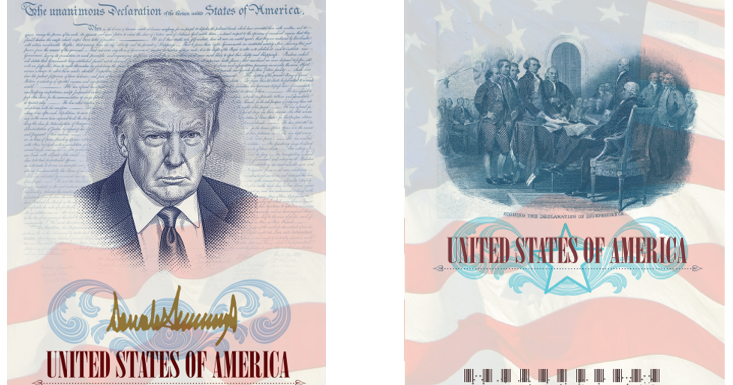

Trump’s Portrait to Grace Special Edition American Passports for Nation’s 250th Birthday
A Bold Departure from Traditional Passport Design
In a move that has sparked both interest and controversy, the U.S. State Department has announced plans to issue a special commemorative passport design featuring President Donald Trump’s portrait and signature. This limited-edition redesign is being released to mark America’s 250th anniversary celebration, scheduled for July 2026. What makes this particularly noteworthy is the significant departure from traditional passport design philosophy. For generations, American passport pages have showcased the nation’s diverse heritage through images of historical landmarks, cultural symbols, and scenes from pivotal moments in U.S. history. The new design instead prominently displays the sitting president’s portrait overlaid on text from the Declaration of Independence on the interior visa pages. State Department spokesperson Tommy Pigott emphasized that while the artistic elements are changing, the passports will maintain the same robust security features that make U.S. passports among the world’s most secure travel documents. The commemorative versions will be offered at no additional cost to applicants, though availability will initially be limited to the Washington Passport Agency, while other passport-issuing locations and online applications will continue to use the existing design.
Understanding the Design Evolution of American Passports
To fully appreciate the significance of this change, it’s worth looking at how American passport design has evolved over the years. The current “Next Generation” passport, which was introduced in 2021, features beautiful illustrations showcasing American landscapes and important historical events spread across its pages. This design philosophy aimed to tell the story of America through visual representation of the land itself and the significant moments that shaped the nation. Before that, a major redesign in 2007 brought important technological advances to prevent counterfeiting and fraud, incorporating electronic chip technology that revolutionized passport security. That version also included inspirational quotations from former U.S. presidents throughout history, offering travelers a connection to the wisdom and vision of past leaders as they journeyed abroad representing their country. The traditional approach to passport design has generally focused on celebrating collective national heritage rather than individual leaders, making this new Trump-featured design a notable shift in philosophy about what should represent America to the world.
The Scope and Availability of the Commemorative Passport
According to State Department officials, the special anniversary passports will be available as the default option at the Washington Passport Agency once they become available. This means that Americans applying for passports at that specific location will automatically receive the commemorative version unless they specifically request otherwise. However, the redesigned passport will not be universally available across all passport application channels. Those applying online or at other passport-issuing locations throughout the country will continue to receive the existing standard passport design. Early reports suggested that approximately 25,000 copies of the commemorative passport would be issued, though a State Department official disputed this number, calling it “fake news” without providing an alternative figure. This lack of clarity about exactly how many commemorative passports will be produced has added to the questions surrounding the initiative. What is clear is that these special edition passports will not carry any additional fee beyond the standard passport application costs, making them accessible to anyone who happens to apply at the right location during the right time period.
Part of a Broader Pattern of Trump Branding
The commemorative passport design is just one element of a much broader effort to attach President Trump’s name and likeness to various government institutions, programs, and official items during his second administration. Perhaps most prominently, there are plans to rename the prestigious John F. Kennedy Center for the Performing Arts in Washington, D.C., rechristing it as the “Trump-Kennedy Center.” Similarly, the United States Institute of Peace, an independent institution created by Congress to prevent and resolve violent international conflicts, is slated to be renamed the “Donald J. Trump Institute of Peace.” The administration has also announced a “Trump gold card” visa program, which would allow non-U.S. citizens to obtain a valid visa to live and work in the United States in exchange for a $5 million investment. Additionally, the Treasury Department has announced that Trump’s signature will appear on paper currency—an unprecedented move for a sitting president—as part of the 250th anniversary commemoration of American independence. The U.S. Mint is also planning to issue a special 24-karat gold commemorative coin featuring President Trump’s image, further cementing his presence on official government materials and collectibles.
The Historical Context of Presidential Recognition
While presidents have traditionally been honored on American currency and through various memorials, such recognition has typically come years or decades after they’ve left office, allowing for historical perspective on their contributions and legacy. Mount Rushmore, perhaps the most iconic presidential monument, features George Washington, Thomas Jefferson, Theodore Roosevelt, and Abraham Lincoln—all presidents whose historical significance was well-established long before their images were carved into stone. Similarly, the faces on American currency belong to presidents and founding fathers whose places in history had been firmly cemented by the passage of time. The practice of waiting until after a presidency concludes—and often until after a president’s death—before bestowing such honors has been rooted in the idea that proper historical assessment requires distance and objectivity. This new approach of featuring a sitting president so prominently on official documents like passports and currency represents a departure from this tradition and raises questions about the appropriate timing and nature of presidential commemoration.
Public Reaction and Questions About Precedent
The announcement of the Trump-featured passport design has generated considerable discussion about the appropriate use of presidential imagery on official government documents. Critics have raised concerns about whether a sitting president’s portrait belongs on items like passports, which serve as the primary identification document for Americans traveling abroad and which remain valid for ten years, potentially well beyond any single administration. There are questions about whether this sets a precedent for future administrations to similarly feature sitting presidents on official documents and whether such personalization of government materials is appropriate in a democracy where institutions are meant to transcend individual leaders. Supporters, meanwhile, view the commemorative design as a fitting way to mark a significant milestone in American history and to celebrate the current administration’s vision for the country during this anniversary year. They argue that the limited-edition nature of the passport and its connection to the 250th anniversary celebration make it a special collectible rather than a standard practice. As with many initiatives from this administration, the Trump passport design has become another flashpoint in broader debates about presidential power, government traditions, and the balance between honoring current leadership and maintaining institutional continuity that extends beyond any single elected official. Regardless of where one stands on these questions, the commemorative passport represents a tangible symbol of how this administration is choosing to mark America’s quarter-millennium milestone.