


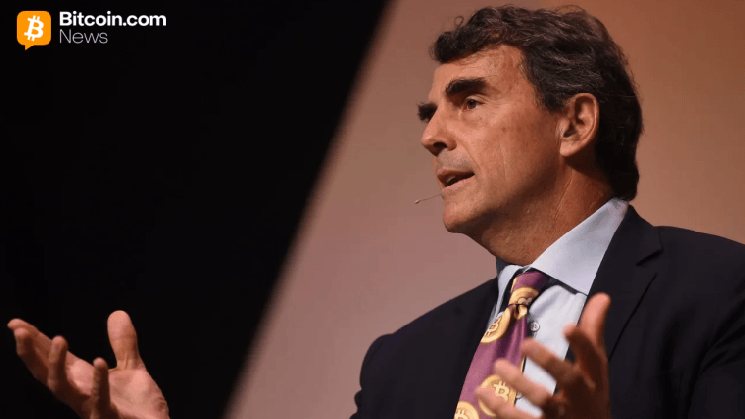

Tim Draper’s Bold Warning: Why Bitcoin Is No Longer Optional for Companies, Families, and Nations
A Venture Capitalist’s Journey from Skeptic to Bitcoin Evangelist
Tim Draper didn’t start out as a bitcoin believer—his path to becoming one of cryptocurrency’s most vocal advocates began with an unlikely source: a Korean friend and an online video game. Speaking to an energized audience at the Bitcoin 2026 conference in Las Vegas, the legendary Silicon Valley venture capitalist and founder of Draper Associates shared how a seemingly trivial conversation around 2002 planted the seeds for his eventual embrace of digital currency. His friend had been paying someone to play his character in the game Lineage while he worked, and when Draper bought a virtual sword as a birthday present for his friend’s son, the realization hit him—he’d just spent real money on pixels. That moment crystallized something profound in Draper’s mind: if people were already treating virtual items as valuable, why couldn’t money itself eventually become virtual? When Bitcoin’s mysterious creator Satoshi Nakamoto launched the network years later, Draper recognized it as the answer to questions he’d been pondering for nearly a decade. Here was a system that eliminated the need for banks and governments as middlemen, created permanent and unchangeable records, and freed money from centralized control. Even after losing substantial holdings to the infamous Mt. Gox exchange collapse—one of cryptocurrency’s darkest chapters—Draper didn’t lose faith. Instead, he noticed something remarkable: Bitcoin’s price only dropped 10-15% on the devastating news, a sign of underlying strength that most observers missed. His conviction was so strong that he later bid above market price at a U.S. Marshals Service auction of seized bitcoin, acquiring even more than he’d originally lost.
The Three-Stage Evolution of Money and Why Fiat Currency Faces an Existential Threat
During his keynote address on April 27, Draper laid out what he believes is an inevitable three-stage progression in how humanity handles money, and we’re currently living through the transition between stages two and three. The first stage, he explained, is traditional fiat currency—dollars, euros, yen—controlled entirely by governments and distributed through banking systems that act as gatekeepers to your own wealth. The second stage is stablecoins, digital currencies that move faster and more efficiently than traditional money but remain fundamentally tied to government-issued currency, meaning they’re still vulnerable to inflation, government spending policies, and the same systemic risks that plague traditional money. The third and final stage, according to Draper, is Bitcoin—a form of money that not only exists outside government control but actually grows in value over time rather than slowly bleeding purchasing power through inflation. To drive his point home, Draper shared a powerful childhood memory: his father once gave him a million-dollar Confederate bill, an impressive-sounding gift until his father explained it was completely worthless because the Confederacy had lost the Civil War. That seemingly worthless piece of paper served as a profound lesson about what happens when the issuing authority behind currency collapses or loses legitimacy. Draper warned that today’s government-issued currencies could face a similar fate if a tipping point is reached where retailers increasingly accept only Bitcoin and panicked consumers rush to convert their dollars, euros, or other fiat money before it loses even more value. “You should be scared if you don’t own bitcoin,” Draper told the crowd bluntly. “You should be very, very worried.”
Why Corporate Treasury Allocation to Bitcoin Is Now a Basic Business Responsibility
One of Draper’s most striking assertions was that companies refusing to hold bitcoin in their treasuries aren’t just being conservative—they’re being irresponsible and putting their entire operations at serious risk. He argued that every business should now hold between 5% and 15% of their corporate treasury in Bitcoin, not as speculation but as basic financial prudence and risk management. His reasoning becomes clear when you consider what happened during the Silicon Valley Bank collapse in 2023, an event that sent shockwaves through the startup ecosystem and beyond. When SVB failed, countless companies suddenly found themselves unable to access their operating accounts, and many came dangerously close to missing payroll—a crisis that could have cascaded into mass layoffs and business failures. Draper emphasized that in such scenarios, having Bitcoin on the balance sheet provides a crucial lifeline: immediate access to funds that can cover two to four weeks of payroll while traditional banking issues get sorted out. The stakes are even higher for European companies, he noted, where employment laws in many countries require businesses to maintain the ability to cover payroll for months or even years. Without Bitcoin reserves, companies operating under these regulations face existential risk if their banks fail or freeze accounts. This isn’t theoretical doomsday thinking—it’s a pragmatic response to demonstrated vulnerabilities in our financial infrastructure. The 2023 banking crisis proved that even well-established financial institutions can fail rapidly, and when they do, businesses without alternative access to capital face immediate catastrophe.
Bitcoin as Essential Protection for Families Against Monetary Collapse
While corporations face unique challenges, Draper made clear that individual families are equally vulnerable to the coming monetary shift and need to take protective action now. His recommendation for households is straightforward but significant: every family should hold at least six months of living expenses in Bitcoin. This isn’t about getting rich quick or speculative investing—it’s about fundamental financial survival in an increasingly unstable monetary environment. Draper pointed to countries like Argentina and Nigeria as cautionary examples of what happens when national currencies collapse under the weight of hyperinflation and government mismanagement. In these nations, families who held their life savings in local currency watched their purchasing power evaporate virtually overnight, unable to buy basic necessities as prices spiraled out of control. The people who maintained wealth through these crises were those who had converted at least some of their holdings into harder assets—including Bitcoin—that couldn’t be devalued by government printing presses or failed monetary policy. The pattern Draper sees emerging isn’t limited to developing nations with historically weak currencies; he suggests that even major currencies like the dollar, euro, and pound could face Argentine-style collapse scenarios as government debt levels reach unsustainable heights and inflation erodes purchasing power. For families, the message is urgent: maintaining a six-month emergency fund in Bitcoin provides insurance against banking system failures, currency devaluation, and the potential for capital controls that could prevent you from accessing or moving your money when you need it most.
Governments and the Bitcoin Reserve Strategy
Draper’s warning extends beyond individuals and corporations to nation-states themselves, arguing that governments facing fiscal challenges or hyperinflationary pressures need Bitcoin-backed reserves to maintain economic stability. This represents a fundamental reimagining of how countries manage their monetary systems and protect against economic shocks. Traditionally, governments have held reserves in gold, foreign currencies, and other sovereign debt, but Draper argues these assets no longer provide adequate protection in our rapidly digitizing global economy. Bitcoin offers something fundamentally different: a reserve asset that can’t be manipulated by any single government, can’t be inflated away, moves across borders instantly, and operates 24/7 without requiring permission from international banking systems. For countries like Argentina, which has experienced multiple currency collapses and sovereign defaults, building Bitcoin reserves could provide genuine monetary sovereignty and protection against the boom-and-bust cycles that have plagued their economy for decades. Even for more stable nations, Draper suggests that Bitcoin reserves represent prudent diversification away from a dollar-dominated global financial system that increasingly appears fragile. As government debts in developed nations reach unprecedented levels and central banks continue expanding money supplies, Bitcoin offers an alternative store of value that exists outside this system. The governments that move first to build substantial Bitcoin reserves, Draper implies, will be best positioned to weather the monetary turbulence ahead and may even gain strategic advantages as the global financial order reshapes itself around digital assets.
Building the Bitcoin Economy and Taking Action Now
Draper concluded his address by looking beyond the warnings to the opportunities emerging as Bitcoin infrastructure develops rapidly. At the conference, he observed startups building Bitcoin-native homes through projects like Liberty City, alongside a growing ecosystem of Bitcoin decentralized finance (DeFi) platforms and businesses creating what he described as an entirely new economic system built on Bitcoin rather than traditional currency. This isn’t just about holding Bitcoin as an investment—it’s about participating in the construction of parallel economic infrastructure that operates independently of traditional financial systems. Draper’s final message to attendees was direct and urgent: “Go out there, buy bitcoin, tell all your loved ones to buy bitcoin. All the businesses you’re related to, tell them to buy some bitcoin.” This call to action reflects his belief that we’re living through a historic monetary transition as significant as the original invention of currency itself, and those who recognize this shift early will be positioned not only to protect themselves but to help guide the global economy through what he described as a “cataclysmic monetary event.” Rather than viewing this transition with fear, Draper encouraged Bitcoin holders to see themselves as pioneers building the financial infrastructure of the future—a future where individuals, families, businesses, and even nations have access to money that can’t be manipulated, devalued, or controlled by any single authority. The question facing everyone, according to Draper, is no longer whether to acquire Bitcoin but how quickly you can position yourself, your family, and your business before the current monetary system undergoes its inevitable transformation.