



Bitcoin’s Brief Rally and the Broader Market Context: What’s Really Driving Crypto’s Recovery
The Surface Story: Bitcoin’s Latest Price Action
Bitcoin made headlines early Tuesday morning when it briefly kissed the $75,912 mark before retreating to settle around $74,372. While this kind of price movement typically generates excitement in trading circles, the real story isn’t found in these minute-to-minute fluctuations. What’s far more revealing is what’s happening beneath the surface when you zoom out to look at the weekly trends. According to analysts at CoinDesk, this particular spike above $75,000 wasn’t driven by a wave of enthusiastic new buyers rushing into the market—instead, it was a technical phenomenon caused by derivatives market mechanics. Specifically, large put options positioned at $60,000 were closing out, which forced market makers to purchase actual bitcoin to rebalance their hedging positions. This kind of mechanical buying pressure can create impressive price spikes, but they often lack staying power. The rapid pullback below $74,400—a price level that previously served as support back in April 2025—confirmed what many seasoned traders already suspected: without a genuine fundamental catalyst, most traders aren’t willing to aggressively chase these higher prices. It’s a reminder that not all upward price movements are created equal, and distinguishing between technical artifacts and genuine demand remains crucial for anyone trying to understand where the market is really headed.
The Broader Crypto Rally: A Market-Wide Phenomenon
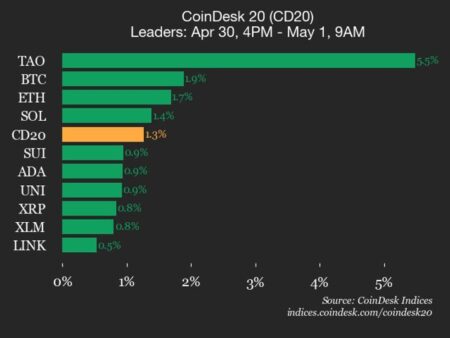
What makes this period particularly noteworthy isn’t just Bitcoin’s movement in isolation, but the fact that we’re seeing a coordinated rally across the entire cryptocurrency spectrum. Every major token has posted gains of at least 5% over the past seven days, which represents the kind of broad-based positive momentum that’s been conspicuously absent for much of the recent past. Ethereum climbed an impressive 13.3% to reach $2,316, demonstrating that the second-largest cryptocurrency by market cap is participating fully in this recovery. XRP rose 11% to $1.53, Solana gained 9.7% to $93.92, and even meme-inspired Dogecoin managed to add 9.5% to climb back above the psychologically important $0.10 threshold—a level that retail investors often watch closely. Meanwhile, Binance Coin (BNB) rose 5% to $676. This represents the broadest sustained rally we’ve witnessed since before geopolitical tensions with Iran escalated into what some are calling a war scenario. The timing is particularly interesting because this coordinated upward movement is occurring just as the Federal Reserve prepares to hold what many consider to be its most consequential meeting in months. The synchronicity of these gains across such a diverse range of cryptocurrencies—from established platforms like Ethereum to meme coins like Dogecoin—suggests that something more systemic is at play than isolated enthusiasm for individual projects.
Following the Smart Money: Institutional Flow Data Tells a Different Story
While skeptics can dismiss short-term price movements as noise, the institutional money flow data underlying this rally is becoming increasingly difficult to ignore or explain away. Mark Pilipczuk, an analyst with CF Benchmarks, pointed out in a recent communication that spot Bitcoin exchange-traded funds attracted approximately $767 million in net inflows over the previous week alone. This figure is significant not just for its size, but for what it represents in terms of trend reversal. This marked the third consecutive week of positive flows into these investment vehicles, which represents a dramatic turnaround from the painful five-week stretch earlier in the year when these same products experienced outflows exceeding $3 billion. This kind of reversal in institutional sentiment doesn’t happen by accident—it typically reflects a fundamental reassessment of risk, opportunity, or both. The Bitcoin ETF products have made it considerably easier for traditional financial institutions, wealth managers, and risk-averse investors to gain exposure to cryptocurrency without the technical complexity and security concerns of directly holding digital assets. When these flows turn positive and sustain that trajectory for multiple weeks, it suggests that professional money managers—the people whose job it is to carefully assess risk and reward—are becoming more comfortable with Bitcoin’s risk-reward profile at current levels.
The Gold Comparison: A Narrative Resurrected
Another fascinating dimension of the current market dynamic is the re-emergence of Bitcoin’s relationship with gold, which provides important context for understanding how investors are thinking about Bitcoin’s role in their portfolios. Through mid-March of this year, the performance divergence between gold and Bitcoin was stark and told a clear story: the SPDR Gold Trust (GLD) had returned approximately 16% while the iShares Bitcoin Trust (IBIT) had lost roughly 19%. This 35-percentage-point gap seemed to definitively settle the debate about whether Bitcoin could serve as “digital gold”—at least for this cycle. However, that narrative has shifted dramatically in recent weeks. Since early March, Bitcoin has outperformed gold by 13.2%, significantly closing what had seemed like an insurmountable gap. Even more intriguing from a quantitative perspective is the shift in correlation between these two assets. The 90-day correlation coefficient between Bitcoin and gold has moved from -0.27 (indicating they moved in opposite directions) to +0.29 (indicating they now move in the same direction) over a six-month period. This represents a fundamental shift in how these assets are behaving relative to each other and suggests that investors may once again be viewing them through a similar lens—as alternative stores of value and hedges against traditional financial system risks. The “digital gold” narrative that looked completely dead and buried in February is suddenly getting oxygen again, and this matters because narratives drive long-term capital allocation decisions in ways that short-term price action simply doesn’t.
The Federal Reserve Meeting: The Week’s True Pivot Point
While cryptocurrency price movements grab headlines, the Federal Reserve meeting that began today and concludes Wednesday represents the actual pivot point that could determine market direction for the remainder of March. According to the CME FedWatch tool, which tracks federal funds futures to estimate the probability of various Fed actions, there’s a greater than 95% probability that the Federal Reserve will hold interest rates steady in the current 3.5% to 3.75% range. Given such overwhelming consensus, the actual decision itself is essentially a non-event—everyone already knows what’s coming. What actually matters—what traders and investors will be parsing word-by-word—is the Fed’s updated “dot plot” projections showing where individual Fed officials expect rates to go over the coming quarters and years, as well as Fed Chair Jerome Powell’s press conference where he’ll attempt to explain the Fed’s thinking and framework for future decisions. The challenge facing the Federal Reserve right now is particularly acute because they’re receiving contradictory signals from different parts of the economy. With oil prices climbing above $100 per barrel, the stagflation scenario—where you get rising prices combined with weak economic growth—is becoming impossible to dismiss or ignore. High energy prices feed through into virtually every other price in the economy and can become self-fulfilling as businesses and consumers adjust their expectations.
The Dual Mandate Dilemma and What It Means for Crypto
At the same time, the labor market is showing clear signs of weakening, with February’s loss of 92,000 jobs still reverberating through economic data and policy discussions. The Federal Reserve operates under a dual mandate from Congress: maximize employment and maintain stable prices. Right now, these two mandates are pulling in completely opposite directions. The inflation data suggests the Fed should keep rates high or even raise them further to cool down price pressures, while the employment data suggests the economy is weakening and might need support through lower rates. How Chair Powell articulates this tension—how he frames the Fed’s thinking about which risk is more serious and which direction they’re leaning—could very well set the direction for risk assets, including cryptocurrencies, through the end of March and potentially beyond. Cryptocurrencies, despite their reputation for independence from traditional finance, have proven quite sensitive to Federal Reserve policy over the past several years. When liquidity is tight and rates are high, speculative assets tend to suffer as investors demand higher returns to compensate for risk and as the opportunity cost of holding non-yielding assets increases. Conversely, when the Fed signals a more accommodative stance, risk assets including crypto tend to benefit. The coming days will reveal whether this recent rally has legs or whether it will fade as just another false start in what’s been a volatile and difficult year for digital assets.