

Litecoin Fires Back at Critics Following Network Disruption and Security Controversy
A Network Hiccup Sparks a Social Media Firestorm
On April 25, 2026, Litecoin—one of the oldest and most established cryptocurrencies in the digital asset space—experienced what’s known in blockchain terminology as a “reorganization” or “reorg” of its network. In simpler terms, the network essentially had to rewind and rewrite a small portion of its recent transaction history, specifically 13 blocks covering roughly 32 minutes of activity. According to the Litecoin team’s explanation, this wasn’t just a random technical glitch but rather the result of a coordinated attack that exploited a previously unknown vulnerability in the network’s privacy feature called Mimblewimble Extension Blocks, or MWEB for short. What happened next, however, wasn’t just a story about blockchain security—it became a masterclass in how not to handle public relations during a crisis. The official Litecoin account on X (formerly Twitter) responded to criticism with a dismissive post telling critics to “stay on the shallow end of the pool,” triggering hundreds of angry responses from community members, investors, and observers who felt the tone was inappropriate given the seriousness of the situation. This incident has reignited questions about Litecoin’s communication practices, its vulnerability disclosure policies, and whether the project’s combative social media presence serves the community or undermines confidence in what should be a serious financial infrastructure project.
Understanding What Actually Went Wrong
To understand the controversy, it helps to break down what actually happened during those critical hours on April 25. The Litecoin team claims that attackers discovered and exploited a “zero-day” bug—a vulnerability unknown to the developers—in the MWEB privacy layer. This exploit was used to launch what’s called a denial-of-service attack against major mining pools, essentially disrupting their operations. The technical mechanics are complex, but the simplified version is this: mining nodes that hadn’t been updated to the latest software version were tricked into accepting transactions that violated the network’s rules. These invalid transactions allowed the attackers to move coins out of the MWEB privacy system and send them to third-party decentralized exchanges, presumably to cash out before anyone noticed the problem. When the issue was detected, major mining pools coordinated an emergency response over approximately three hours, deliberately creating a longer competing chain that excluded the fraudulent transactions. This defensive reorganization effectively erased those 32 minutes from the official blockchain record, reversing the invalid transactions while preserving all legitimate activity from that period. Cross-chain bridge service NEAR Intents initially reported potential exposure of around $600,000, though if Litecoin’s account is accurate, the quick reorg may have prevented actual permanent losses. The network stabilized once miners upgraded to the patched software version, and by the team’s account, all valid user transactions remained intact and no legitimate funds were lost from the main chain.
The “Zero-Day” Label Becomes the Flash Point
The real controversy ignited when technical observers began questioning whether this was truly a “zero-day” vulnerability at all. A zero-day, by definition, is a security flaw that’s exploited before developers even know it exists—there are literally zero days between discovery and attack. But Coindesk reporter Shaurya Malwa did some digging through Litecoin’s public Github repository and uncovered something that contradicted the official narrative: code commits showing that Litecoin’s core developers had actually discovered and privately patched this exact MWEB consensus vulnerability between March 19 and March 26, 2026—more than five weeks before the April 25 exploit occurred. This revelation fundamentally changed the nature of the incident. If developers knew about the vulnerability for 37 days before it was exploited, why wasn’t there a coordinated, urgent push to get all miners and node operators updated? Why wasn’t there a public security advisory warning the community about the critical nature of the patch? The gap between private knowledge and public disclosure left the network vulnerable during that entire window, and critics argued this pointed to either poor coordination, inadequate responsible disclosure practices, or possibly something worse. In the cryptocurrency world, where security and transparency are supposed to be foundational values, the optics of privately fixing a critical bug while not ensuring the entire network upgraded before an attack could occur looked very bad to many observers.
When Social Media Strategy Backfires Spectacularly
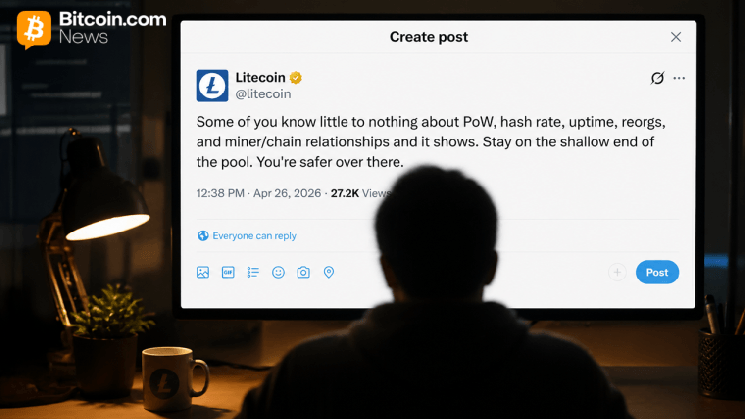
Rather than addressing these legitimate technical and procedural concerns with transparency and humility, Litecoin’s official X account doubled down with a tone that struck many as arrogant and dismissive. On April 26, the day after the incident, the account posted: “Some of you know little to nothing about PoW, hash rate, uptime, reorgs, and miner/chain relationships and it shows. Stay on the shallow end of the pool. You’re safer over there.” The response was swift and brutal. Community members, long-time holders, analysts, and casual observers flooded the replies with criticism, calling the post “salty,” “childish,” “unprofessional,” and worse. One disappointed investor wrote, “I held your coin for years… this is the sh** you post? So childish.” Another suggested, “Maybe you guys need a new social media person.” The frustration wasn’t just about tone—it was about the fundamental mismatch between the seriousness of a network security incident and the flippant, combative response. When people’s money and the integrity of a financial system are potentially at risk, they expect transparency, accountability, and professionalism, not sarcastic put-downs that question their technical knowledge. The incident also attracted attention from competitors, with Solana’s official account chiming in with its own jab: “How’s your weekend going little buddy?”—a comment widely interpreted as payback for months of Litecoin’s account taking shots at Solana’s own history of network outages.
A Pattern of Provocative Communication
What made this response particularly problematic is that it wasn’t an isolated incident but rather part of an established pattern. The Litecoin official account has built a reputation over the years for edgy, confrontational, and sometimes juvenile social media engagement. Back in September 2025, the account sarcastically announced it had fired the “abrasive intern” after facing complaints about its tone—but the style never actually changed. The account has regularly engaged in Twitter feuds with critics, rival blockchain projects, and crypto influencers, deploying everything from fart jokes to bear market taunts to pointed one-liners. While some might argue this approach makes the project seem more relatable or shows they don’t take themselves too seriously, the April 2026 incident revealed the downside of this strategy: when a genuine crisis occurs, the same voice that jokes around during good times comes across as tone-deaf, dismissive, and unprofessional during bad times. There’s a fundamental question here about what a project’s social media presence should accomplish. Is it meant to entertain, to build community through humor and edge? Or is it meant to inform, reassure, and maintain confidence in what is ultimately financial infrastructure that people trust with real money? The disconnect between these two approaches was never more apparent than when the account responded to security concerns with what essentially amounted to “you’re too dumb to understand.”
The Bigger Picture: Trust, Transparency, and the Future
Setting aside the social media drama, the incident raises substantive questions about Litecoin’s development and governance practices. The technical fundamentals, according to the team, remain sound—the MWEB vulnerability is patched, the canonical blockchain is stable, and no funds were permanently lost from the main chain. But the episode exposed real coordination gaps between core developers and the broader ecosystem of miners and node operators, a known friction point in proof-of-work networks where upgrades aren’t mandatory and must be adopted voluntarily. Unlike proof-of-stake networks where validators can be more easily coordinated, proof-of-work systems like Litecoin rely on decentralized miners making individual decisions about which software to run. This creates both strength (greater decentralization and censorship resistance) and vulnerability (slower response to critical security updates). The March-to-April gap between private patch and public exploit reveals this challenge in stark terms. Moving forward, Litecoin faces questions about how to handle responsible disclosure, how to ensure critical security patches achieve rapid adoption, and perhaps most visibly, how to communicate with its community and the broader public during moments of stress. The snarky social media persona that might have seemed edgy or entertaining during bull markets now appears as a liability—one that undermines confidence rather than building it. For long-time holders and potential investors evaluating whether Litecoin deserves a place in their portfolios, the question isn’t just about the code or the technology, but about the maturity and professionalism of the people representing the project to the world.