


Breaking the Silence: Justice Comes to the Texas Killing Fields After Four Decades
A Chilling Mystery That Haunted a Community for Generations
For nearly half a century, a desolate stretch of land near Houston, Texas, has harbored one of America’s most disturbing unsolved mysteries. Known ominously as the “Texas Killing Fields,” this 50-mile corridor became a dumping ground for the bodies of more than 30 young women and girls, their lives cut tragically short beginning in the 1970s. The case has captured national attention through a Netflix documentary and numerous true crime features, including CBS News’ “48 Hours.” Now, after decades of pain and unanswered questions for families of the victims, prosecutors have announced a significant breakthrough. A Galveston grand jury has indicted 61-year-old James Dolphs Elmore Jr. in connection with the deaths of two victims whose bodies were discovered in 1986: 16-year-old Laura Miller and 30-year-old Audrey Cook. This development represents a major step forward in solving a piece of this haunting puzzle that has tormented a community and left countless families without closure.
The charges against Elmore include manslaughter and felony tampering with evidence in Laura Miller’s death, along with tampering with evidence in Audrey Cook’s killing. When he appeared before a judge, his bond was set at a staggering $3 million—$1.5 million for the manslaughter charge and $750,000 for each evidence tampering charge. As Elmore sits in the Galveston County Jail awaiting his August 31st trial date, the announcement has brought a complex mixture of emotions to those who have waited so long for answers. Federal agent Don Ferrarone once described the Texas Killing Fields as “a perfect place for killing somebody and getting away with it,” a chilling assessment that captures why this area became such a nightmare for investigators and families alike.
A Father’s Unwavering Quest for Truth
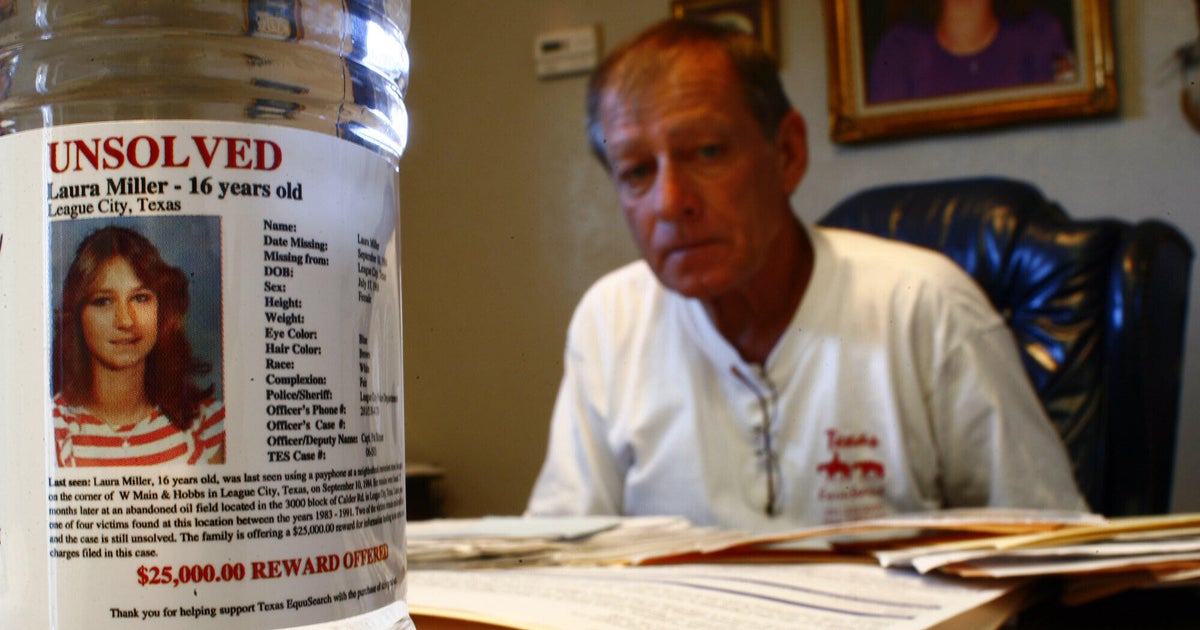
Perhaps no one has been more deeply affected by these crimes than Tim Miller, Laura’s father, whose personal tragedy transformed him into a tireless advocate for missing persons. In a remarkable revelation, Miller disclosed that he has met with Elmore approximately 30 times over the past four years. During these encounters, Elmore shared information with Miller, though the grieving father declined to elaborate on the details, fearing it might jeopardize the ongoing legal proceedings. This extraordinary interaction between a victim’s father and the man now accused of involvement in his daughter’s death speaks to Miller’s desperate need for answers and his determination to see justice served, no matter how long it took.
The pain of losing his teenage daughter drove Miller to establish EquuSearch, a nonprofit organization dedicated to helping find missing persons. Through this work, he has channeled his grief into helping countless other families facing the nightmare of a missing loved one. His advocacy has kept the Texas Killing Fields case in the public eye, refusing to let these young women be forgotten or their deaths dismissed as cold cases too old to solve. Miller’s reaction to the recent developments was bittersweet. While he welcomed Elmore’s indictment, he expressed frustration that Clyde Hedrick, whom authorities believed was the primary perpetrator and Elmore’s longtime friend, died by suicide before he could face justice. “It’s inexcusable that Clyde Hedrick had the opportunity to die without never been indicted, convicted,” Miller stated, voicing the anguish of knowing that one of the alleged killers escaped accountability.
The Victims: Lives Cut Tragically Short
The four bodies found in the same desolate field between 1984 and 1991 tell a heartbreaking story of young lives stolen far too soon. The first victim discovered was Heidi Fye-Villareal, a 25-year-old bartender who disappeared in 1983 and whose remains were found in 1984. Her niece, Nina Jager, has become another vocal advocate in the case, celebrating the recent indictment while expressing the “bittersweet” nature of the breakthrough. Jager revealed that her grandfather had long suspected Hedrick’s involvement and conducted his own investigation when he felt authorities weren’t taking the case seriously enough. “Maybe today is a result of all the work that he put in, all the searching the fields, going and talking to people and doing his own investigation because he just didn’t feel supported,” she reflected, honoring her grandfather’s determination to find answers.
Laura Miller was just 16 years old when she disappeared in 1984, her body discovered two years later in 1986. At the same time Laura’s remains were found, another unidentified body was also discovered in the field. It would take until 2019—more than three decades later—for advanced forensic techniques to identify this victim as Audrey Cook, a 30-year-old mechanic who had vanished in 1985. A second unidentified woman found in 1991 was also identified in 2019 as Donna Prudhomme, a 34-year-old mother who disappeared in 1989. The fact that two of the four victims remained nameless for so many years compounds the tragedy, their families living in uncertainty and hope that gradually dimmed with each passing year. Notably, Elmore has not been charged in the deaths of Villareal or Prudhomme, leaving those cases still seeking resolution.
A Complex Web of Alleged Perpetrators
The investigation into the Texas Killing Fields has always been complicated by the belief that multiple killers may be responsible for the numerous deaths. Galveston County District Attorney Kenneth Cusick revealed that prosecutors had prepared evidence for grand jury indictments against both Elmore and Clyde Hedrick, who was believed to be the person directly responsible for the four women’s deaths. The two men had been longtime friends, allegedly working together in these horrific crimes. However, before the grand jury could return a decision in his case, the 72-year-old Hedrick took his own life, forever closing one avenue to justice and leaving many questions unanswered.
Hedrick wasn’t unknown to the justice system. In 2014, he had been convicted of manslaughter in the death of Ellen Beason, a young woman who disappeared in 1984 and whose body was found in 1985. After serving his sentence, he was released on parole in 2022 and was still under parole supervision when he died. The fact that someone previously convicted in a related killing was walking free while other cases remained unsolved has fueled frustration among victims’ families and advocates. The timing of his suicide, just as he was about to face additional charges, has left many feeling robbed of the full accountability they deserved. District Attorney Cusick acknowledged this disappointment, even as he emphasized the significance of bringing charges against Elmore.
The Long Road to Justice Continues
Despite this recent breakthrough, most of the deaths associated with the Texas Killing Fields remain unsolved, representing a massive failure of justice spanning multiple decades. The discovery of more than 30 victims’ bodies in a 50-mile stretch over nearly five decades suggests a killing ground that multiple perpetrators used with disturbing frequency. The victims have been predominantly young women and girls, their vulnerability apparently making them targets for predators who used the desolate location to commit and conceal their crimes. In 2022, there was another significant development when William Reece, an Oklahoma death row inmate, pleaded guilty to three murders in Texas, including those of 12-year-old Laura Smither, 17-year-old Jessica Cain, and 20-year-old Kelli Cox. Reece received life sentences for these killings, demonstrating that justice, though delayed, could still be achieved.
After his appointment as district attorney, Kenneth Cusick made a public commitment to taking a harder look at cases linked to the Texas Killing Fields. He acknowledged that the passage of time has made investigations challenging, with witnesses deceased, memories faded, and evidence degraded. Nevertheless, he expressed determination to continue working on these cases, noting that active leads still exist that could bring additional perpetrators to justice. “Due to the concerted efforts of the law enforcement agencies in this county, this 40-year cycle of violence by these defendants against women, we’re trying to make headway on it, and I think we made significant headway yesterday in getting a charge against Mr. Elmore and having him arrested,” Cusick stated at a news conference announcing the indictment.
Hope Amid Heartbreak: A Community Seeks Closure
The indictment of James Dolphs Elmore Jr. represents more than just legal proceedings; it symbolizes hope for families who have lived with uncertainty and grief for decades. For Tim Miller, who has dedicated his life to finding missing persons since losing his daughter, this development validates years of refusing to let these cases fade into obscurity. For Nina Jager, whose grandfather spent years investigating her aunt’s murder when he felt authorities weren’t doing enough, the charges honor his memory and determination. Yet the bittersweet nature of this progress cannot be ignored—justice delayed for 40 years is justice that comes too late for many who didn’t live to see this day.
The Texas Killing Fields case serves as a stark reminder of how predators can exploit isolated locations and jurisdictional complexities to evade capture for extended periods. It also demonstrates how advancements in forensic science, including DNA analysis and improved identification techniques, can eventually break open cases that seemed hopelessly cold. As Elmore awaits trial and investigators continue pursuing additional leads, the families of the victims watch with cautious optimism. They know that convictions in a few cases, while meaningful, still leave the majority of Texas Killing Fields deaths unsolved. The ultimate hope is that these recent charges will encourage witnesses to come forward with information, that evidence will be re-examined with fresh eyes and new technology, and that more perpetrators will be identified and brought to justice. For the more than 30 young women and girls whose lives were stolen in this notorious stretch of Texas, and for the families who have never stopped seeking answers, anything less would be another failure—one that a community haunted by these crimes for half a century can no longer accept.