
Robert Kiyosaki’s Contrarian Strategy: Preparing to Profit During Market Turbulence
Building Wealth Outside the Traditional Financial System
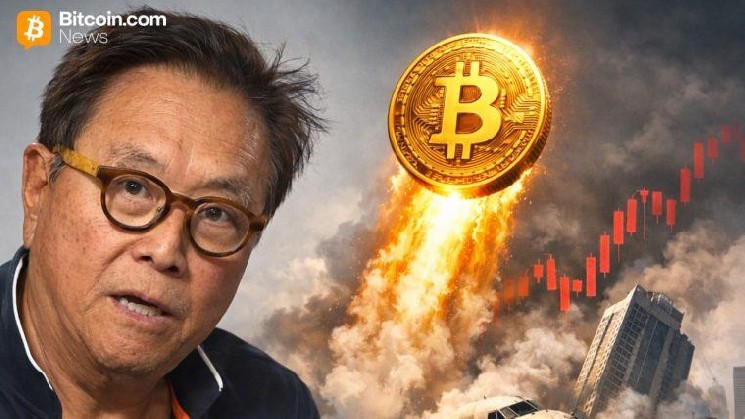
In an era where economic uncertainty looms large and traditional market indicators flash warning signs, renowned financial educator Robert Kiyosaki is doubling down on his unconventional investment philosophy. The bestselling author of “Rich Dad Poor Dad” recently shared his strategic approach to not just weathering an anticipated market downturn, but actually thriving during it. His message is clear and unapologetic: he’s deliberately positioning himself to “get richer in a crash” by focusing exclusively on assets that exist outside the control of governments, central banks, and Wall Street institutions.
Kiyosaki’s investment philosophy represents a fundamental rejection of conventional wisdom. While most financial advisors recommend diversified portfolios including stocks, bonds, and mutual funds, he’s taken a radically different path. “I do not invest in stocks such as the S&P 500, U.S. bonds, mutual funds, ETFs, or save cash,” he explained in recent statements on social media. His reasoning stems from a deep skepticism about any asset that can be created or manipulated by monetary authorities. In his view, when governments can simply print more money or financial institutions can create paper assets out of thin air, the real value of these investments inevitably erodes over time. Instead, he’s built his wealth around what he calls “real” assets—things with intrinsic value that can’t be conjured up by central bank policy or Wall Street financial engineering.
The Portfolio of Tangible and Decentralized Assets
So what exactly does Kiyosaki’s alternative investment universe look like? His portfolio reads like a manifesto for tangible, productive, and decentralized wealth. Real estate forms a substantial foundation, with the investor managing approximately 1,500 rental units that he’s strategically acquired using debt financing. But his holdings extend far beyond property. He’s invested heavily in oil production, with operations spanning Texas and North Dakota—assets that generate consistent cash flow from a fundamental commodity the world continues to need. His agricultural interests include cattle operations that provide both food production capability and ongoing revenue streams.
On the precious metals front, Kiyosaki maintains substantial positions in gold and silver, viewing these ancient stores of value as insurance against currency debasement. Perhaps most notably for modern investors, he’s been an early and consistent advocate for cryptocurrencies, particularly Bitcoin and Ethereum. His entry into Bitcoin came remarkably early—he recalls buying his first six Bitcoin for just $600 total, a purchase that required such commitment he “did not eat for days” afterward. This investment, made when Bitcoin traded around $100 per coin, represents the kind of conviction-based positioning that has characterized his entire investment approach. Today, he continues accumulating these digital assets, viewing them as decentralized alternatives to government-controlled currencies.
Rounding out his portfolio are what might be called lifestyle businesses that also generate income: golf course investments, a billboard company, surgical centers, and the global distribution of his Cashflow board game in over 50 languages. The common thread? Each asset either produces ongoing cash flow, has tangible real-world utility, or exists outside the traditional financial system’s direct control.
Strategic Moves and Tactical Flexibility
While Kiyosaki’s philosophy emphasizes long-term holding—”bought small assets, held for years and almost never sold”—he’s not rigidly inflexible. His investment moves demonstrate tactical sophistication within his broader strategic framework. In late 2025, he made waves by selling approximately $2.25 million worth of Bitcoin when the cryptocurrency traded around $90,000 per coin. Given his original purchase prices near $6,000, this represented extraordinary returns. However, this wasn’t a retreat from his core beliefs but rather a strategic reallocation.
The proceeds from that Bitcoin sale weren’t converted to cash and left idle or invested in traditional securities. Instead, Kiyosaki immediately redirected the capital into income-producing businesses: specifically, two surgical centers and a billboard operation. His calculation showed these investments could generate approximately $27,500 in monthly tax-free income—creating ongoing cash flow that would then fund further acquisitions of the “real” assets he prizes. This move illustrates an important nuance in his approach: he’s willing to take profits on appreciated assets when it allows him to diversify into other hard assets or cash-flowing businesses, but always within his preferred asset classes.
More recently, Kiyosaki has pivoted back to accumulation mode, particularly in cryptocurrencies. As concerns about a potential 2026 market crash have intensified, he’s been buying rather than selling, using the cash flow generated from his oil production, cattle operations, and publishing businesses to add to his Bitcoin and Ethereum holdings. This approach exemplifies his strategy of using productive assets to fund acquisitions of appreciating stores of value—a perpetual cycle that compounds wealth across different asset categories while maintaining his independence from traditional financial markets.
The Philosophy Behind the Strategy
Understanding Kiyosaki’s investment approach requires grasping the philosophical framework that underpins it. At its core is a fundamental distrust of what he calls “fake” assets—financial instruments whose value is ultimately based on government promises, institutional credibility, or collective market faith rather than intrinsic utility. When central banks engage in quantitative easing, when governments run massive deficits, when financial institutions create complex derivative products, Kiyosaki sees a system that’s fundamentally rigged against ordinary savers and investors.
His preference for “real” assets stems from this worldview. Real estate provides shelter and generates rental income regardless of what’s happening in stock markets. Oil powers civilization’s machinery and transportation. Precious metals have been valued for thousands of years across every culture and economic system. Food production addresses humanity’s most basic need. Even Bitcoin, despite being digital, appeals to Kiyosaki because it has a fixed supply cap—no government or central bank can decide to create more Bitcoin the way they can print more dollars or euros.
This philosophy also explains his comfort with debt, which might seem contradictory given his skepticism about the financial system. However, Kiyosaki views debt strategically: borrowing depreciating currency to purchase appreciating or income-producing assets essentially uses the system’s own mechanisms against it. If currencies lose purchasing power over time through inflation, then debt taken on today becomes easier to service with tomorrow’s devalued money, while the assets purchased maintain or increase their real value.
Perhaps most importantly, Kiyosaki’s approach reflects a crisis-opportunist mindset. Rather than fearing market crashes, he positions himself to take advantage of them. When panic selling drives down prices of assets he values, he’s prepared with cash flow and liquidity to buy. His statement “I planned to get richer in a crash” isn’t bravado—it’s the logical outcome of maintaining income streams from productive assets that continue generating cash even when financial markets are in turmoil, combined with a portfolio of holdings he believes will retain value better than conventional investments.
The Practical Reality and Accessibility Question
One crucial consideration when evaluating Kiyosaki’s strategy is the question of accessibility and replicability. His current portfolio—spanning oil production facilities, 1,500 rental properties, cattle ranches, surgical centers, and international business operations—represents a level of capital and operational complexity that’s simply beyond the reach of most individual investors. When he discusses his journey, he acknowledges starting with nothing: “Like many of you, I had no money to start with… But just bought small assets, held for years and almost never sold.” This suggests a path that began modestly and compounded over decades.
The practical takeaway for everyday investors isn’t necessarily to replicate his exact portfolio, but rather to embrace the underlying principles: prioritize assets with intrinsic value or productive capability, maintain skepticism about paper wealth that can be created through monetary policy, generate cash flow that can fund further acquisitions, think in decades rather than quarters, and position for opportunity during periods when others are panicking. These principles can be applied at any scale—a single rental property, modest precious metals holdings, or small cryptocurrency positions can embody the same philosophy that guides Kiyosaki’s much larger operations.
It’s also worth noting that his approach carries distinct risks that he doesn’t always emphasize. Real estate requires active management and is subject to local market conditions, regulatory changes, and property-specific issues. Commodity production like oil faces price volatility and operational challenges. Cryptocurrencies, despite his enthusiasm, remain highly volatile and relatively unproven compared to traditional stores of value. His strategy works for his risk tolerance, time horizon, and operational capabilities—factors that vary considerably among investors.
Preparing for Uncertainty in Today’s Economic Climate
As economic headwinds gather strength and traditional market valuations remain elevated by historical standards, Kiyosaki’s contrarian positioning offers a thought-provoking alternative perspective. Whether citing historical predictors like Edgar Cayce and Nostradamus (whose actual predictive accuracy regarding modern markets is debatable) or pointing to contemporary warning signs, he’s clearly convinced that significant financial disruption lies ahead. His response isn’t to retreat to the perceived safety of cash or government bonds, but rather to intensify his commitment to the asset categories he’s favored throughout his career.
For investors concerned about market vulnerability, Kiyosaki’s approach suggests several considerations: Are your holdings dependent on continued confidence in financial institutions and government fiscal responsibility? Do your assets generate cash flow that would continue during a market downturn? Have you diversified beyond paper assets into things with tangible utility? Are you positioned to deploy capital when others are forced sellers? These questions don’t require adopting his entire philosophy, but they encourage thinking beyond conventional portfolio construction.
Ultimately, Robert Kiyosaki’s strategy represents a coherent, if unconventional, approach to building and preserving wealth in uncertain times. By focusing on assets outside traditional financial systems, generating multiple streams of cash flow from productive enterprises, and maintaining conviction in tangible stores of value, he’s positioned himself not just to survive potential market turbulence, but to potentially emerge stronger. Whether his specific predictions about timing and severity of market disruption prove accurate, his underlying emphasis on real assets, productive capability, and independence from conventional financial institutions offers valuable perspective for anyone rethinking their investment approach in an era of unprecedented monetary experimentation and mounting economic uncertainties.