



Bitcoin’s Market Dynamics: Understanding the Push and Pull Between Whales and Retail Investors
The Big Picture: Bitcoin’s Recent Price Movement and What It Really Means
Bitcoin has been on quite a journey lately, and if you’ve been watching the charts, you’ve probably noticed the rollercoaster ride from the dizzying heights near $100,000-$110,000 down to a more modest mid-$70,000 range. While this might look like just another typical crypto swing, what’s happening beneath the surface tells a much more interesting story about who’s buying, who’s selling, and what it all means for Bitcoin’s future.
When Bitcoin was riding high, many expected the momentum to continue indefinitely, but markets rarely work that way. The pullback we’ve seen isn’t necessarily a sign of doom and gloom—instead, it represents a natural cooling-off period after an intense rally. Think of it like a marathon runner taking a breather at a water station. The real story isn’t just about the price dropping; it’s about the fascinating dance happening between different types of investors during this consolidation phase. The mega-whales—those holding more than 10,000 BTC—decided it was time to take profits, selling off roughly 25,500 Bitcoin. Can you blame them? When you’re sitting on gains that could fund small nations, locking in profits makes perfect sense. But here’s where it gets interesting: while the biggest players were cashing out, a different group was quietly stepping in to scoop up those coins.
The Shark Tank: Mid-Tier Players Become the Market’s Backbone
Enter the “sharks”—investors holding between 100 and 1,000 Bitcoin. These aren’t your casual weekend traders checking Coinbase on their phones; these are serious players with significant capital, yet they’re not quite in the mega-whale category. Over the past thirty days, this group has absorbed approximately 37,920 BTC, actually exceeding what the mega-whales sold off. This is a crucial development that many casual observers might miss, but it reveals something profound about market structure.
What we’re witnessing is essentially a changing of the guard, or more accurately, a rotation of holders. When prices climb to euphoric levels, the earliest and largest holders often take the opportunity to realize gains. They’ve seen multiple cycles, weathered countless storms, and know that taking profits after a major rally is simply prudent risk management. But markets need buyers to function, and that’s where the mid-tier players come in. These sharks are stepping up during weakness, essentially providing a safety net under the price. They’re building what traders call a “defensive base”—a price level where enough buying interest exists to prevent catastrophic drops.
This behavior pattern is actually quite bullish when you understand what it signals. It means that conviction in Bitcoin’s long-term value proposition isn’t limited to just the earliest adopters or the ultra-wealthy. A broader base of well-capitalized investors is willing to deploy serious money even after prices have pulled back from recent highs. They’re not chasing green candles at the top; they’re buying the dip with strategic intent. This kind of accumulation pattern has historically preceded significant moves higher, though timing is always uncertain in crypto markets.
The Exchange Reserve Mystery: Where Did All the Bitcoin Go?
Perhaps one of the most telling indicators of what’s really happening comes from looking at exchange reserves—the amount of Bitcoin sitting on trading platforms ready to be sold. Currently, these reserves hover around 2.6 million BTC, which represents a multi-year low. Let that sink in for a moment: despite all the volatility, despite the price uncertainty, Bitcoin is steadily flowing off exchanges and into long-term storage solutions like hardware wallets and institutional custody services.
When coins leave exchanges, it typically signals that holders have moved from a trading mentality to a holding mentality. They’re not looking to flip their Bitcoin for quick profits; they’re storing it away, possibly for years. This withdrawal of supply from readily available markets creates what economists call supply tightness. Imagine if suddenly half the houses in your neighborhood were taken off the market—the remaining ones would become more valuable simply due to scarcity, assuming demand stays constant or increases.
This setup creates an interesting potential scenario: if demand returns to the market with any meaningful force—whether from institutional buyers, retail FOMO, or positive regulatory developments—there’s simply less Bitcoin available to satisfy that demand at current prices. Basic economics tells us what happens next: prices would need to rise to entice holders to part with their coins. However, there’s a flip side to this coin (pun intended). If demand remains weak or further deteriorates, even tight supply won’t prevent prices from stagnating or declining. The market needs both reduced supply AND increasing demand to generate the kind of explosive moves Bitcoin is famous for. Right now, we have one half of that equation firmly in place.
Institutional Conviction Versus Retail Hesitation: The Tale of Two Markets
The contrast between institutional and retail behavior right now couldn’t be more stark, and it’s creating a fascinating dynamic in Bitcoin markets. On one side, we have spot Bitcoin ETFs—the investment vehicles that allow traditional finance players to gain Bitcoin exposure through regulated products—buying nearly 19,000 BTC in just five days. To put that in perspective, that’s far more than Bitcoin miners produced during that same period. These institutions are voting with serious money, absorbing supply and sending a signal that professional money managers see value at these levels.
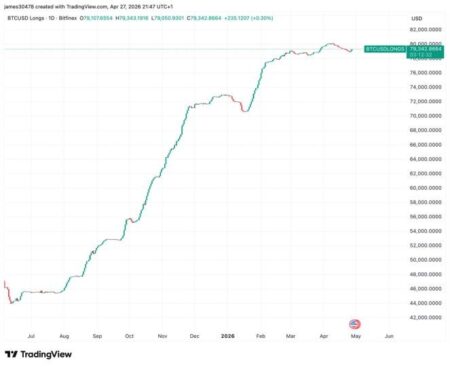
Meanwhile, whales in the derivatives markets are also positioning for upside, taking long positions that bet on higher prices ahead. These aren’t reckless gamblers; these are sophisticated traders and institutions with research teams, risk management protocols, and access to information flows that retail traders can only dream about. Their willingness to position for gains suggests they see the current environment as opportunity, not danger.
Contrast this with retail sentiment, which remains decidedly cautious. The Fear and Greed Index—a gauge of market emotion that ranges from extreme fear to extreme greed—recently approached 48, which sits right in the neutral-to-slightly-fearful zone. Retail investors, burned by previous market crashes and weary from volatility, are holding back. Many are likely selling into strength or simply sitting on the sidelines, waiting for “confirmation” that might never come at attractive prices. This divergence is actually quite typical at market inflection points. Institutions and whales often accumulate when retail is fearful, then sell when retail finally gets excited near market tops. Right now, retail selling is actually providing the liquidity that allows whales and institutions to build positions without pushing prices sharply higher. This arrangement can definitely fuel growth if and when retail conviction returns, but the hesitancy we’re seeing now means that even with strong structural demand from institutions, the dramatic breakouts might wait until broader participation returns.
The Federal Reserve Shadow: How Macro Forces Are Keeping Bitcoin in Check
No matter how bullish the supply dynamics look, Bitcoin doesn’t exist in a vacuum—it trades within the broader context of global financial markets, and right now, that context is dominated by one question: what will the Federal Reserve do next? As markets approach the April 28 FOMC (Federal Open Market Committee) meeting, where the Fed announces policy decisions, traders across all asset classes are positioning cautiously, knowing that the statement and subsequent press conference could trigger major moves.
The 10-year Treasury yield—a benchmark interest rate that influences everything from mortgage rates to corporate borrowing costs—is holding near 4.31% as of this writing. That might not sound dramatic, but it represents relatively firm (some would say tight) financial conditions. Here’s why this matters for Bitcoin: when you can get over 4% annually from safe U.S. government bonds, the opportunity cost of holding assets that don’t pay interest—like Bitcoin, gold, or artwork—increases significantly. Risk-averse capital naturally flows toward these safer options, especially when economic uncertainty is elevated.
This creates what traders call a “spring-loaded” setup across markets. Imagine compressing a spring tighter and tighter—eventually, it’s going to release that energy in one direction or another. Right now, positioning is compressed as traders wait to see whether the Fed signals a hawkish stance (suggesting more tightening or higher-for-longer rates) or a dovish one (hinting at cuts or easier policy ahead). If the Fed surprises hawkish and yields rise further, risk assets like Bitcoin could face significant downside pressure as capital seeks safety and yield. Conversely, if the Fed strikes a softer tone or suggests rate cuts are coming sooner than expected, it could release the sidelined capital waiting nervously on the sidelines, potentially triggering a relief rally across crypto markets. Bitcoin’s immediate future may be more dependent on what happens in that Washington, D.C. meeting room than on any development specific to cryptocurrency itself.
The Bottom Line: Waiting for the Pieces to Align
So where does all this leave us? Bitcoin finds itself in a genuinely interesting position—structurally sound from a supply perspective, with accumulation patterns that historically precede major moves, institutional buying that demonstrates serious conviction, and exchange reserves at multi-year lows. All of these factors suggest a market that’s building a foundation for potential growth. However, the macro environment is keeping a lid on immediate expansion, with elevated yields and Federal Reserve uncertainty causing risk-off sentiment that prevents the kind of capital inflows needed to spark a sustained rally.
The current range-bound trading represents this tension perfectly—bulls and bears in a temporary stalemate, each waiting for a catalyst to tip the scales. Whale conviction is building steadily through accumulation and long positioning, but retail sentiment remains cautious after the recent volatility. The FOMC meeting represents the next major catalyst that could break this deadlock one way or another. A dovish surprise could be the match that lights the accumulated supply on fire, as returning demand meets constricted availability. A hawkish shock could send Bitcoin testing the lower bounds of its current range as risk appetite evaporates further.
For anyone holding or considering Bitcoin, the message is nuanced: the fundamental supply dynamics are increasingly bullish, with coins moving into strong hands and off exchanges at a remarkable pace. Institutional confidence is demonstrably present through ETF flows and derivatives positioning. However, these positive factors are currently constrained by macro forces beyond Bitcoin’s control. The breakout that many are anticipating hinges not on crypto-specific news, but on broader financial conditions easing enough to allow accumulated supply to meet returning demand. Patience, as always in crypto markets, remains not just a virtue but a necessity. The pieces are arranging themselves—now we wait to see which external force tips the first domino.