


Lawyer Wins Big After Airport Censorship Battle: A Victory for Free Speech and Sexual Harassment Advocacy
When a Simple Advertisement Became a Constitutional Battle
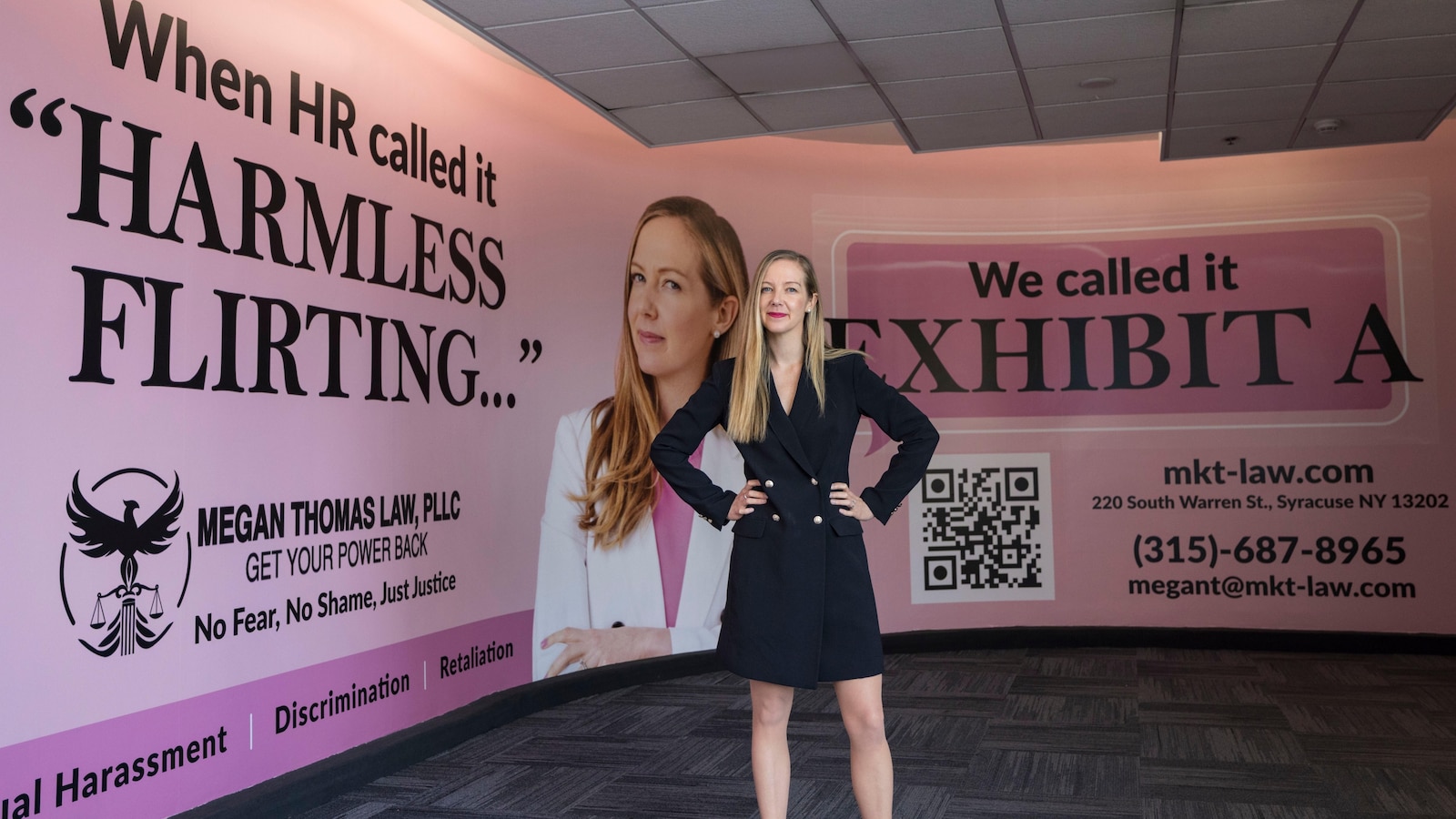
What started as a routine advertising purchase has transformed into a powerful statement about free speech and women’s rights in the workplace. Megan Thomas, a New York attorney specializing in sexual harassment cases, found herself in an unexpected legal battle last summer when Syracuse Hancock International Airport rejected her advertising proposal. The ad she wanted to display carried a straightforward message: “When HR called it harmless flirting … we called it exhibit A.” However, airport officials deemed the wording too “harsh” and requested she tone it down. Rather than backing down or compromising her message, Thomas made a bold decision that would ultimately result in far more visibility than she originally anticipated. She filed a federal lawsuit against the Syracuse Regional Airport Authority, arguing that their rejection violated her First Amendment rights. Today, her advertisement doesn’t just appear at the airport—it dominates two entire walls of the travel hub in bold pink lettering, accompanied by a large photograph of Thomas herself, serving as an unmissable reminder about workplace sexual harassment.
The Strategic Choice Behind Airport Advertising
Thomas’s decision to advertise at Syracuse Hancock International Airport wasn’t random or simply convenient—it was deeply strategic and connected to the experiences of her clients. According to Thomas, many women who have sought her legal services reported experiencing sexual harassment during work-related travel. Business trips, conferences, and other professional travel situations often create environments where harassment can occur, sometimes far from the protections and witnesses available in a regular office setting. The airport represents a crossroads where business travelers from various companies and industries pass through, making it an ideal location to reach potential clients who might need her services. Beyond just reaching her target audience, Thomas specifically wanted the advertisement placed in a prominent location where it would be visible to as many people as possible. Her goal wasn’t merely commercial—it was about raising awareness of an issue that affects countless working women across the country. The visibility of her message in such a public space would serve both to inform potential clients of their rights and to remind companies and HR departments that dismissive attitudes toward workplace harassment have consequences.
How a Straightforward Ad Became “Too Threatening”
The timeline of events reveals a troubling pattern of censorship masked as editorial concern. Initially, the Syracuse Regional Airport Authority approved a draft version of Thomas’s advertisement, giving her every reason to believe the contract would proceed smoothly. However, just one day after that approval, the airport authority reversed its position, informing Thomas that her slogan was “considered to be a bit harsh.” What followed was even more revealing about the underlying motivations for the rejection. During a subsequent phone call, Thomas was told that airport leadership believed the proposed advertisement might be viewed as “threatening” or “intimidating” to men. The following day brought yet another justification: an official explained that the ad would not be displayed because of concerns about potential negative feedback from community members and the possibility that local politicians might find it offensive. These shifting explanations suggested that the real issue wasn’t the advertisement’s content or professionalism, but rather discomfort with its message about holding perpetrators of sexual harassment accountable. In court documents, lawyers representing the airport authority claimed they had offered alternative slogans that would convey “a similar message in a more professional and less misleading and disparaging manner,” but this characterization would not hold up under judicial scrutiny.
A Judge Calls Out the Censorship as “Nonsense”
When the case came before Judge Anthony Brindisi, he didn’t mince words in his assessment of the airport authority’s justification for rejecting Thomas’s advertisement. In a preliminary decision issued in January, Judge Brindisi flatly declared that the authority’s claim about the ad being misleading was “nonsense.” To illustrate just how unreasonable the airport’s position was, the judge pointed to other advertisements currently displayed at the same airport. He specifically cited a Chick-fil-A advertisement featuring a cow and the phrase “Chikin 4 Din Makez U Grin,” noting that by the airport’s logic, this ad would be misleading because it suggested “that chicken dinners will always make a person happy, or that cows can speak.” The comparison effectively demonstrated that Thomas’s slogan was well within the bounds of acceptable advertising language and no more hyperbolic than countless other commercial messages. The judge’s decisive language made clear that this was a case of viewpoint discrimination rather than legitimate concerns about advertising standards. His ruling recognized what Thomas had argued from the beginning: that the airport authority, as a government entity, cannot selectively censor speech simply because it finds the message uncomfortable or potentially controversial. Shortly after Judge Brindisi’s ruling, both parties reached a confidential settlement agreement, paving the way for Thomas’s advertisement to finally be displayed—and in an even more prominent format than originally planned.
The Bigger Picture: Why This Case Matters Beyond One Advertisement
Thomas understood from the outset that her fight was about more than just her business interests or even her specific advertisement. “When the airport told me the First Amendment did not apply and that they could do what they liked, I realized I would need to bring a lawsuit,” she explained this week. “I understood that if I won this battle, it would protect not only my rights, but also the rights of other women who come after me.” Her perspective reflects a broader understanding of how censorship works and why it must be challenged. If a government-operated facility like an airport can reject advertisements simply because they address uncomfortable truths about sexual harassment, what message does that send to survivors? Such censorship effectively silences conversations about workplace misconduct and signals that speaking up about harassment is somehow inappropriate or too controversial for public discourse. By standing her ground and pursuing legal action, Thomas established an important precedent. Her case demonstrates that government entities cannot use vague concerns about “harshness” or potential offense to justify viewpoint-based censorship. The victory ensures that other attorneys, advocates, and organizations addressing sexual harassment and other sensitive workplace issues can advertise their services without facing discriminatory rejection based on the substance of their message.
The Outcome: Justice Served and Business Booming
The resolution of Thomas’s case represents both a personal victory and a broader win for free speech principles. The advertisement that now graces two walls of Syracuse Hancock International Airport is considerably larger and more visible than what Thomas originally contracted for, turning what could have been a setback into a triumph. The bold pink display, complete with Thomas’s photograph and her uncompromised message, is impossible to miss for the thousands of travelers who pass through the airport. Beyond the symbolic victory, there have been tangible professional benefits as well. Thomas reports that calls to her Syracuse-based law firm have been “way up” since the larger advertisement was installed. The increased business has been significant enough that she has already hired an additional attorney and plans to bring on another office staff member to handle the growing caseload. She also maintains a second, smaller advertisement elsewhere in the airport, further extending her reach. Meanwhile, the Syracuse Regional Airport Authority issued a statement Tuesday calling the judge’s decision “unfortunate” while noting that the settlement “permits both parties to return focus to their core corporate purposes while preserving the authority’s ability to manage and operate the airport.” The carefully worded statement attempts to save face while accepting the reality of their legal defeat. Ultimately, this case serves as a reminder that standing up for constitutional rights, even over what might seem like a small matter, can lead to significant outcomes—not just for the individual involved, but for everyone who comes after. Thomas’s willingness to fight for her message has resulted in greater visibility for issues of workplace sexual harassment and has reinforced the principle that government entities cannot silence speech simply because it makes people uncomfortable.