



Bitcoin and Crypto Markets Show Strength Amid Global Tensions: Weekly Analysis
Market Opens Strong Despite Geopolitical Uncertainty
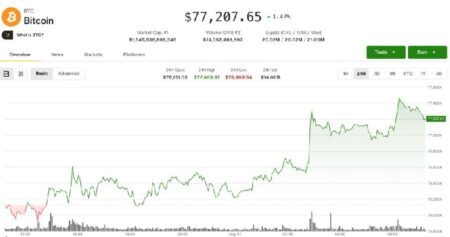
The cryptocurrency market kicked off the new week on a positive note, with Bitcoin and various alternative cryptocurrencies posting notable gains even as geopolitical tensions between the United States and Iran continued to simmer in the background. Bitcoin, the world’s largest cryptocurrency by market capitalization, demonstrated its characteristic volatility by briefly pushing above the psychologically significant $74,000 threshold. However, as is often the case in these uncertain times, the digital asset couldn’t maintain that momentum and subsequently retreated to trade around the $73,000 level. This pattern of short-lived recoveries has become something of a recurring theme for Bitcoin in recent weeks, reflecting the cautious sentiment among investors who remain hesitant to commit fully amid ongoing global uncertainties. Despite these fluctuations, the broader cryptocurrency market continues to show remarkable resilience, with digital assets increasingly being viewed through a different lens than traditional risk assets.
Institutional Investment Flows Signal Growing Confidence
In what can only be described as encouraging news for the cryptocurrency sector, Coinshares, one of the industry’s leading digital asset investment firms, released its latest weekly report revealing substantial institutional interest in crypto investment products. According to their findings, cryptocurrency investment vehicles experienced impressive inflows totaling $1.06 billion during the past week, marking the third consecutive week of positive flows into these products. This sustained momentum is particularly noteworthy given the backdrop of heightened geopolitical tensions and general market uncertainty. The Coinshares analysis emphasized that these consistent inflows “highlight their resilience during geopolitical tensions and reinforce Bitcoin’s role as a relative safe haven.” This characterization represents a significant evolution in how Bitcoin is perceived within the broader financial ecosystem—moving from purely speculative asset to something that institutional investors increasingly view as a store of value during times of global instability, much like gold has traditionally functioned in investor portfolios.
Bitcoin Dominates Investment Inflows
When examining the breakdown of where exactly these substantial investment dollars were flowing, the data reveals that Bitcoin continued to command the lion’s share of institutional attention and capital allocation. Of the total $1.06 billion in inflows, Bitcoin alone accounted for an impressive $793.4 million, representing approximately 75% of all incoming investment capital. This dominant position underscores Bitcoin’s status as the primary gateway for institutional investors entering the cryptocurrency space. Ethereum, the second-largest cryptocurrency and the foundation for much of the decentralized finance ecosystem, also posted respectable numbers with inflows reaching $315.3 million for the week. Taken together, these figures for the two largest cryptocurrencies demonstrate that while investors are increasingly comfortable with digital assets, they continue to gravitate toward the most established and liquid options available. The three-week cumulative inflows for Bitcoin have now reached $2.2 billion, nearly offsetting the $3.0 billion in outflows witnessed during the previous five-week period of market pessimism and uncertainty.
Mixed Performance Among Alternative Cryptocurrencies
The picture becomes more nuanced when looking beyond Bitcoin and Ethereum to the broader universe of alternative cryptocurrencies, commonly referred to as “altcoins.” The performance here was decidedly mixed, with some digital assets attracting fresh investment while others experienced capital flight. XRP, the cryptocurrency associated with Ripple Labs and often positioned as a potential solution for cross-border payments, had a particularly challenging week, experiencing outflows totaling $76.1 million. This marked the second consecutive week of negative flows for XRP, possibly reflecting ongoing concerns about regulatory clarity or simply profit-taking following earlier gains. On the positive side, Solana (SOL), which has positioned itself as a high-performance blockchain alternative to Ethereum, attracted inflows of $9.1 million. Other gainers included Sui, a newer layer-1 blockchain project, which saw $3.1 million in inflows, and Chainlink (LINK), the leading decentralized oracle network, which brought in $2.7 million. These figures suggest that while investors remain selective, there’s still appetite for quality projects with clear use cases and strong development communities.
Ethereum Shows Recovery Signs with Staking Products
Ethereum’s performance during this period deserves special attention, as the smart contract platform demonstrated significant strength with its $315 million in weekly inflows. What makes this particularly interesting is that Ethereum’s year-to-date inflows have nearly reached a net-neutral position, representing a substantial recovery from earlier weakness. A significant factor contributing to this renewed interest appears to be the recent launch of new staking-focused Exchange Traded Fund (ETF) products in the United States market. These new investment vehicles allow traditional investors to gain exposure not just to Ethereum’s price appreciation but also to the staking rewards that come from participating in the network’s proof-of-stake consensus mechanism. This development represents an important maturation of cryptocurrency investment products, moving beyond simple price exposure to incorporate the yield-generating aspects of certain blockchain networks. The availability of these staking ETFs addresses a previous gap in the market and provides income-focused investors with another reason to consider Ethereum as part of their portfolio allocation strategy.
Regional Investment Patterns Reveal US Dominance
Examining the geographical distribution of these cryptocurrency investment flows provides fascinating insights into where institutional adoption is strongest. The United States absolutely dominated the global picture, accounting for $1.02 billion of the total $1.06 billion in weekly inflows—representing more than 96% of all positive flows during the period. This overwhelming concentration reflects several factors, including the size and sophistication of US capital markets, the recent regulatory clarity provided by the approval of spot Bitcoin ETFs, and the generally high level of cryptocurrency awareness and adoption among American investors and institutions. Following far behind in second place was Hong Kong, which saw inflows of $23.1 million as the Asian financial hub continues its efforts to position itself as a cryptocurrency-friendly jurisdiction. Canada, which has long been ahead of the curve in approving cryptocurrency investment products, recorded inflows of $19.4 million, while Switzerland, another crypto-forward nation, attracted $10.4 million. Interestingly, not all regions saw positive flows—Germany, Europe’s largest economy, experienced outflows of $17.1 million, potentially reflecting different regulatory environments, investor sentiment, or simply regional portfolio rebalancing. These geographical patterns underscore that cryptocurrency adoption and investment remain uneven globally, with regulatory frameworks and institutional infrastructure playing crucial roles in determining where capital flows most readily.
This content is provided for informational purposes only and should not be construed as investment advice. Cryptocurrency investments carry significant risks, and you should conduct your own research and consult with financial professionals before making any investment decisions.