


Federal Court Strikes Down Arkansas Ten Commandments Law as Religious Freedom Debate Intensifies
A Constitutional Challenge to Classroom Religious Displays
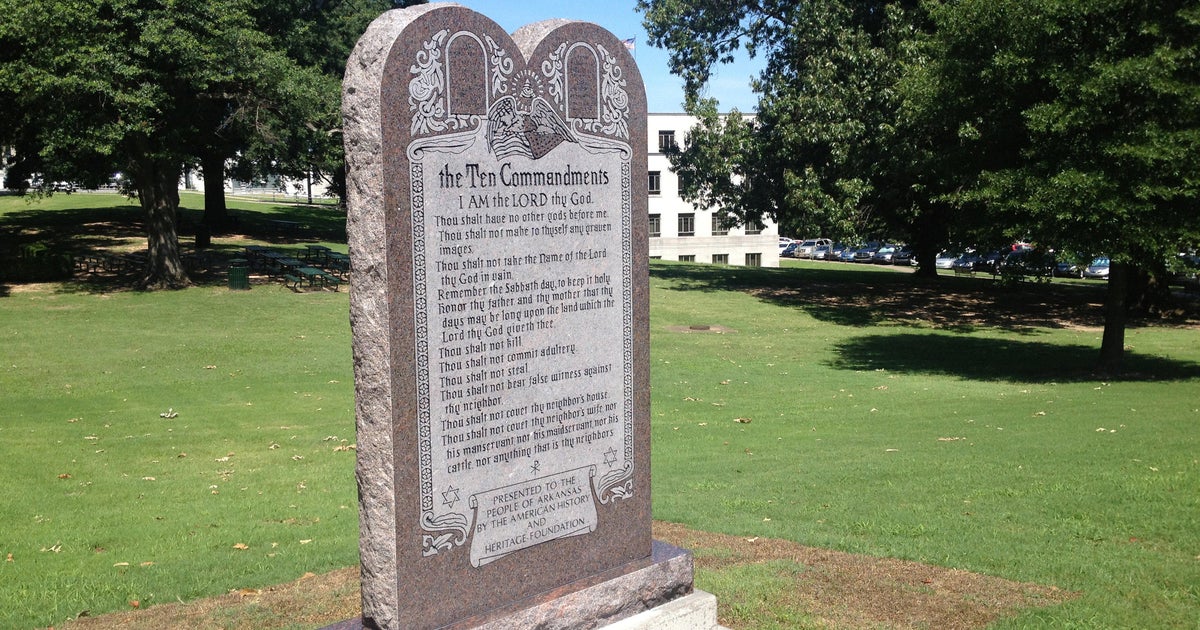
In a significant ruling that has reignited the national conversation about religion in public education, a federal judge in Louisiana struck down an Arkansas law on Monday that would have required the Ten Commandments to be prominently displayed in every public school classroom. The decision, delivered by U.S. District Court Judge Timothy L. Brooks, represents the latest chapter in an ongoing legal battle that has engulfed multiple states and is widely expected to eventually reach the U.S. Supreme Court. Judge Brooks, who was nominated to the bench by former President Barack Obama, issued a strongly worded opinion that questioned the very premise of the mandate, stating unequivocally that “nothing could possibly justify hanging the Ten Commandments – with or without historical context – in a calculus, chemistry, French, or woodworking class, to name a few.” His ruling went even further, declaring that there is simply no constitutional way to implement the 2025 law as written, concluding bluntly that “one doesn’t exist.”
The Arkansas law was part of a broader Republican-led initiative, supported by President Trump, aimed at incorporating religious elements into public education. Similar legislation has been enacted in Louisiana and Texas, creating a coordinated effort across multiple Southern states to mandate the display of the Ten Commandments in classroom settings. The Arkansas version required all public elementary and secondary schools to display the biblical text in every classroom and library, a sweeping mandate that quickly drew legal challenges. Last year, seven Arkansas families representing a diverse spectrum of religious and nonreligious backgrounds joined forces to file a lawsuit against the new requirement. Their legal action named six specific school districts in Arkansas as defendants, though the scope of the judge’s ruling and how broadly it can be applied remains somewhat unclear—it may be limited to just those districts named in the lawsuit, or it could potentially apply statewide.
Schools Already Acting Despite Legal Uncertainty
Despite the legal controversy swirling around these mandates, evidence has emerged over the past five months that numerous school districts and publicly-funded universities in Arkansas have already moved forward with hanging the posters. Local media outlets have documented multiple instances of compliance with the law before it was struck down. Among the most notable examples was the University of Arkansas’s Fayetteville campus, where the Arkansas Advocate reported in October that Ten Commandments displays had already been installed. This raises important questions about what happens next in those institutions that have already complied with a law that has now been deemed unconstitutional. The situation highlights the confusion and tension that exists when state legislatures pass controversial laws that face immediate legal challenges, leaving educators and administrators caught in the middle, uncertain about whether to comply with state mandates or wait for the courts to settle the constitutional questions.
The central argument from critics of these laws centers on what they view as a clear violation of the constitutional principle of separation of church and state. They contend that government-mandated religious displays in public schools amount to state endorsement of a particular religious tradition, which is precisely what the First Amendment’s Establishment Clause was designed to prevent. On the other side of the debate, proponents of the legislation frame their position quite differently. They argue that the Ten Commandments possess genuine historical significance that transcends their religious origins, positioning them as foundational documents that influenced the development of American law and civic values. From this perspective, displaying the Ten Commandments is not about promoting religion but about acknowledging an important part of our cultural and legal heritage. However, Judge Brooks’s ruling decisively rejected this argument, at least as applied to the Arkansas law, finding that no amount of historical context could justify the blanket requirement to post religious texts in classrooms devoted to secular subjects.
Civil Liberties Organizations Celebrate the Decision
The American Civil Liberties Union of Arkansas, which represented the families challenging the law, celebrated Monday’s ruling as a major victory for constitutional principles. The organization characterized the decision as “a victory for religious freedom and church-state separation,” emphasizing that protecting students from government-imposed religious doctrine is fundamental to American democracy. John C. Williams, who serves as legal director for the ACLU of Arkansas, offered a particularly pointed assessment of the ruling’s significance: “The ruling is a resounding affirmation that public schools are not Sunday schools. The Constitution protects every student’s right to learn free from government-imposed religious doctrine.” This statement captures the essence of the plaintiffs’ argument—that public education must remain a neutral space where students from all backgrounds can learn without feeling that the government is promoting one religious tradition over others.
Megan Bailey, a spokesperson for the ACLU of Arkansas, went further in her comments to The Associated Press, suggesting that the implications of the ruling should extend well beyond the specific school districts named in the lawsuit. She stated that the decision “makes clear the law is unconstitutional,” and warned that “it would be unwise for any school district in Arkansas to move forward with posting the Ten Commandments.” This interpretation suggests that even schools not directly bound by the court order should recognize the writing on the wall and voluntarily comply with the spirit of the decision. However, not everyone shares this interpretation, and the legal ambiguity about the ruling’s scope may lead to continued uncertainty and potentially more litigation as different districts make their own decisions about how to proceed.
Political Leaders Vow to Continue the Fight
The political response to the ruling was swift and predictable. Arkansas Governor Sarah Huckabee Sanders, a Republican and prominent conservative figure, issued a statement making clear that her administration has no intention of accepting the decision as final. She announced plans to appeal the ruling and promised to “defend our state’s values,” framing the issue as one of cultural identity and state sovereignty rather than constitutional law. This commitment to appeal ensures that the legal battle will continue, potentially for years, as the case works its way through higher courts. The governor’s defiant stance also reflects the political calculus at work in many conservative states, where supporting these religious display laws plays well with a significant portion of the electorate who feel that traditional religious values have been marginalized in public life.
Meanwhile, in Louisiana, the situation has taken a different turn. Louisiana became the first state in 2024 to mandate poster-sized displays of the Ten Commandments in every public school classroom, covering all grade levels from kindergarten through college. The legal challenge to Louisiana’s law has followed a complex path through the federal court system over nearly two years. In a significant development last month, a ruling from the full 5th U.S. Circuit Court of Appeals vacated an earlier court order that had been preventing the law from taking effect. This February 20th decision essentially removed the legal obstacle that had been blocking implementation, clearing the way for schools to begin installing the displays. Louisiana Governor Jeff Landry responded immediately by instructing schools to follow the law and post the Ten Commandments. In a letter sent to educators across the state, Landry wrote that the court’s decision “removes any obstacles to the implementation of Louisiana’s Ten Commandments law” and directed that schools “should now proceed with placing the posters in classrooms.” The law specifies that schools must accept donated Ten Commandments posters printed in “large, easily readable font,” and a conservative advocacy group called the Louisiana Family Forum has already sent posters to most of the state’s parish school systems, as reported by The New Orleans Advocate/The Times-Picayune.
The Texas Experience and the Path Forward
Texas represents yet another front in this expanding legal and cultural battle. Last year, Texas implemented what has been described as the widest-reaching attempt in the nation to hang the Ten Commandments in public schools. The Texas mandate has generated no shortage of strong opinions among teachers, parents, and students, creating divisions within communities about the appropriate role of religious expression in public education. In the months since the law took effect, posters have begun appearing in classrooms across the state as school districts either accepted donations or allocated funds to have them printed. However, the implementation has been far from uniform. About two dozen of Texas’s roughly 1,200 school districts have been barred from hanging the posters after federal judges issued injunctions in cases challenging the law. In January, the 5th U.S. Circuit Court of Appeals heard oral arguments over the constitutionality of the Texas law, and litigation remains pending. The outcome of that case could have significant implications for similar laws in other states, potentially providing clearer guidance about what is and isn’t permissible under the Constitution.
The broader pattern emerging from these cases suggests that this issue is far from resolved and will likely remain a source of legal and political controversy for years to come. Many legal observers believe that the ultimate destination for these cases is the U.S. Supreme Court, which would have the final word on whether state-mandated displays of the Ten Commandments in public school classrooms violate the Establishment Clause of the First Amendment. The current Supreme Court, with its conservative majority, might view these questions differently than previous courts have, potentially opening the door to a new interpretation of the relationship between religion and public education. For now, schools, families, and communities across Arkansas, Louisiana, Texas, and potentially other states remain caught in legal limbo, uncertain about what the future holds and what will ultimately be required or permitted in their classrooms. The Arkansas ruling provides a clear statement from one federal judge about the constitutional problems with these mandates, but until higher courts weigh in definitively, the debate will continue, fueled by deeply held beliefs on both sides about religious freedom, government neutrality, and the values that should guide public education in a pluralistic society.