


Bad Bunny’s Super Bowl Halftime Show: A Powerful Celebration of Unity and Latin American Identity
A Historic Performance That Transcended Sports and Entertainment
Bad Bunny made history at Super Bowl LX with a groundbreaking halftime show that was performed almost entirely in Spanish, transforming the world’s biggest sporting stage into a vibrant celebration of Latin American culture and unity. The Puerto Rican superstar, born Benito Antonio Martínez Ocasio, delivered a 13-minute performance at Levi’s Stadium in Santa Clara, California, that went far beyond entertainment. It was a bold statement about identity, belonging, and the diversity of the Americas. Near the end of his electrifying set, Bad Bunny delivered what would become the most talked-about moment of the evening—a powerful message that challenged conventional thinking about what it means to be “American.” Standing before millions of viewers worldwide, he shouted “God Bless America” before proceeding to name dozens of countries throughout the Americas, from Chile in South America to Central American nations, then Mexico, the United States, and Canada, before finishing with an emotional tribute to his birthplace, Puerto Rico, a U.S. territory home to over 3 million people.
“We’re Still Here”: A Message That Resonated Across Continents
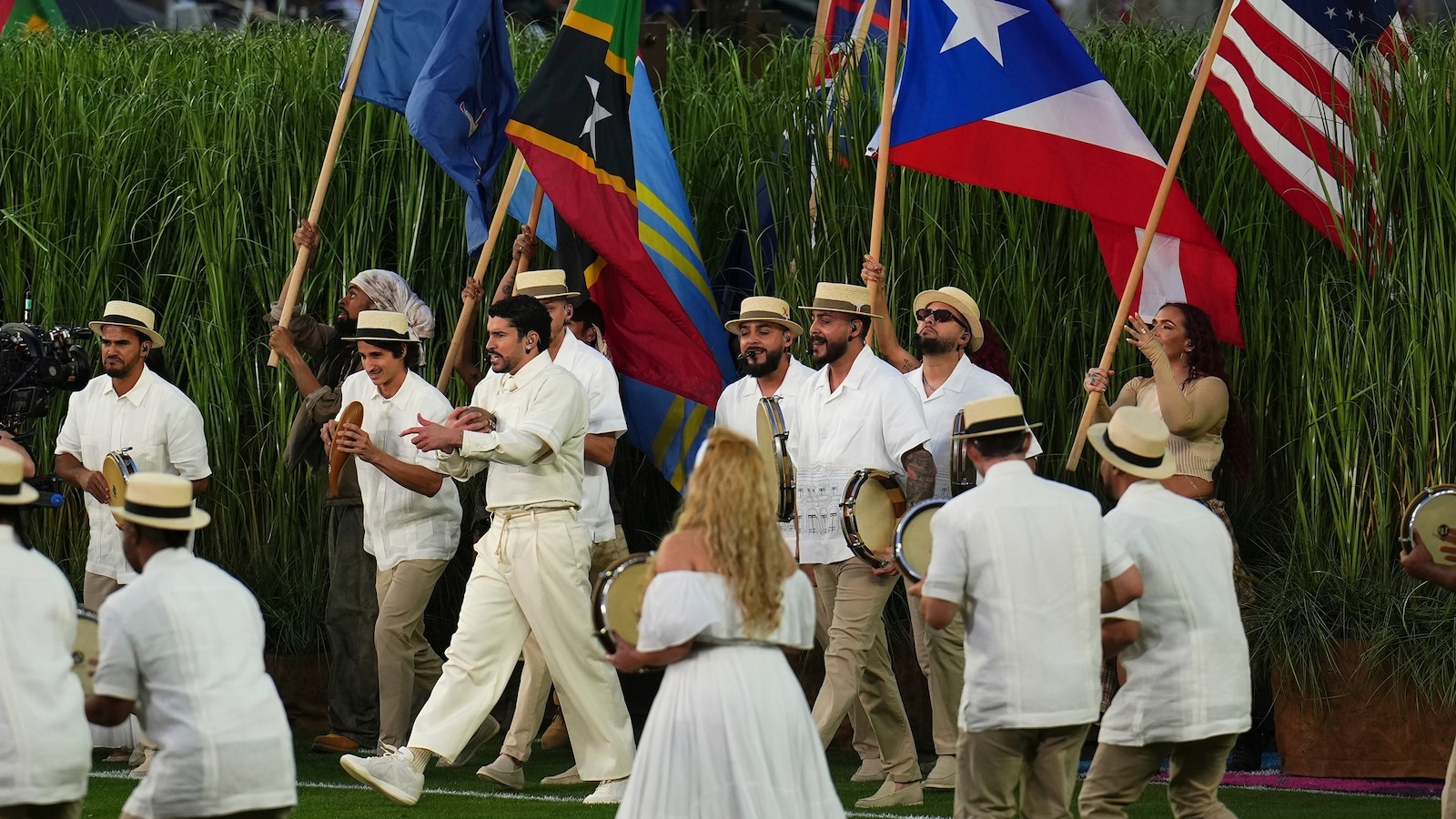
The emotional climax of Bad Bunny’s performance came when he led a parade of national flags representing countries across the Americas. After naming each nation, the 31-year-old artist shouted “seguimos aquí”—Spanish for “we’re still here”—before dramatically spiking a football inscribed with the words “Together, We Are America.” This simple yet profound gesture carried enormous weight, especially in today’s political climate. By methodically naming each country, Bad Bunny highlighted the expansive and diverse nature of the Americas, challenging the common tendency to use “America” solely as shorthand for the United States. His performance offered a broader, more inclusive perspective that resonated deeply with Latin American audiences who have long criticized the narrow use of the term “American.” Gabriel Alejandro Negron Torres, a fellow native of Vega Baja, Bad Bunny’s hometown, shared his emotional response with ABC News, describing feeling “a lot of pride” watching his fellow townsman on the world’s biggest stage. Torres interpreted the message as one of universal welcome, emphasizing that “everyone is welcome to enjoy our culture from the perspective of respect, dignity, admiration and love.”
A Cultural Journey Through Puerto Rico’s Heart and Soul
Bad Bunny’s halftime show was more than a concert—it was an immersive cultural experience that transported audience members and millions of viewers on a visual journey through Puerto Rico. The elaborate production recreated iconic scenes from the island, beginning with sugar cane fields represented by dozens of performers, moving to a colorful casita (small house), and then to the vibrant streets of San Juan, the island’s capital. The attention to detail was remarkable, with the stage featuring domino players, block party revelers, and even a piragua vendor selling traditional Puerto Rican shaved ice. This wasn’t just spectacle for spectacle’s sake—each element told a story about Puerto Rican life, culture, and resilience. The performance featured an impressive lineup of celebrity guests who added their own star power to the celebration. Fellow Puerto Rican icon Ricky Martin joined Bad Bunny on stage, alongside international superstars Karol G, Pedro Pascal, Jessica Alba, Cardi B, and Lady Gaga. Lady Gaga’s appearance was particularly noteworthy, as she performed a salsa version of her hit song “Die With A Smile” while wearing a custom light blue Luar dress adorned with a red flor de maga—Puerto Rico’s national flower—demonstrating the cultural significance woven throughout every aspect of the production.
The Symbolism of a Lighter Shade of Blue
Among the many symbolic elements of Bad Bunny’s performance, one detail carried particular political and cultural significance: the shade of blue in the Puerto Rican flag he carried. Casual observers might have missed this subtle choice, but for those familiar with Puerto Rican history and politics, it spoke volumes. Carlos A. Morales-Ramírez, an assistant professor of geography at West Chester University in Pennsylvania, explained the deeper meaning behind this seemingly minor detail. In 1995, the Puerto Rican government changed the official flag color back to a sky blue shade. Over the years, these different shades of blue have become associated with distinct political ideologies on the island. Pro-independence supporters typically favor the lighter blue version—the one Bad Bunny prominently displayed—while pro-statehood supporters generally prefer the darker blue. This choice was no accident. It represented Bad Bunny’s alignment with those who celebrate Puerto Rican identity and sovereignty, a stance he has consistently taken throughout his career, especially in his advocacy for the island and its people.
Highlighting Puerto Rico’s Ongoing Struggles and Resilience
Bad Bunny used his platform not only to celebrate Puerto Rican culture but also to draw attention to the serious challenges facing the island. Puerto Rico has been a U.S. territory for over a century, since 1917, and while Puerto Ricans are American citizens, they face significant political limitations. They can vote in primary elections but cannot vote in general elections or for U.S. president, and Puerto Rico’s representative in Congress has no voting power—a situation many view as fundamentally undemocratic. For decades, Puerto Rico has experienced an exodus of residents due to political and economic turmoil. One of the most devastating recent examples was Hurricane Maria in 2017, a Category 5 storm that resulted in nearly 5,000 deaths. The hurricane’s impact continues to be felt today, with frequent power outages still plaguing residents eight years later. Bad Bunny addressed this ongoing electricity crisis directly in his halftime show by climbing prop power lines alongside performers, a visual reference to the island’s infrastructure that remains unrestored. This powerful imagery served as a reminder that while Puerto Ricans contribute to American culture and society, their home continues to struggle with basic services that most Americans take for granted.
A Timely Message of Unity in a Divided World
Torres, the Bad Bunny fan from Vega Baja, noted that the performance delivered an especially important message at a critical moment in global politics. “At a moment where the U.S. seems to be isolating itself from the rest of the world, it serves as a great message of international unity to speak of the Americas, including the U.S., as a beautiful region and one of shared history,” he observed. This perspective highlights how Bad Bunny’s performance transcended entertainment to become a cultural and political statement about belonging, identity, and solidarity. The halftime show challenged viewers to think more broadly about what it means to be American—not just as citizens of the United States, but as inhabitants of a vast, diverse region with interconnected histories, cultures, and futures. By performing primarily in Spanish on one of the most-watched television events in the world, Bad Bunny normalized Latino culture for mainstream American audiences while simultaneously celebrating it for the millions of Spanish-speaking viewers who rarely see themselves represented on such a prominent stage. His message was clear and inclusive: the Americas belong to all of us, and our diversity is our strength. In spiking that football emblazoned with “Together, We Are America,” Bad Bunny offered a vision of unity that doesn’t require assimilation or the erasure of cultural identity, but instead celebrates the rich tapestry of languages, traditions, and experiences that make the Americas truly remarkable. His performance will be remembered not just for its musical excellence or production values, but for its courage in asserting that Latino culture, Spanish language, and Puerto Rican identity belong at the center of the American story.