



Shakespeare’s Lost London Home: A Groundbreaking Discovery
Uncovering the Bard’s Hidden London Life
For centuries, William Shakespeare has been synonymous with Stratford-upon-Avon, the picturesque riverside town where he was born and where thousands of tourists still flock annually to visit his childhood home. While this charming market town remains the spiritual home of England’s greatest playwright, the truth is that Shakespeare actually made his name in London, where he wrote his masterpieces, performed on stage, and built his reputation as the greatest dramatist the world has ever known. Yet despite spending much of his professional life in the bustling capital, very few traces of Shakespeare’s London existence have survived to the present day. Now, thanks to a remarkable discovery by Shakespeare scholar Lucy Munro, we have an unprecedented window into the Bard’s life in London—a newly unearthed 17th-century map that reveals, for the first time, the precise location of the only property Shakespeare ever purchased in the city, and potentially the place where he penned his final dramatic works.
This discovery represents a significant breakthrough in our understanding of Shakespeare’s later years and challenges some long-held assumptions about where he spent his time as his career drew to a close. Lucy Munro, a professor of Shakespeare and early modern literature at King’s College London, stumbled upon this historical treasure while researching something entirely different in the London Archives—a reminder that some of history’s most important discoveries happen when we’re looking for something else entirely. “I came across it in the London Archives when I was looking for other things,” Munro explained, highlighting the serendipitous nature of her find. The map supplies what she describes as “extra bits of the jigsaw puzzle” of Shakespeare’s life, filling in crucial gaps in our knowledge of how and where the playwright lived during the period when he was creating some of his most sophisticated works.
The Mystery of Shakespeare’s Blackfriars Property
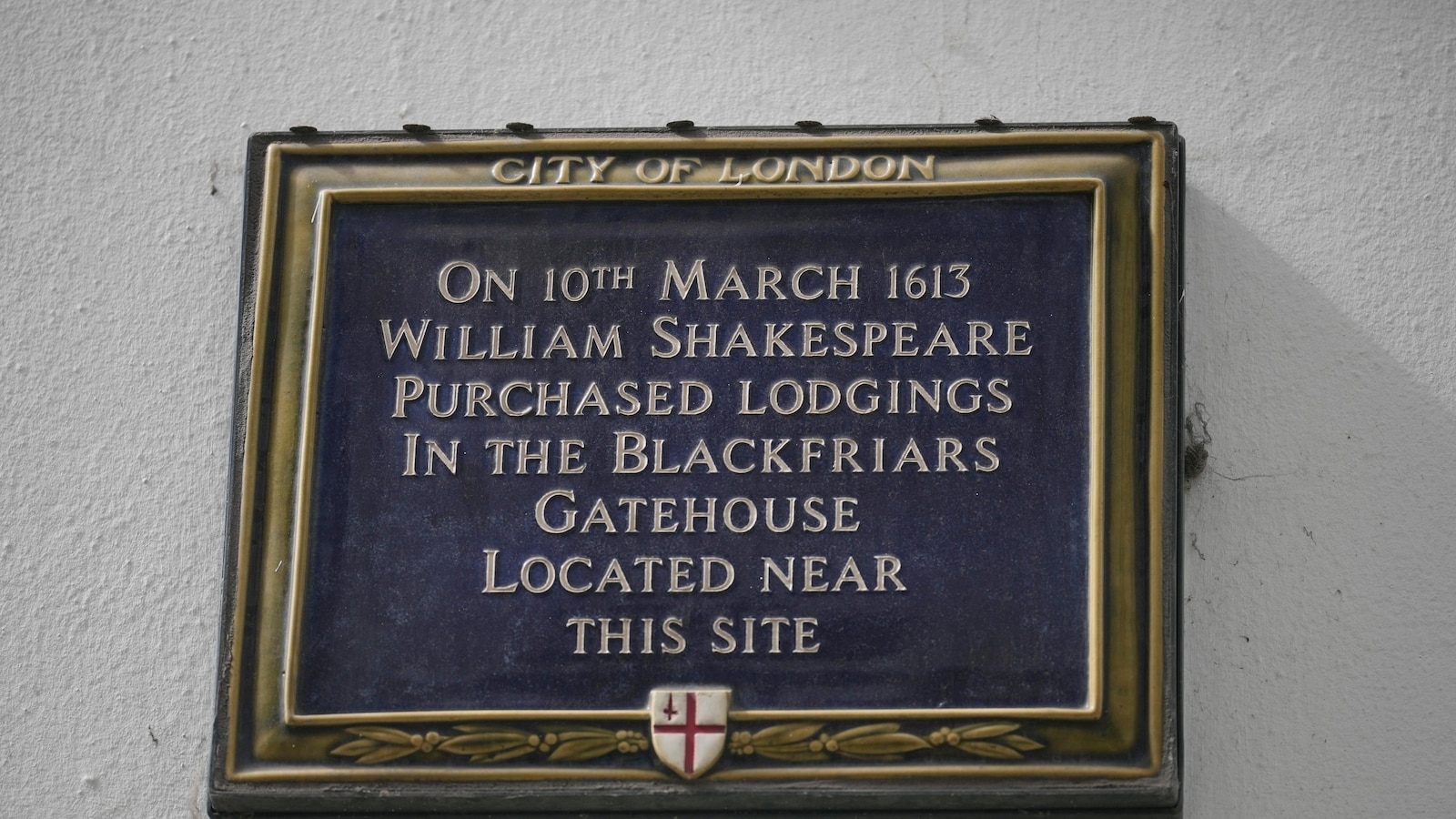
Historians have long been aware that Shakespeare invested in London real estate, specifically that he purchased a property in 1613 near the Blackfriars Theatre. This purchase was well documented in historical records, but one crucial detail had remained frustratingly elusive—the exact location of this property. Over the centuries, scholars could only gesture vaguely at the general area, and a plaque mounted on a 19th-century building offered little more than the unhelpfully vague statement that the playwright had lodgings “near this site.” For anyone trying to walk in Shakespeare’s footsteps or understand the geography of his daily life, this ambiguity was profoundly unsatisfying. The newly discovered map changes everything, providing detailed architectural information about Shakespeare’s house that allows us to pinpoint its location with unprecedented precision.
The plan of the Blackfriars precinct that Munro found reveals Shakespeare’s house to have been a substantial L-shaped dwelling, a property of considerable size and value that had been carved out of a former medieval monastery. The map even shows the gatehouse that would have marked the entrance to his property. The building was part of what had once been a 13th-century Dominican friary, which had been redeveloped for more secular, residential purposes following King Henry VIII’s dissolution of the monasteries in the mid-16th century. This dramatic act of royal appropriation had transformed the religious landscape of England, and the Blackfriars area—its very name preserving the memory of the black-robed Dominican friars who once lived there—became prime real estate in a rapidly expanding London. The precinct also housed the Blackfriars playhouse, an indoor theater in which Shakespeare held a financial stake, making his property purchase not just a residential investment but also a strategic business decision that placed him within a few minutes’ walk of his workplace.
Shakespeare’s Upwardly Mobile Neighborhood
The social character of the Blackfriars neighborhood in Shakespeare’s time tells us something important about his status and the changing nature of London society. According to Munro, Blackfriars was a desirable area that was experiencing a subtle shift downmarket—ironically, due to the arrival of people exactly like Shakespeare himself. He was certainly affluent, having made considerable money from his theatrical ventures, but he remained associated with the world of the stage, which, despite its popularity, was viewed by many in polite society as somewhat disreputable. “After the dissolution of the monasteries, a lot of the nobility, quite high-ranking courtiers, court officials are living in the Blackfriars,” Munro explained. These aristocratic residents represented the old guard of the neighborhood. By the time Shakespeare made his purchase, “there are still a lot of important people living there, people who make protests against the playhouses at various points, because they see the playhouses as a bit of a public nuisance.”
This tension between the established residents and the theater community speaks volumes about the social dynamics of Elizabethan and Jacobean London. The theater was wildly popular with audiences across all social classes, but it also attracted criticism from those who associated it with disorder, immorality, and the gathering of rowdy crowds. That Shakespeare could afford to buy property in such a neighborhood demonstrates his financial success, while the complaints of his neighbors reveal the persistent social stigma attached to his profession. It’s a reminder that even as he was creating works that would be celebrated for centuries as the pinnacle of human artistic achievement, Shakespeare was still viewed by some of his contemporaries as something of a cultural outsider, someone whose commercial success couldn’t quite compensate for the dubious respectability of making one’s living in the theater.
Did Shakespeare Actually Live There?
One of the most intriguing questions raised by this discovery is whether Shakespeare actually lived in his Blackfriars property or simply purchased it as an investment to rent out to tenants. Shakespeare had used the considerable profits from his plays to build an impressive family home—now sadly demolished—in Stratford-upon-Avon, about 100 miles northwest of London, and it’s in Stratford that he died in 1616 at the age of 52. The traditional narrative has suggested that Shakespeare essentially retired to Stratford in his later years, spending less time in London as his career wound down. However, Munro’s discovery may require us to revise this understanding of Shakespeare’s final years.
The size of the London house and its remarkably convenient location—just a five-minute walk from the Blackfriars Theatre—suggest that Shakespeare may have spent considerably more time in London toward the end of his life than scholars have generally assumed. If he did use the house as a residence rather than purely as an investment property, it would have provided him with a comfortable base from which to continue his theatrical work. Munro speculates that Shakespeare may have worked in this house on his final plays, “Henry VIII” and “The Two Noble Kinsmen,” both of which were co-written with John Fletcher, a younger playwright who would eventually succeed Shakespeare as the principal dramatist for the King’s Men, the theater company with which Shakespeare was associated. The idea of the aging Shakespeare collaborating with his younger colleague in a substantial townhouse within earshot of the theater where their plays would be performed adds a wonderful human dimension to these late works.
What This Means for Shakespeare Studies
Will Tosh, director of education at Shakespeare’s Globe—the faithful reconstruction of the open-air Elizabethan playhouse where many of Shakespeare’s plays were first performed—praised Munro’s discovery for providing a “dazzling new sense of Shakespeare the London writer.” He noted that “She’s helped us to understand how much the city meant to our greatest ever dramatist, as a professional and personal home.” This perspective is crucial because it challenges the tendency to think of Shakespeare primarily as a Stratford man who happened to work in London. Instead, it presents him as someone who was deeply embedded in the urban life of the capital, someone for whom London was not just a workplace but potentially a true home.
The property remained in Shakespeare’s family for half a century after his death. He left it to his daughter Susanna, and Munro also discovered two archival documents that detail its eventual sale by Shakespeare’s granddaughter, Elizabeth Hall Nash Barnard, in 1665. Tragically, just one year after this sale, the building was destroyed in the Great Fire of London in 1666, the catastrophic blaze that consumed much of the medieval city and erased countless physical traces of Elizabethan and Jacobean London. Today, only scattered remnants of Shakespeare’s London survive in the area, which is now part of the city’s financial district. These include a fragment of wall from the medieval friary and street names like Playhouse Yard that serve as ghostly reminders of the theaters that once stood here. Visitors can still enjoy a pint at the Cockpit pub, located directly across the street from where Shakespeare’s house once stood. The 1600s map shows this building as a place called the Sign of the Cock, likely a tavern even in Shakespeare’s day. It’s not difficult to imagine Shakespeare and his fellow actors gathering there for drinks after a performance, trading stories and gossip. As Munro notes, “There are certainly complaints in the period about the playhouses leading to the opening of more and more drinking houses—’houses for tippling,’ as they call them in one of the documents I was looking at.” This discovery reminds us that Shakespeare wasn’t just a literary genius working in isolation, but a social being embedded in the vibrant, messy, sometimes controversial world of London’s theatrical community.