



Bitcoin’s Pullback from $80K: Understanding the Market Dynamics and Future Outlook
The Recent Price Movement and What Triggered It
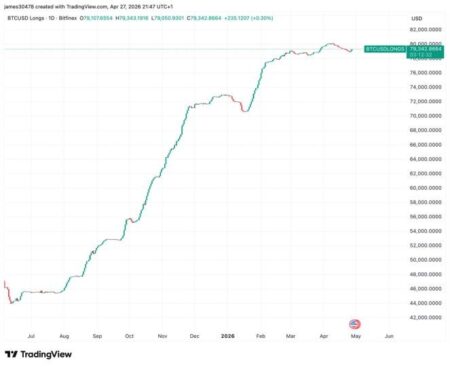
Bitcoin made headlines today as it climbed tantalizingly close to the significant psychological threshold of $80,000, reaching a peak of $79,420 before reversing course. The cryptocurrency has since experienced a notable decline, currently trading at $76,757, representing a 3.35% decrease from its recent high. What’s particularly interesting about this downturn is that it wasn’t sparked by any groundbreaking news or major announcement. Instead, the culprit appears to be intense selling pressure that emerged following massive liquidations in the derivatives market, which had become dangerously over-leveraged. Within just one hour of the price reversal, cryptocurrency exchanges processed a staggering combined total of $1.35 billion in sell orders, with the world’s largest exchange, Binance, handling the lion’s share at $1.2 billion. For Bitcoin specifically, these liquidations eliminated $112.66 million from traders who had bet on the price continuing to rise (long positions) over the past 24 hours. This cascade of forced selling created a domino effect that pushed prices lower as leveraged positions were automatically closed to prevent further losses.
External Factors Adding Pressure to the Market
While the immediate cause of Bitcoin’s decline was related to market mechanics and over-leverage, broader economic and geopolitical concerns are creating an atmosphere of uncertainty that isn’t helping matters. The global economy is dealing with significant instability, particularly surrounding tensions in the Middle East. A fragile ceasefire between the United States and Iran remains uncertain, and peace negotiations have unfortunately failed to produce meaningful results. The situation has escalated to the point where critical infrastructure has been damaged, and there are serious concerns about the potential closure of the Strait of Hormuz, a vital waterway through which a significant portion of the world’s oil supply flows. These geopolitical tensions have translated into economic consequences, with WTI crude oil prices climbing to $96.73 per barrel. Rising oil prices typically signal increased economic uncertainty and can dampen investor enthusiasm for risk assets like cryptocurrencies. This broader context of global instability provides an additional headwind for Bitcoin and the wider cryptocurrency market, even though digital assets are often touted as hedges against traditional financial system disruptions.
Why Experts See This as a Buying Opportunity
Despite the concerning price action and negative short-term sentiment, many seasoned cryptocurrency analysts and market observers are viewing this moment not as a reason for panic, but rather as a potentially generational buying opportunity. They argue that Bitcoin’s current price behavior is actually typical of what happens at or near market bottoms, and that investors should prepare themselves for a substantial rebound over the longer term. The reasoning behind this optimistic outlook is rooted in both historical patterns and technical analysis. When we look at how Bitcoin has performed in previous market cycles, similar price levels and technical indicators have preceded some of the most explosive rallies in the cryptocurrency’s history. The current situation shares many characteristics with those previous bottom formations, suggesting that patient investors who accumulate Bitcoin at these levels could be handsomely rewarded in the months and years ahead. This perspective represents a fundamental shift in how we should interpret short-term price weakness—not as a sign of fundamental failure, but as a temporary dislocation that creates opportunity for those with sufficient conviction and time horizon.
The Technical Indicators Pointing Toward Recovery
Cryptocurrency analyst Michaël van de Poppe has provided particularly compelling evidence for why the current moment might represent an exceptional entry point for Bitcoin investors. He points to historical patterns showing that when the Mayer Multiple Z-score falls below -1.5 standard deviations, Bitcoin has subsequently experienced rallies of up to 1,300% in the following two years. For those unfamiliar with this metric, it’s a technical indicator that measures Bitcoin’s current price relative to its long-term moving average, helping to identify when the asset is significantly overvalued or undervalued compared to historical norms. The fact that this indicator has now reached that critical threshold in the current market cycle suggests that Bitcoin is substantially undervalued and historically “oversold” relative to its long-term average price trajectory. Van de Poppe describes this as the “ultimate accumulation trigger” in this cycle, noting that such signals don’t appear frequently, but when they do, they’ve consistently provided what he calls “generational opportunities.” Looking at previous cycles, these extreme readings were hit at actual bear market bottoms—after the 2018 bottom, Bitcoin rallied 400% over the following two years. Based on this pattern, the analyst is confident that we’re on the verge of a significant bullish reversal, with some projections suggesting that even $200,000 could eventually become the bottom of the next bear market, implying much higher peaks in between.
Additional Evidence Supporting the Bullish Case
Beyond the Mayer Multiple Z-score, several other technical indicators are painting an increasingly optimistic picture for Bitcoin’s near-term prospects. The Relative Strength Index (RSI), which measures the momentum of price movements and helps identify whether an asset is overbought or oversold, currently reads 53.40. This level indicates that Bitcoin has moved out of oversold territory and into what technical analysts consider the “valued region,” where buying pressure typically begins to build. Meanwhile, the MACD (Moving Average Convergence Divergence), another popular momentum indicator, remains both positive and rising. When both the RSI and MACD are showing these characteristics simultaneously, it typically signals that a shift in market sentiment is underway, with momentum beginning to favor buyers rather than sellers. These technical signals are being reinforced by concrete evidence of renewed institutional interest in Bitcoin. Last week alone, Bitcoin investment products experienced a surge in demand, with $933 million in fresh capital flowing into these vehicles. BlackRock’s Bitcoin ETF (IBIT) has been particularly impressive, recording a nine-day consecutive inflow streak totaling $983 million, marking its most dominant performance in six months. This institutional buying is significant because it represents “smart money” making strategic allocations at prices they believe represent value, providing a strong foundation for future price appreciation.
Policy Developments and Long-Term Outlook
Adding further fuel to the bullish thesis, political developments in the United States are creating a potentially transformative environment for Bitcoin adoption at the national level. Congressman Nick Begich III has announced the revival of proposals for a Bitcoin strategic reserve, as the United States seeks to position itself as a global Bitcoin hub and leader in cryptocurrency innovation. If such initiatives gain traction, they would represent a fundamental shift in how the world’s largest economy views Bitcoin—not as a speculative asset to be merely tolerated, but as a strategic reserve asset worthy of government accumulation and support. This type of institutional and governmental embrace could provide the foundation for Bitcoin’s next major bull run, potentially dwarfing previous cycles. The combination of technical indicators showing Bitcoin is undervalued, institutional money flowing back into the market, and supportive policy developments creates a compelling case that the current weakness is temporary and presents an opportunity rather than a threat. While short-term volatility is inevitable and further downside is always possible, the weight of evidence suggests that patient investors who maintain exposure to Bitcoin through this turbulent period are likely to be rewarded. The key lesson from previous cycles is that the best buying opportunities often feel the most uncomfortable in the moment, occurring when sentiment is negative and headlines are bearish, yet these are precisely the times when future returns are typically generated for those with the conviction to act contrary to the prevailing mood.