


Washington’s Delaware Crossing and the Story of Climate Change
When Ice Shaped History
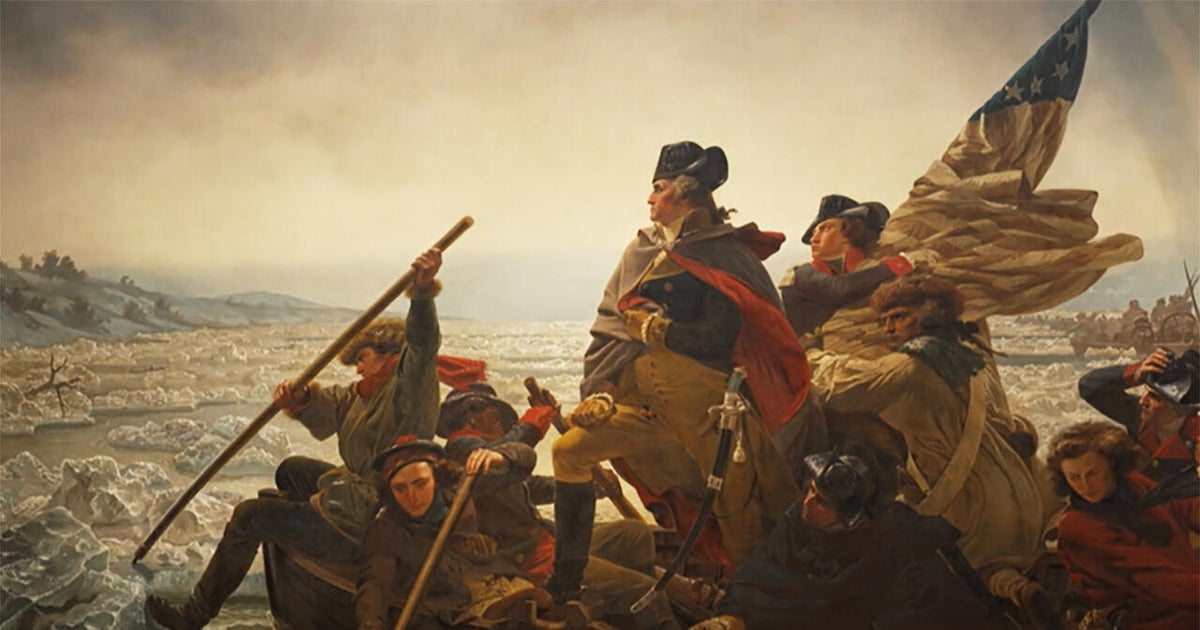
Take a moment to examine Emanuel Leutze’s iconic 1851 painting “Washington Crossing the Delaware,” and one element dominates the scene: ice. Chunks of frozen water fill the Delaware River, creating a treacherous obstacle course for General George Washington and his troops. But according to Alex Robb, an educator at Washington Crossing Historic Park near Philadelphia, this frigid barrier became more than just a challenge—it transformed into a crucial military advantage. “It does a lot to impede the crossing and endanger the whole operation,” Robb explains, “but it actually becomes our shield.” The brutal cold that made the crossing so dangerous also provided Washington with something invaluable: the element of surprise. As 1776 drew to a close, Washington’s Continental Army was teetering on the brink of defeat after suffering multiple devastating losses. His forces were depleted, morale was crumbling, and the cause of American independence seemed all but lost. Yet on Christmas Day, as ice formed thick patterns across the Delaware River, enemy forces made a fatal assumption. They believed the treacherous conditions made a river crossing impossible, that no commander would risk such a dangerous maneuver in such weather. Washington proved them spectacularly wrong, and his stunning victory at Trenton became a turning point that breathed new life into the revolutionary cause.
The Margin Between Victory and Defeat
The success of Washington’s bold Christmas crossing came down to incredibly narrow margins—specifically, just a few degrees of temperature. As Robb points out, “Looking back, had the weather proven more mild, they most definitely would’ve encountered resistance outside Trenton.” Those few degrees of difference created the ice that convinced British and Hessian forces that an attack was impossible, allowing Washington to achieve complete tactical surprise. The victory at Trenton wasn’t just a military success; it was a psychological triumph that demonstrated the war could still be won, energizing the revolutionary cause at its darkest hour. Today, historical re-enactors gather annually at the site to commemorate this pivotal moment, recreating the dangerous crossing that changed American history. But the weather conditions that made that crossing possible—and strategically brilliant—tell us something important about how our climate has changed since America’s founding. In Washington’s era, Americans were accustomed to much harsher winters. We know this from historical records like Thomas Jefferson’s meticulous, handwritten weather observations, which document the climate conditions of the late 18th century with scientific precision.
The Warming Trend
Since the time when Washington’s troops battled ice flows in the Delaware, winters have undergone a dramatic transformation. Jen Brady, a data analyst at Climate Central, a science-focused nonprofit organization, has studied temperature patterns in the Philadelphia area spanning from the Revolutionary era to today. Her research reveals that while average winter temperatures have fluctuated year to year, creating natural variations, the overall trend is unmistakable and stark. “Ever since Washington was here, there has been a steady increase,” Brady explains. The numbers tell a compelling story: average winter temperatures in the Philadelphia region are now 5.5 degrees Fahrenheit warmer than they were in 1970—a significant shift in just over fifty years. This doesn’t mean that winter has disappeared from places like Washington Crossing, Pennsylvania. As Brady clarifies, “It will continue to snow. There will continue to be cold in cold places. But there will be less of it.” The character of winter is changing, with fewer extreme cold events, less ice formation, and milder temperatures becoming the new normal. This warming trend has profound implications not just for weather patterns, but for how we understand our climate’s trajectory and the environmental challenges we face.
A Time Machine Made of Ice
The most compelling evidence for understanding how our climate has changed comes from an unlikely source: ice cores extracted from the massive glaciers of Greenland and Antarctica. These long cylindrical tubes of ice, drilled from deep within ancient ice sheets, serve as what glaciologist Eric Steig calls “a time machine.” Steig, who works at the University of Washington in Seattle, studies these remarkable climate archives to understand Earth’s atmospheric history. Within the layers of ice are perfectly preserved air bubbles—tiny capsules of ancient atmosphere trapped when the ice formed. The deeper researchers drill, the older the air bubbles become, creating a chronological record stretching back hundreds of thousands of years. “It’s this sort of magical way of going back in time,” Steig explains with evident enthusiasm. Among his collection is an ice core dating specifically from 1776, containing microscopic pockets of air from the very year Washington crossed the Delaware. “So, like, you’re breathing a little bit of the air that George Washington breathed,” Steig notes, highlighting the tangible connection these samples provide to our past. But these ice cores offer far more than a nostalgic link to history—they provide hard scientific data about atmospheric composition across millennia.
The Carbon Story Written in Ice
Those ancient air bubbles trapped in ice cores contain carbon dioxide, a crucial greenhouse gas that plays a fundamental role in regulating Earth’s temperature. By analyzing these bubbles from different depths and time periods, scientists have reconstructed atmospheric carbon dioxide levels stretching back 800,000 years. Throughout this vast span of time, carbon dioxide concentrations fluctuated naturally, rising and falling in response to various geological and climatic cycles. But here’s the striking pattern: for those entire 800,000 years, carbon dioxide levels never exceeded 300 parts per million—not until around 1800, when something unprecedented happened. The levels began to spike dramatically, breaking through that ancient ceiling and continuing to climb at an accelerating rate. What caused this sudden, dramatic change that broke an 800,000-year pattern? According to Steig, the answer is straightforward: “We began burning fossil fuels, and we’re doing it really fast.” The timing is significant—this carbon spike began around the time of the Industrial Revolution, which coincided closely with the American Revolution. As human civilization developed new technologies and industries, we increasingly relied on burning coal, oil, and natural gas to power our factories, vehicles, and cities. This massive combustion of fossil fuels has pumped enormous quantities of carbon dioxide into the atmosphere, fundamentally altering its composition in a geological blink of an eye.
Two Stories Converging
The consequences of this atmospheric transformation have been profound and far-reaching. Since the Industrial Revolution began reshaping both American society and global climate, rising carbon dioxide levels have driven warmer temperatures worldwide. This warming doesn’t just mean milder winters like those now experienced in Philadelphia; it intensifies extreme weather events including devastating floods, prolonged droughts, and catastrophic wildfires. These changes affect ecosystems, agriculture, human health, and economic systems in complex, interconnected ways. “It would seem to me it’s good for people to understand things have changed, and will continue to change, and have an understanding of what to expect going forward,” Steig emphasizes, highlighting the importance of climate awareness for planning our future. Looking back at that frozen Christmas in 1776, we can see two monumental stories beginning simultaneously: the birth of American democracy and the start of human-driven climate change. Both narratives continue to shape our world today in profound ways. The icy Delaware that provided Washington his strategic advantage would look quite different today—not just because of seasonal variation, but because our entire climate system has fundamentally shifted. If General Washington could somehow be transported from that freezing Christmas to modern-day America, the changes would be dramatic and disorienting. As Steig notes, “You pluck somebody from that time period, they would see things having changed quite dramatically.” The ice that protected Washington’s crossing is melting into history, not just as a specific event, but as a representation of a climate that no longer exists in quite the same way. Understanding this transformation helps us appreciate not only how far we’ve come as a nation, but also the environmental challenges we must address to protect the world we’ll leave to future generations.