



Finding Hope and Confidence: How One Soccer Star is Changing Lives Through Representation
A Life-Changing Moment at Mile High Stadium
When the brand-new Denver Summit FC women’s soccer team took to the field at Mile High Stadium for their home opener last month, the scoreboard may have read zero, but for nine-year-old Hayden Stine sitting in the stands, the day represented an immeasurable victory. The young soccer enthusiast wasn’t there just to watch a game – she was there to witness something she had never seen before: a professional athlete who looked like her. Hayden was born without most of her right arm, and when she spotted Carson Pickett, a Summit FC player with a similar limb difference, something profound clicked in the young girl’s mind. “I want to be a professional soccer player when I grow up,” Hayden enthusiastically shared with CBS News after meeting her new hero. “And she was able to do that. And it really fills me with hope that I’m able to as well.” In that stadium, surrounded by thousands of fans, Hayden found more than entertainment – she discovered a mirror reflecting her own potential and a roadmap to her dreams.
The Power of Seeing Yourself Represented
The impact of representation cannot be overstated, particularly for young people navigating the world with visible differences. For Hayden, seeing Carson Pickett compete at the highest level of women’s soccer fundamentally shifted her understanding of what’s possible for her own future. “Role models make you feel like you can do anything – just like them,” Hayden explained with the simple wisdom that often comes from children who’ve experienced a transformative moment. Her mother, Christina Hayden, has witnessed firsthand the remarkable transformation in her daughter since that fateful meeting. “Hayden’s confidence has skyrocketed,” Christina disclosed to reporters, her voice filled with gratitude and amazement. “At school, on the soccer field, it’s through the roof.” The change wasn’t subtle or gradual – it was immediate and dramatic. Where there might have once been hesitation or self-consciousness, there now exists bold self-assurance. The family describes meeting Pickett as nothing short of life-altering, a single encounter that opened doors in Hayden’s mind that she perhaps didn’t even know were closed. Yet, as powerful as this meeting was, it almost never happened at all.
A Journey From Hiding to Embracing
Carson Pickett’s own relationship with being a visible role model has been a complex evolution. For years, she actively resisted the spotlight that came with her limb difference. “I didn’t want to be known as the girl with one arm that plays soccer,” Pickett candidly admitted to CBS News. “I just wanted to be known for the girl that plays soccer.” This desire to be recognized solely for her athletic abilities rather than her physical difference is completely understandable – she wanted to be valued for her skills, dedication, and achievements on the field, not reduced to a single physical characteristic. Throughout much of her career, Pickett went to great lengths to minimize attention to her arm, carefully positioning herself in photographs and steering conversations away from her limb difference whenever possible. She wanted to control her own narrative and be defined by her accomplishments rather than by what she was born without. This protective stance persisted until a pivotal conversation with her mother, who gently pointed out that by hiding this part of herself, Pickett was inadvertently closing the door on a greater purpose that extended far beyond her own comfort zone.
A Mother’s Wisdom and a Shift in Perspective
Sometimes the people closest to us can see opportunities and purposes that we ourselves cannot recognize. Pickett’s mother helped her daughter understand that her visibility as an athlete with a limb difference wasn’t a burden to bear but rather an opportunity to impact lives in ways that most athletes never could. This conversation sparked a fundamental shift in Pickett’s perspective. She began to understand that her journey wasn’t solely about her personal success or comfort – it was about the countless young people who might see themselves in her and dare to dream bigger because of her example. Reflecting on this transformation, Pickett later wrote on social media: “Finding out that the journey is a lot less about myself and a lot more about the hearts I can touch along the way.” This realization marked a turning point not just in how Pickett presented herself publicly, but in how she understood her role as a professional athlete. She moved from avoidance to embrace, from hiding to seeking out opportunities to connect with people who might benefit from her story and her presence.
Embracing the Role Model Mantle
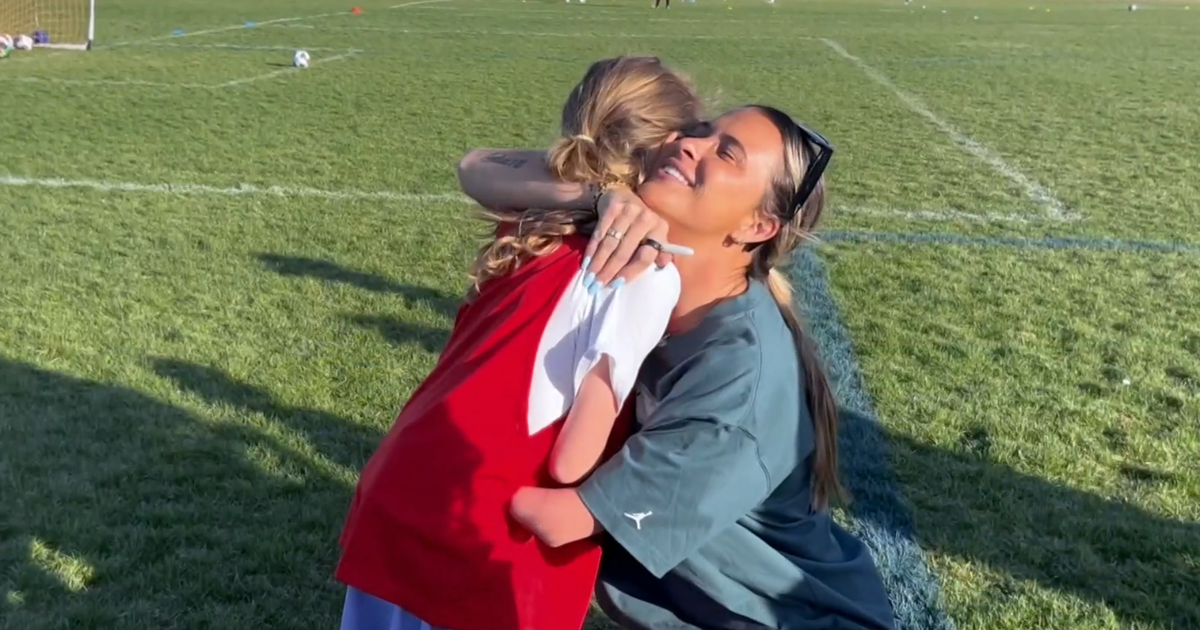
Today, Pickett’s approach to visibility and representation represents the “complete opposite” of where she started. Rather than avoiding attention or deflecting conversations about her limb difference, she actively seeks out opportunities to connect with families and individuals navigating similar experiences. “I want to meet all the kids, all the families, all the adults,” Pickett enthusiastically shared. “I want to meet everyone that I can.” This isn’t merely a publicity strategy or a reluctant acceptance of an uncomfortable reality – it’s a genuine embrace of a calling that extends beyond the soccer field. Pickett has discovered that her platform as a professional athlete gives her a unique opportunity to provide hope, encouragement, and tangible proof that physical differences don’t have to limit anyone’s dreams. This commitment to connection manifested beautifully when Pickett decided to surprise Hayden at her team’s soccer practice this week. The young girl, still riding high on the confidence boost from their first meeting, was stunned and delighted to see her role model show up to her own practice. The gesture demonstrated that Pickett’s commitment to being a role model isn’t performative – it’s personal, intentional, and ongoing.
Passing the Torch to the Next Generation
The relationship between Carson Pickett and Hayden Stine represents something far more significant than a one-time meeting between an athlete and a fan. Pickett plans to stay in touch with Hayden, providing ongoing encouragement and mentorship as the young girl pursues her soccer dreams. Perhaps more importantly, Pickett hopes to help Hayden discover her own purpose – the unique way she might impact others as she grows and develops her own platform. The beautiful truth is that role models don’t just inspire others to follow in their footsteps; they empower the next generation to become role models themselves, creating a ripple effect of representation and inspiration. When asked if she sees herself becoming a role model one day, Hayden responded with characteristic confidence: “Yes, I am up for it.” This simple statement captures the essence of why representation matters so profoundly. A few weeks ago, Hayden might not have envisioned herself in such a role, but now, having seen what’s possible through Carson Pickett’s example, she can imagine herself not just achieving her dreams but helping others achieve theirs as well. Because when it comes to role models, as the saying goes, it takes one to be one. And in this beautiful cycle of inspiration, visibility, and representation, both Carson Pickett and Hayden Stine are proving that our differences don’t limit what we can achieve – they enhance our ability to inspire others and change lives along the way.