


Lindsey Vonn’s Unwavering Determination: Fighting to Compete at the 2026 Winter Olympics Despite Devastating Injury
A Champion’s Resolve in the Face of Adversity
Just one week before the opening ceremony of the 2026 Winter Olympic Games, American skiing legend Lindsey Vonn found herself facing what could have been a career-ending setback. Standing tall at a press conference in Cortina d’Ampezzo, Italy, the 41-year-old athlete delivered a message that embodied the fighting spirit that has defined her remarkable career. Despite suffering a completely torn ACL, bone bruise, and meniscal tears in her left knee during a devastating crash in Switzerland, Vonn declared with unwavering conviction that she would not let her Olympic dream slip away. “I’m not letting this slip through my fingers. I’m gonna do it. End of story,” she told reporters at the Cortina Curling Stadium, her voice strong and determined. With her head held high and refusing to shed tears of defeat, Vonn made it clear that regardless of the outcome, she would give everything she had to compete. Her statement wasn’t just about participating in a sporting event; it was a testament to the resilience and determination that has made her one of the greatest alpine skiers in history. The three-time Olympic medalist, who had already defied expectations by coming out of retirement in 2024 after six years away from Olympic competition, was now facing perhaps her greatest challenge yet.
The Devastating Crash That Could Have Ended Everything
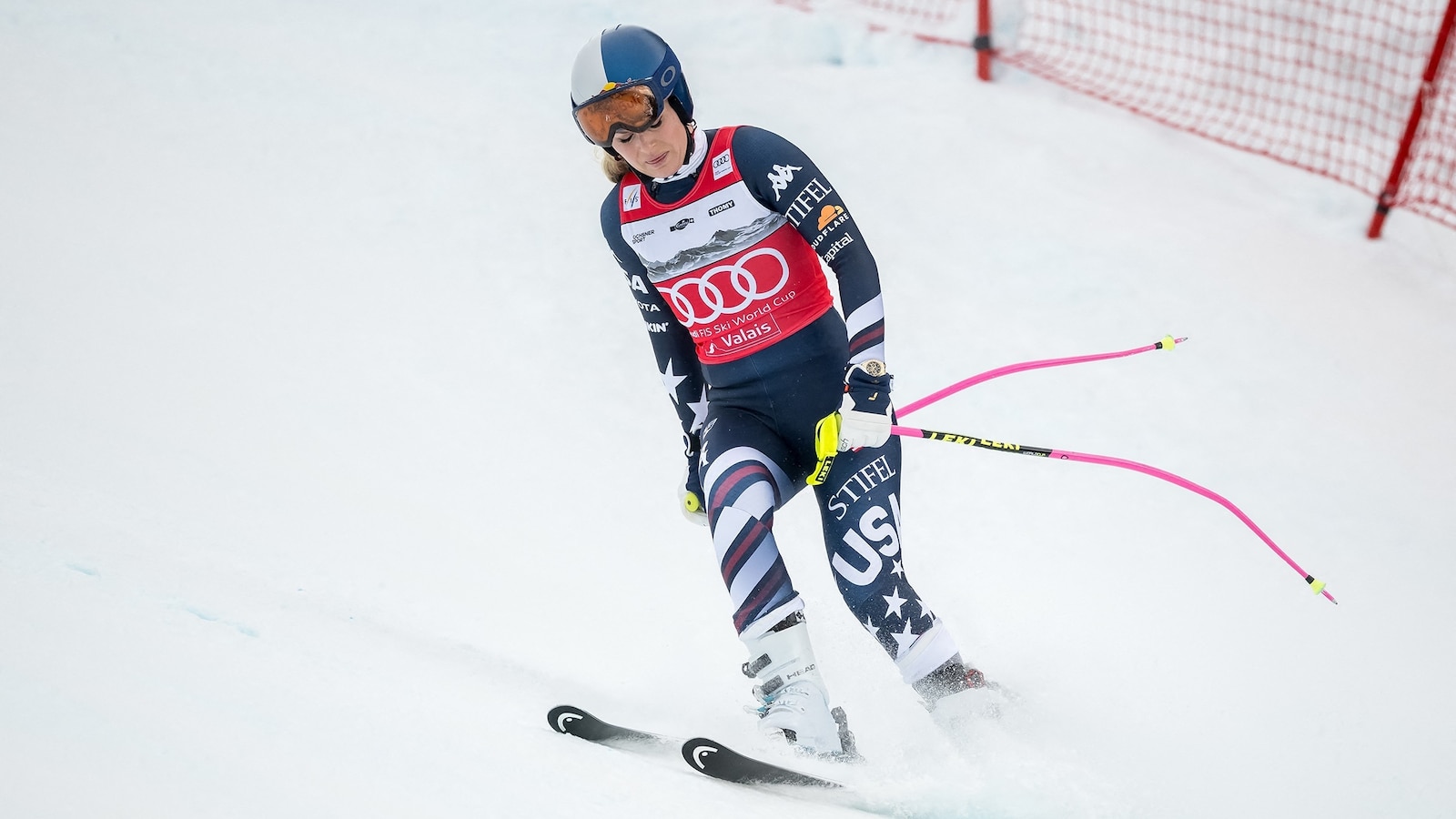
The incident that threatened to derail Vonn’s Olympic aspirations occurred on January 30, 2026, during a downhill race in Crans-Montana, Switzerland. In an Instagram post following the accident, Vonn detailed the extent of her injuries, explaining that she had completely torn her ACL when she crashed during what was supposed to be her final downhill race before the Olympics. The crash was dramatic and frightening—Vonn lost control while landing a jump at the top of the course and became entangled in the safety nets. For nearly five agonizing minutes, medical personnel attended to her on the slope while spectators and fellow competitors watched with concern. Eventually, she was able to slowly ski to the finish line, but the severity of the situation became immediately apparent when she required further medical attention at an on-site tent before being airlifted by helicopter to receive more comprehensive care. The U.S. Ski & Snowboard Team quickly shared news of the injury on social media, and the skiing world held its collective breath waiting for updates on the beloved champion’s condition. Adding to the somber nature of the day, Vonn was the third person to crash in the Crans-Montana World Cup race, and the event was ultimately canceled due to poor course conditions. In her initial statement, Vonn also extended her thoughts to 26-year-old Norwegian skier Marte Monsen, who had also suffered a major crash and injury during the same competition.
Understanding the Full Extent of the Injuries
In her comprehensive Instagram update on Tuesday, Vonn provided detailed information about her injuries that painted a picture of the significant challenge she was facing. The complete ACL tear was the most serious concern—a ligament injury that typically requires surgical reconstruction and months of rehabilitation for most athletes. Beyond the ACL damage, she also sustained a bone bruise, which she noted is a common accompanying injury when an ACL tear occurs. Additionally, medical examinations revealed meniscal tears, though Vonn acknowledged that it remained unclear how much of the meniscal damage was pre-existing from previous injuries versus new trauma from the recent crash. This ambiguity speaks to the accumulated wear and tear that elite skiers experience over their careers, particularly someone like Vonn who has pushed her body to its absolute limits for decades. The timing of the injury made the situation particularly heartbreaking—receiving such devastating news just one week before the Olympic Games would test anyone’s mental fortitude. Vonn candidly shared that the diagnosis was “incredibly hard news to receive” and expressed appreciation for those who gave her time and space to process what had happened and determine a path forward. However, despite the severity of the injuries listed in medical reports, Vonn pointed to some encouraging signs: her knee remained stable, there was no swelling, and her muscles were “firing and reacting as they should,” all of which gave her hope that competition might still be possible.
The Road to Olympic Competition: A Race Against Time
After receiving the devastating diagnosis, Vonn immediately went into problem-solving mode, conducting what she described as “extensive consultations with doctors” along with “intense therapy” and “physical tests.” Most remarkably, she actually returned to skiing to test her body’s capabilities and limitations. Based on all of this information and assessment, she made the bold determination that she was capable of competing in the Olympic Downhill scheduled for Sunday, February 9. The path to competition wouldn’t be straightforward, however. Vonn acknowledged that she would still need to complete one mandatory training run—a requirement for all competitors before they can race on Sunday. This training run, scheduled for Friday, February 5, would serve as both an official prerequisite and a crucial real-world test of whether her injured knee could withstand the forces and demands of Olympic-level downhill skiing. Vonn and her medical team committed to evaluating her condition daily, ensuring that they made “smart decisions” rather than reckless ones driven purely by competitive desire. This approach demonstrated a maturity and wisdom that comes from years of experience managing injuries and understanding the fine line between pushing through adversity and causing irreparable harm. In her statement, Vonn was refreshingly honest about her situation, acknowledging, “I know what my chances in these Olympics were before this crash, and even though my chances aren’t the same now, there is still a chance.” This realistic assessment showed that she wasn’t in denial about her circumstances—she simply refused to give up as long as any possibility remained.
A Legacy of Comebacks and Resilience
Lindsey Vonn’s determination to compete despite her injuries is entirely consistent with the fighting spirit she’s demonstrated throughout her legendary career. Her decision to come out of retirement in 2024, six years after her most recent Olympic appearance, already spoke to her extraordinary drive and love for the sport. Over the course of her career, Vonn has accumulated three Olympic medals and established herself as one of the greatest alpine skiers in history, but her journey has been far from smooth. She has battled numerous injuries over the years, each time finding the strength and determination to come back stronger. In her Instagram post, she referenced this experience directly, writing, “if there’s one thing I know how to do, it’s a comeback.” This wasn’t empty bravado—it was a statement backed by years of evidence. Her ability to return to elite competition after serious setbacks has been one of the defining characteristics of her career. At 41 years old, an age when most alpine skiers have long since retired, Vonn’s decision to pursue Olympic competition demonstrates an almost superhuman combination of physical capability and mental toughness. Her message to supporters was filled with gratitude and determination: “Thank you to everyone who has reached out and supported me. I feel the love and it is giving me strength.” This acknowledgment of her support system revealed the human side of the champion—someone drawing strength not just from within but from the community that has followed and cheered for her throughout her remarkable journey.
The Broader Message: Never Give Up on Your Dreams
Beyond the specific details of injuries, treatment plans, and competition schedules, Lindsey Vonn’s story carries a powerful universal message about perseverance and the human spirit. Her statement at the press conference—”never say I didn’t try”—encapsulates an approach to life that resonates far beyond the world of competitive skiing. In choosing to pursue her Olympic dream despite the significant obstacles in her path, Vonn is demonstrating that the effort itself has value, regardless of the outcome. She explicitly stated, “whatever the result is, that’s what it is,” showing that she has made peace with uncertainty and focused instead on what she can control: her preparation, her effort, and her attitude. This mindset is particularly powerful coming from someone who has already achieved so much in her sport. Vonn isn’t chasing Olympic glory because she needs to prove herself—she’s doing it because the dream still matters to her, because she believes in possibility, and because giving up isn’t in her nature. Her declaration that “It’s not over yet!” and her refusal to “lose hope” or “give up” as long as a chance remains serves as an inspiration to anyone facing their own challenges, whether in sports or in life. As the world watches to see whether Vonn will be able to compete in the Olympic Downhill on Sunday, the outcome has almost become secondary to the larger story she’s writing—one about courage, determination, and the refusal to let circumstances define your limits. Regardless of whether she crosses the finish line or how she places, Lindsey Vonn has already demonstrated what it means to be a true champion.