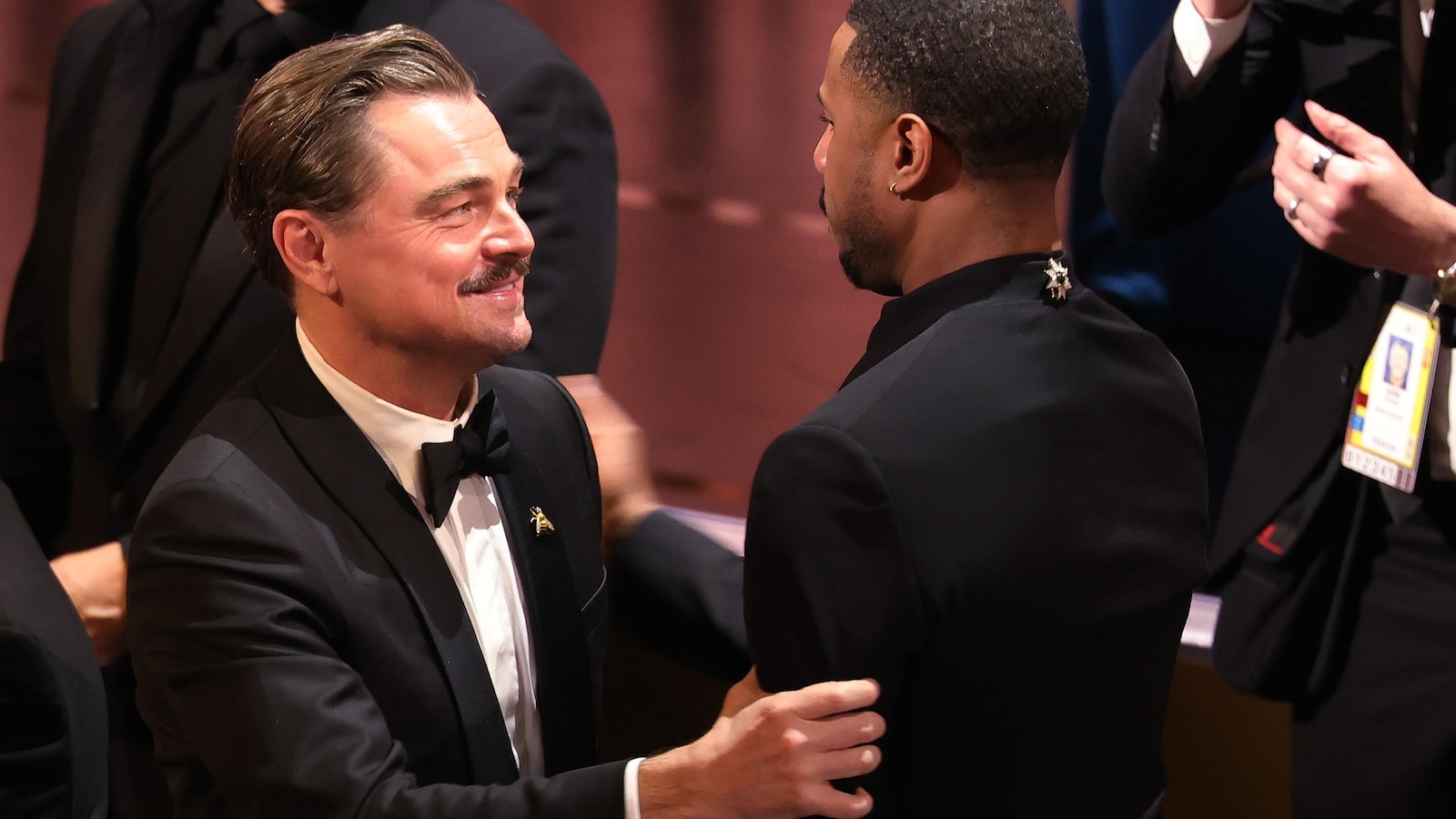

A Heartwarming Display of Sportsmanship: Leonardo DiCaprio and Michael B. Jordan’s Touching Moment at the Oscars
When Competition Meets Genuine Respect
The 98th Academy Awards ceremony at the Dolby Theatre in Hollywood delivered more than just golden statuettes and memorable speeches on that memorable Sunday night in March 2026. Among the glitz and glamour, a genuinely touching moment unfolded that reminded everyone watching why Hollywood can still be a place of camaraderie and mutual respect. Leonardo DiCaprio and Michael B. Jordan, both nominated in the fiercely competitive Best Actor category, shared a warm embrace that quickly captured hearts across social media. The video of their interaction spread rapidly online, showcasing what many felt was the true spirit of the evening—talented artists celebrating each other’s achievements rather than dwelling on personal disappointments.
The embrace came immediately after Jordan’s name was announced as the winner of the Best Actor award for his powerful performance in “Sinners.” Rather than any awkwardness or forced politeness that might sometimes characterize such moments between competitors, the interaction between DiCaprio and Jordan appeared entirely genuine and heartfelt. DiCaprio, who had been nominated for his role in “One Battle After Another,” showed no visible disappointment as he congratulated his fellow actor. The two shared what onlookers described as a warm, extended hug, followed by a brief exchange of words that, while inaudible in the circulating video, clearly conveyed mutual admiration and respect. This moment resonated deeply with viewers who appreciated seeing such authentic grace and sportsmanship on display during one of entertainment’s biggest nights.
A Moment of Brotherhood Among Hollywood’s Finest
The touching scene didn’t end with just DiCaprio and Jordan. As the two men concluded their conversation, Benicio del Toro, DiCaprio’s co-star from “One Battle After Another” and a Best Supporting Actor nominee himself, joined the pair. Del Toro added his own congratulations to Jordan with what appeared to be warm words and an encouraging pat on the arm. This three-way interaction painted a beautiful picture of solidarity among actors who understand the challenges, dedication, and vulnerability required to deliver the kind of performances that earn Oscar nominations. These men weren’t just competitors for a night; they were colleagues who respected each other’s craft and the journey each had taken to reach that prestigious stage.
The Best Actor race had been one of the evening’s most anticipated categories, with the award circuit throughout the season building considerable excitement and speculation. Jordan and Timothée Chalamet, nominated for “Marty Supreme,” had emerged as the clear frontrunners as Oscar night approached, though the category was rounded out by equally impressive performances from Ethan Hawke as Lorenz Hart in “Blue Moon” and Wagner Moura as Armando Solimões in “The Secret Agent.” Each nominee had delivered career-defining work, making the competition particularly intense. The fact that DiCaprio, himself a previous Oscar winner with multiple nominations throughout his illustrious career, showed such genuine warmth toward Jordan spoke volumes about his character and his understanding of what the moment meant, not just for Jordan personally, but for the broader significance of his win.
An Acceptance Speech That Honored Past, Present, and Future
When Michael B. Jordan took the stage to accept his Oscar, he delivered an acceptance speech that was both personal and historically conscious, acknowledging the weight of the moment while expressing gratitude to those who had supported his journey. He began by thanking his supporters and specifically recognizing his relationship with Ryan Coogler, the director of “Sinners” who had given him the opportunity to deliver such a powerful performance. “Thank you for betting on me, and I’m going to keep stepping up, and I’m going to keep being the best version of myself I can be,” Jordan said, his voice filled with emotion as he addressed those who had believed in him throughout his career.
His words to Coogler were particularly moving, highlighting the collaborative nature of filmmaking and the trust between actor and director that can result in truly remarkable work. “You’re an amazing, amazing person. I’m so honored to call you a collaborator and a friend, and you gave me the opportunity and space for me to be seen—and I love you too, bro, love you to death,” Jordan said. These weren’t just polite thank-yous; they were heartfelt acknowledgments of a creative partnership that had clearly meant a great deal to him. But perhaps the most powerful portion of Jordan’s speech came when he took time to honor the Black Oscar winners who had paved the way for his achievement, including legends like Halle Berry, Sidney Poitier, and Denzel Washington. “I stand here because of the people who came before me,” he declared, adding, “To be amongst those giants, amongst those greats, amongst my ancestors, amongst my guys, thank you everybody in this room and everybody at home for supporting me over my career. I feel it.” This acknowledgment of history and legacy elevated his personal victory into something larger—a continuation of a journey that many had fought hard to make possible.
A Successful Night for Both Films
Beyond the individual moments and interactions, the evening proved successful for both “Sinners” and “One Battle After Another,” with each film taking home multiple Academy Awards. “Sinners” had a particularly strong showing, bringing home four Oscars in total, including Best Original Screenplay, Best Cinematography, and Best Original Score, in addition to Jordan’s Best Actor win. These victories demonstrated that the film’s success wasn’t just about one standout performance but rather a complete artistic achievement across multiple dimensions of filmmaking. The recognition for screenplay, cinematography, and score showed that “Sinners” had succeeded in creating a fully realized cinematic vision that resonated with Academy voters.
Meanwhile, “One Battle After Another” actually took home even more hardware, earning six Academy Awards total across various categories. While DiCaprio didn’t win the Best Actor award, his film’s overall success at the ceremony was undeniable. The fact that both films performed so well at the Oscars perhaps made it easier for those involved to celebrate each other’s achievements—there was plenty of recognition to go around, and both projects had clearly made significant impacts on audiences and critics alike. This context makes the warmth between DiCaprio and Jordan even more understandable; they were both part of critically acclaimed, award-winning films, and while individual awards certainly matter, being part of something larger that receives such validation is its own reward.
What This Moment Means for Hollywood and Beyond
The interaction between Leonardo DiCaprio and Michael B. Jordan at the 98th Oscars represents something important in an industry often characterized by competition, ego, and rivalry. Their embrace, and the subsequent joining of Benicio del Toro, offered a counter-narrative—one of mutual respect, genuine appreciation for each other’s work, and grace in both victory and defeat. DiCaprio, an established Hollywood icon with numerous accolades to his name, showed that true greatness includes the ability to celebrate others’ achievements. Jordan, in his moment of triumph, remained humble and gracious, acknowledging those who came before him and those who supported him along the way.
In an era when social media can amplify negativity and competition can sometimes bring out the worst in people, moments like these remind us of the best of what humanity can offer. The video of their embrace circulating online became popular not because of drama or conflict, but because people genuinely appreciated seeing kindness, respect, and authentic connection. It reminded viewers that awards, while meaningful, are not the only measure of success, and that how we treat each other—especially our competitors—says as much about our character as any trophy ever could. As both actors continue their careers, this moment at the Oscars will likely be remembered not just for who won or lost, but for the grace and humanity displayed by everyone involved. It set an example for future generations of actors, filmmakers, and indeed anyone in any competitive field, showing that excellence and kindness are not mutually exclusive—they can, and should, exist together.