


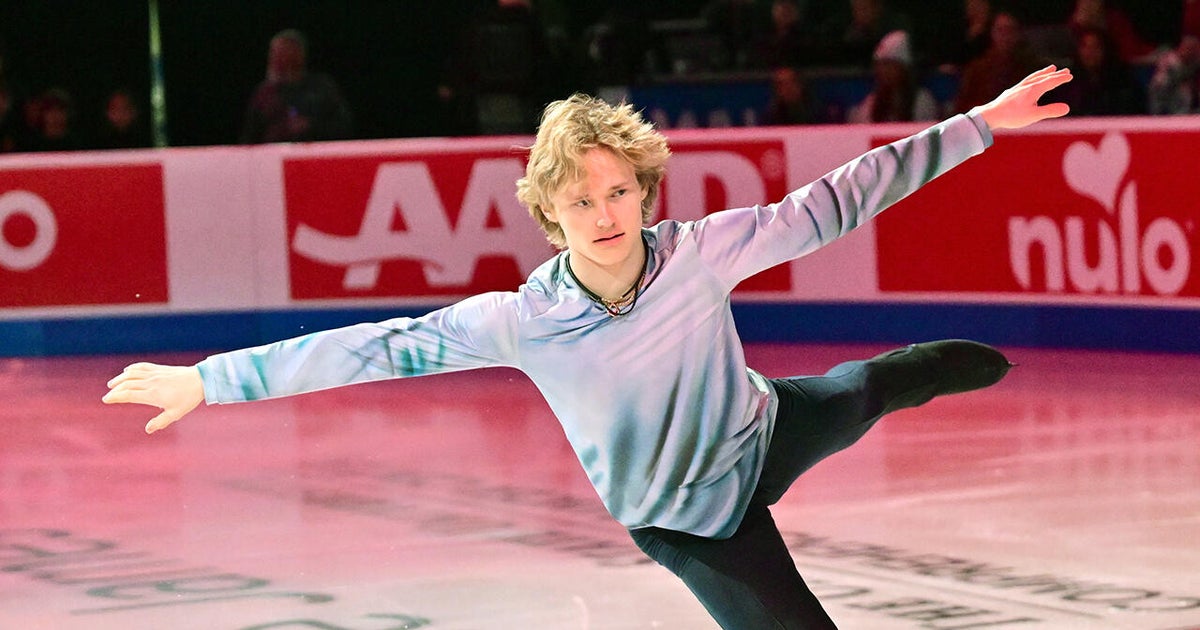

The Rise of Figure Skating’s “Quad God”: Ilia Malinin’s Journey to Olympic Glory
Mastering the Impossible: The Quad Axel Revolution
In the elegant and demanding world of figure skating, there exists a jump so difficult that only one person on Earth has ever successfully landed it in competition. That jump is the quad axel, and that person is 21-year-old American figure skater Ilia Malinin. This extraordinary feat involves launching into the air and completing four-and-a-half rotations before landing on a blade roughly an eighth of an inch thick, absorbing half a ton of force on a single leg. When asked about his seemingly superhuman ability to accomplish what no other skater has achieved, Malinin responded with characteristic confidence and humor: “The human body can do amazing things. And I guess I’m one of them!” This young athlete’s journey from a kid who didn’t initially plan to follow in his parents’ footsteps to becoming the heavy gold medal favorite at this year’s Olympics is a story of determination, innovation, and an unwavering desire to prove doubters wrong.
To understand what makes Malinin’s achievement so remarkable, it’s important to grasp the technical complexity of what he’s doing on the ice. In figure skating, there are six different types of jumps, and the axel stands alone as the most challenging. Unlike other jumps where skaters launch while moving backward, the axel requires the skater to take off while facing forward, which adds an extra half-rotation to the maneuver. A single axel is already difficult; a quad axel is nearly impossible. The jump demands perfect synchronization of power, muscle control, speed, and torque—all executed on one leg. Malinin must generate enough velocity to propel himself high enough into the air to complete four-and-a-half full rotations before his blade touches down on the ice again. The margin for error is microscopic, yet Malinin has made this impossible jump his signature move.
From Reluctant Beginnings to “Quad God” Status
The nickname “Quad God” wasn’t bestowed upon Malinin by adoring fans or sports commentators—he actually gave it to himself, though somewhat accidentally. The story behind the name reveals much about his personality and ambition. “I was like, ‘Oh, I landed a quad? Quad God, there it is, okay, let’s put it in,'” he explained about changing his Instagram handle. “And from there everyone’s like, ‘Why’d you name yourself Quad God? You only have one quad.’ And I’m like, ‘Well, now that I think about it, maybe I should try to land all of them to get the Quad God status.'” True to his word, Malinin set about earning the self-appointed title. At the Grand Prix Finals in December, he made history by landing seven quadruple jumps in a single performance—a feat no other skater had ever accomplished. The brash confidence that led him to crown himself “Quad God” has been backed up by performances that have redefined what’s possible in the sport.
But Malinin’s appeal extends beyond his technical prowess. He’s brought a fresh energy to figure skating with his swagger, fashion sense, and unconventional music choices. While many skaters opt for classical compositions or popular ballads, Malinin has taken to the ice with rap music pumping through the arena speakers. He’s even incorporated back-flips into his routines—a move that’s actually illegal in competition but showcases his athletic versatility and willingness to push boundaries. This combination of record-breaking skill and personality has made him a superstar in a sport that’s sometimes struggled to connect with younger audiences. Malinin represents a new generation of figure skating—one that honors the sport’s traditions while boldly reimagining what it can be.
A Family Legacy: Skating in the Blood
Figure skating runs deep in the Malinin family. Ilia grew up in Virginia, but his roots trace back to Russia. Both of his parents were accomplished figure skaters who competed in the Olympics—not once, but twice—representing Uzbekistan. His father, Roman Skorniakov, and his mother, Tatiana Malinina, understand better than most what it takes to reach the pinnacle of the sport. Interestingly, despite their own success, they didn’t initially want their children to follow in their footsteps. “They did not want me to skate at all,” Malinin revealed. “They wanted me to do something else, ’cause they know. They went through all those years of hard work, dedication, commitment to get to where they were, two-time Olympians.” His parents, who now coach skating, were hoping to spare their children from the grueling demands of competitive figure skating. “So, they were like, ‘Oh, we don’t want another skater in our family.’ But here I am. Me and my sister skate now. So it’s like, okay!”
Today, Malinin is coached by those same parents who once hoped he’d choose a different path. The arrangement has its unique dynamics. His mother, despite being one of his coaches, doesn’t actually attend his competitions in person because she worries too much about him—a detail that humanizes the often-intense relationship between elite athletes and their families. When asked if his parents ever ask him to hold back or play it safe on the ice, Malinin’s response reveals a competitive streak that may have actually been fueled by their caution: “Yeah, basically. It’s just like, even with the quad axel, they didn’t really believe me. It was like, ‘I wanna do this, and I want to, like, in a way prove you wrong.'” That desire to prove people wrong—even his own parents—has become a defining characteristic of Malinin’s approach to skating.
The Pursuit of Perfection: Practice and Precision
During a filming session with The New York Times in Boston, where cameras captured Malinin’s jumps in super-slow motion, his perfectionist nature was on full display. Even after landing what appeared to be flawless quad axels, Malinin remained critical of his own performance. “That was okay. Ehhhh, I’m really picky,” he said while reviewing footage with the crew. “So far I think this is the best one. I have one or two in me more.” This relentless pursuit of perfection is what separates good athletes from great ones. For Malinin, it’s not enough to land the jump—it has to be executed exactly right, with perfect form, optimal rotation speed, and a clean landing. The fact that he makes it look easy is itself the result of countless hours of practice, conditioning, and refinement. Each attempt is analyzed, critiqued, and improved upon, even when the naked eye might not detect any flaws.
The physical demands of what Malinin does cannot be overstated. Generating enough power and speed to launch into the air, maintaining the tight body position necessary for rapid rotation, and then landing with precision—all while making it appear graceful and effortless—requires extraordinary athleticism. And he does all of this knowing that a single mistake could result in a devastating fall. The mental aspect is equally challenging. Malinin must maintain absolute focus while performing under immense pressure, with thousands of eyes watching and his Olympic dreams hanging in the balance. Yet he’s developed techniques for managing that pressure. “You get on the ice and once that music starts you’re always in this, like, autopilot zone or tunnel vision,” he explained. “Okay, now I just need to let my muscle memory take over and just, you know, think of it as it was, like, a practice.” This ability to transform competition pressure into practice-like focus is perhaps as valuable as his physical skills.
From Disappointment to Dominance: The 2022 Turning Point
Malinin’s path to Olympic glory hasn’t been without setbacks, and ironically, his greatest disappointment may have catalyzed his current success. In 2022, competing at the senior level for the first time, Malinin won the silver medal at the U.S. National Championships—a result that would typically secure a spot on the Olympic team. However, officials made the controversial decision to pass him over in favor of a more experienced skater for the Beijing Games. For many young athletes, such a rejection might have been crushing. For Malinin, it became fuel. “To be honest, I think if it wasn’t for that decision, I don’t think I’d be here in this moment – landing a quad axel or trying to really revolutionize the sport, or just pushing the limits of my own capabilities or the sport in general,” he reflected. Was 2022 really a pivotal moment for him? “I think that’s the best way to describe it,” he confirmed. “I think that’s also kind of my personality – I really like to kind of own up and say, like, someone doesn’t believe in me? I really like, ‘No, watch. I’ll do it. I’ll prove you wrong.'”
And prove them wrong he did. Since November 2023, Malinin has been undefeated, dominating every competition he’s entered. He recently captured his fourth consecutive U.S. National Championship title, further cementing his status as the undisputed king of men’s figure skating. The quad axel that officials didn’t get to see in Beijing has become his calling card, a jump that symbolizes both his technical superiority and his refusal to accept limitations. Now, as he heads into his first Olympic Games as the heavy favorite for gold, that 2022 disappointment seems like ancient history—or better yet, like the necessary adversity that forged a champion. Malinin has used every doubt, every skeptical comment, every instance of being underestimated as motivation to push himself further. The result is a skater who isn’t content with simply winning; he wants to revolutionize the entire sport.
The Future of Figure Skating: What’s Next for the Quad God?
As Malinin prepares for this month’s Olympics, speculation has already begun about what boundaries he might push next. When asked if a quintuple jump—five full rotations—might be in his future, he offered a tantalizing response: “We’ll see. Maybe soon. Maybe after Olympics.” For now, he’s focused on the task at hand: winning Olympic gold and showcasing the quad axel on the sport’s biggest stage. But the fact that he’s even considering a quint jump speaks to his visionary approach to skating. He’s not just trying to win competitions with the skills that already exist; he’s actively imagining and working toward skills that don’t yet exist, pushing the boundaries of what the human body can achieve on ice.
Malinin represents something larger than just one talented athlete. He embodies a new era in figure skating—one where technical difficulty is being pushed to unprecedented levels, where athletes are younger and more athletic than ever, and where the sport’s aesthetic is evolving to include diverse musical choices and performance styles. His success has inspired a generation of young skaters who see in him proof that you don’t have to fit the traditional mold to excel in figure skating. As he takes the ice at the Olympics, Malinin carries not just his own dreams but the hopes of a sport that’s been revitalized by his presence. Whether or not he stands atop the podium with a gold medal, the Quad God has already secured his legacy as the skater who dared to attempt the impossible—and succeeded. His journey from a kid whose parents didn’t want him to skate to the favorite for Olympic gold is a testament to the power of determination, the value of channeling disappointment into motivation, and the extraordinary things that happen when someone refuses to accept the word “impossible.”